

When researching a used car, one document stands above all others for verifying a vehicle’s true identity: the original window sticker. This factory label reveals the exact configuration when the car left the assembly line—MSRP, every option, fuel economy, and safety ratings.
Most people assume you need the VIN (Vehicle Identification Number) to access this information. But what if you only have the license plate?
Whether you’re browsing online listings, walking a dealer lot, or spotting a car on the street, a window sticker lookup by license plate is often faster and more convenient. In this guide, you’ll learn exactly how it works, what information you can access, and why it’s an essential tool for any used car buyer.
What is a Window Sticker?
A window sticker, sometimes called a Monroney label, is the federally mandated document displayed on the window of every new vehicle sold in the United States. It was introduced through the Automobile Information Disclosure Act of 1958, named after Senator Almer “Mike” Monroney, who championed the law to protect consumers from deceptive pricing practices.
Why It Is Called a Monroney Sticker
The name “Monroney label” honors the senator who sponsored the legislation. Before this law, dealers could set prices arbitrarily without disclosing the manufacturer’s suggested price, leaving buyers at a significant disadvantage. Today, the Monroney label ensures complete transparency about a vehicle’s price, features, and specifications.
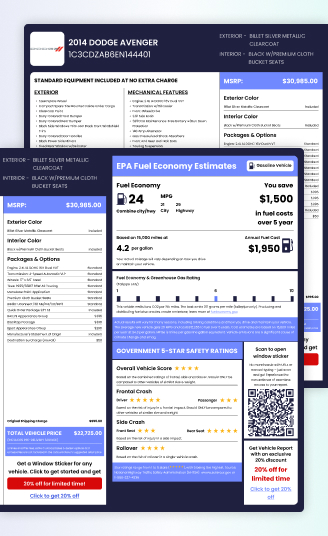
Information Required on Every Window Sticker
A standard window sticker includes several mandatory sections:
| Section | What It Shows |
|---|---|
| MSRP Breakdown | Base price, optional equipment costs, destination charges |
| Standard Equipment | Features included with the base trim |
| Optional Packages | Factory-installed upgrades and their prices |
| Engine & Transmission | Exact powertrain specifications |
| Fuel Economy | EPA-estimated city, highway, and combined MPG |
| Safety Ratings | NHTSA crash test scores |
| Warranty Information | Basic, powertrain, and corrosion coverage |
Why Window Sticker Matters for a Used Car?
Even though window stickers are originally designed for new vehicles, they remain valuable for used car buyers. A window sticker reveals the original factory configuration, information that sellers often misrepresent or simply don’t know.
Did that truck really come with the tow package? Is it truly a “Limited” trim? You can get the answer from the window sticker.
What Information a Window Sticker Shows
A window sticker is more than just a price tag—it’s a complete snapshot of the vehicle as it left the factory.
Vehicle Identification Details
On the window sticker, you can get the complete details of the vehicle. On a sticker, you can see the VIN, model, make, and trim level. Check the section below to see the vehicle’s identification details.
VIN (Vehicle Identification Number)
The 17-character VIN uniquely identifies the vehicle and connects it to manufacturer records. Every window sticker displays the VIN prominently, allowing you to verify that the sticker matches the vehicle.
Model Year, Make, and Trim Level
The sticker confirms the exact model year, manufacturer, and trim designation (e.g., “Limited,” “Rubicon,” “Platinum”). This is critical because different trims can have dramatically different values.
Original MSRP Breakdown
MSRP of the Manufacturer Suggested Retail Price breakdown is one of the crucial sections that is available on the vehicle’s window sticker. It shows the complete information of the vehicle’s price when it was still with the manufacturer.
Base Price of the Vehicle
The base price represents the manufacturer’s starting price for that trim level before any options or packages are added.
Optional Equipment and Packages
This section lists every factory-installed upgrade, such as:
- Technology packages
- Premium sound systems
- Driver assistance features (adaptive cruise, blind spot monitoring)
- Performance packages
- Appearance packages
- Sunroof or panoramic roof
- Heated and ventilated seats
Each option is listed with its individual price, and package totals are clearly shown.
Destination and Delivery Charges
The sticker also shows the transportation cost from the factory to the dealership. This non-negotiable fee is added to the total MSRP.
Fuel Economy Ratings
Fuel efficiency information is provided by the United States Environmental Protection Agency (EPA). The fuel economy information can help you find the most fuel-saving vehicle, which can help you save money on gas.
City vs. Highway Fuel Economy
The sticker shows separate MPG ratings for city and highway driving, plus a combined figure for general comparison.
Estimated Annual Fuel Cost
Based on 15,000 miles per year and current fuel prices, the EPA estimates yearly fuel expenses, helping buyers understand long-term ownership costs.
Vehicle Safety Ratings
This section shows how safe the vehicle is. Always make sure to examine this part of the window sticker to know that the vehicle you are about to purchase is fully safe.
NHTSA Crash Test Safety Ratings
The sticker often includes National Highway Traffic Safety Administration (NHTSA) ratings, using a 1-to-5-star scale for frontal, side, and rollover crash protection.
Driver Assistance and Safety Features
Modern window stickers highlight advanced safety technologies such as:
- Lane departure warning
- Blind spot monitoring
- Automatic emergency braking
- Rear cross-traffic alert
- Adaptive headlights
How a License Plate Lookup Finds a Window Sticker
You might wonder: how can a license plate number lead to a window sticker? The process is surprisingly straightforward.
License Plate to VIN Matching
Every vehicle has a unique VIN, and every registered vehicle has a license plate linked to that VIN through state registration databases. When you perform a license plate lookup, the system first matches the plate number to the corresponding VIN, then retrieves the window sticker data associated with that VIN.
Why the VIN Is Still Important
Even when you start with a license plate, the underlying retrieval always happens through the VIN. The VIN is the permanent, unchanging identifier that connects to manufacturer records. The license plate is simply a convenient “key” to access that same data.
Vehicle Registration Databases
State Department of Motor Vehicles (DMV) records link license plates to VINs. Services like PremiumVIN access these registration databases (with appropriate data sources) to perform the matching, enabling a seamless lookup experience.
When a License Plate Window Sticker Lookup is Useful
A license plate lookup isn’t just a convenience—it’s a powerful tool in several real-world scenarios.
Researching Used Car Listings
When you have a plan to purchase a used car, one thing you need to do is check the car thoroughly. One thing you can do is to get the window sticker and to make sure of these two crucial aspects: vehicle specification and MSRP.
Verify Vehicle Specifications
Online listings often contain errors; sometimes accidental, sometimes intentional. A window sticker lookup lets you confirm whether the vehicle actually has the trim level, engine, and features the seller claims the vehicle has.
Check the Original MSRP
Knowing the original MSRP helps you determine whether the current asking price is reasonable. A car that sold for $35,000 new should be priced differently from one that stickered at $25,000—even if they look similar.
Inspecting Cars at Dealerships
When you visit a dealership to check the car’s condition, two cars might look the same. In reality, these cars are different. We suggest that you ask for the VIN or license plate number to get the original copy of a window sticker with our tool.
Verify Trim Levels
Walk a dealer lot, and you’ll see dozens of similar-looking vehicles. The window sticker reveals which base models are and which have premium packages—information that’s not always obvious from exterior appearance alone.
Confirm Optional Equipment
That “fully loaded” claim means nothing without proof. The original window sticker shows exactly which options were factory-installed, separating genuine upgrades from dealer-added accessories.
Comparing Vehicles Before Buying
Before you make up your mind between two cars, be sure to check the information contained in each window sticker to make sure you get the desired car correctly. Here’s how a window sticker can help you check out the crucial information about a vehicle.
Compare Similar Models
When you’re deciding between two similar vehicles, window stickers provide an apples-to-apples comparison. One might have the premium audio and navigation; the other might have the tow package. The sticker tells you which features matter to you.
Understand Depreciation
Seeing the original MSRP provides context for current pricing. A vehicle that stickered at $50,000 and now sells for $25,000 has experienced 50% depreciation. A comparable vehicle that stickered at $40,000 and now sells for $25,000 has held its value better—useful information for your purchase decision.
License Plate Lookup vs VIN Lookup
Both methods can retrieve vehicle information, but they serve slightly different purposes. Understanding when to use each can save you time and effort.
VIN Lookup
The VIN is the most reliable way to identify a vehicle and access accurate data. It connects directly to manufacturer records, making it essential for retrieving a window sticker and checking detailed vehicle history before making any decision.
Most Accurate Vehicle Identification
The VIN is the gold standard. It’s permanent, unique, and directly linked to manufacturer records. If you have the VIN, you can access the most complete and accurate data.
Used for Full Vehicle History Reports
Beyond window stickers, the VIN is the key to comprehensive vehicle history reports—including accident records, title brands, mileage history, and lien checks.
License Plate Lookup
A license plate lookup offers a practical alternative when the VIN is not accessible. It allows users to begin vehicle research quickly, making it useful for initial checks before retrieving more detailed information using the VIN.
Useful When the VIN Is Not Available
Walking a dealer lot? Browsing online listings? Spotting a car on the street? The license plate is often visible when the VIN isn’t. A plate lookup bridges this gap.
Helpful for Quick Vehicle Research
When you’re evaluating multiple vehicles quickly—perhaps at a used car lot—entering license plates is often faster than hunting for VINs under windshields or in door jambs.
| Feature | VIN Lookup | License Plate Lookup |
|---|---|---|
| Input Required | 17-character VIN | License plate + state |
| Accuracy | Highest | Very high (once matched) |
| Best Use Case | Detailed research, history reports | Quick checks, lot walkthroughs |
| Availability | Always in the vehicle | Visible on the exterior |
Can You Get a Window Sticker for Any Vehicle?
Window sticker availability depends on several factors. While modern vehicles are almost always accessible, older vehicles may present challenges.
Vehicle Age
The VIN is the most reliable way to identify a vehicle and access accurate data. It connects directly to manufacturer records, making it essential for retrieving a window sticker and checking detailed vehicle history before making any decision.
Modern Vehicles Are Easier to Retrieve
Most vehicles manufactured after 1981 (when the 17-character VIN standard was adopted) have factory data stored in manufacturer databases. For these vehicles, window sticker retrieval is usually straightforward.
Older Vehicles May Have Limited Records
Classic and vintage vehicles may not have digital window sticker records. However, PremiumVIN supports pre-1981 VIN decoding for many manufacturers, allowing you to access available factory data even for older vehicles.
Manufacturer Data Availability
Not all manufacturers store or share vehicle data in the same way. The level of detail available for a window sticker often depends on the brand, model year, and how well records have been preserved over time.
Some Automakers Provide More Detailed Records
Different manufacturers maintain varying levels of historical data. Brands like Ford, General Motors, and Dodge often have strong archives, while some import brands may offer less detail, especially for older vehicles.
What to Do If a Window Sticker Isn’t Found
If a window sticker is not available, you still have options. Try a trusted VIN-based lookup service to retrieve available specs, check a vehicle history report, explore manufacturer owner portals, or contact a dealership for build sheet information.
How to Perform a Window Sticker Lookup by License Plate
A license plate lookup is a quick way to access a vehicle’s original specifications when the VIN is not available. By following a few simple steps, you can retrieve the window sticker and review key details before making a decision.

Step 1: Locate the License Plate Number
Start by noting the vehicle’s license plate number and the issuing state. This information is usually visible on the front or rear of the car, and no additional details are required at this stage.

Step 2: Enter the Plate Number and State
Go to a trusted lookup service and enter the plate number along with the state. The system will use this information to match the plate with the correct VIN and vehicle records.

Step 3: View Basic Vehicle Information
Once submitted, the system will display basic details such as the year, make, and model. This step helps confirm that the correct vehicle has been identified before proceeding further.

Step 4: Unlock the Full Window Sticker
To access complete details, proceed to unlock the full report. This includes MSRP, factory-installed options, fuel economy ratings, and other key specifications from the original window sticker.

Step 5: Download and Save
After unlocking the report, you can view it instantly. Most services also allow you to download the window sticker as a PDF, making it easy to save and review anytime.
Why Choose PremiumVIN for Window Sticker Lookup
Getting a window sticker should be quick and straightforward. PremiumVIN simplifies the process by delivering accurate vehicle data in seconds, helping buyers and sellers verify specifications, pricing, and factory options without unnecessary steps or delays.
License Plate and VIN Support
Whether you have the VIN or just a license plate, the system supports both. Simply enter the available details, and it will match the vehicle to the correct records without requiring extra information.
Comprehensive Data
Each report provides a complete view of the vehicle’s original factory details, including MSRP breakdown, installed packages and options, fuel economy, safety ratings, engine and drivetrain specifications, as well as exterior and interior colour codes.
Instant Results
No need to wait for dealership involvement. Once the details are entered, the system generates the window sticker within seconds, allowing immediate access to key vehicle information.
Affordable
At just $19.99, a window sticker report offers strong value. It helps confirm a vehicle’s true configuration and pricing, reducing the risk of overpaying or relying on incomplete or inaccurate seller information.
Conclusion
A window sticker lookup by license plate gives used car buyers a clear advantage. Whether reviewing listings or checking a vehicle in person, it allows instant access to factory-issued details that are not always visible or accurately described. From confirming trim levels and options to understanding original MSRP, it helps you see the car as it was built.
With PremiumVIN, the process is quick and straightforward. Enter a license plate number and state to retrieve the full window sticker within seconds. It is a simple way to verify specifications, avoid surprises, and make more informed buying or selling decisions.
FAQs About Window Sticker by License Plate
Can You Get a Window Sticker with a License Plate?
Yes. A license plate lookup can be used to find the associated VIN, which is then used to retrieve the original window sticker data. This is useful when the VIN is not easily accessible.
Is a Window Sticker the Same as a Vehicle History Report?
No. A window sticker shows factory specifications, including features and pricing when the vehicle was new. A vehicle history report covers events after production, such as accidents, title changes, mileage records, and ownership history.
Does a Window Sticker Show MSRP?
Yes. The window sticker includes the Manufacturer’s Suggested Retail Price (MSRP), covering the base price, optional equipment, and destination charges listed at the time the vehicle was sold new.
Is a Window Sticker Useful for Used Cars?
Yes, it provides valuable context when evaluating a used vehicle. It helps confirm the original trim level, verify factory-installed options, understand pricing at launch, and identify any differences between seller claims and actual specifications.
What’s the Difference Between a Window Sticker and a Build Sheet?
A window sticker is a consumer-facing document that highlights pricing and key features. A build sheet is a factory record that lists every component used during production, including internal codes not shown on the sticker.
Can You Get a Window Sticker for a Classic Car?
In many cases, yes. Availability depends on the manufacturer and model year. Some services support pre-1981 VIN formats and can access historical records for certain classic and vintage vehicles.
How Quickly Can You Get a Window Sticker by License Plate?
Results are typically available within seconds. After entering a license plate number and state, the system retrieves the linked VIN and generates the window sticker data almost instantly.
Do You Need the Owner’s Permission to Look Up a Window Sticker?
No. Window sticker data is based on vehicle specifications and is not considered private information. You can look it up using a VIN or license plate without needing the owner’s consent.
Will the Window Sticker Show Dealer-Installed Accessories?
No. The window sticker only includes factory-installed equipment. Any dealer-added features, such as aftermarket wheels, tint, or accessories, will not appear on the original document.
Is a License Plate Lookup Always Accurate?
It is accurate when the license plate is correctly matched to the VIN. However, recent plate changes or ownership transfers may cause short delays in database updates. If you are unsure, you can use the VIN directly.