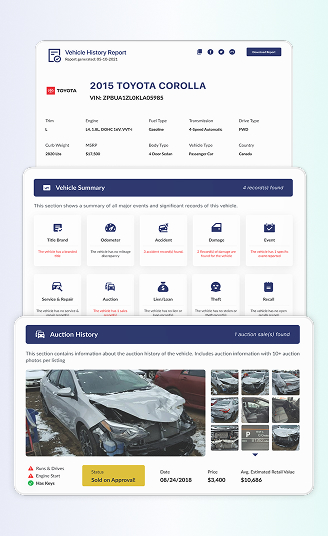

Mileage Check by VIN: Verify Odometer Reading & Detect Rollback Fraud
A car with “low mileage” might not be what it seems. Behind that attractive number on the dashboard could be a vehicle that has already driven tens of thousands more miles than it shows.
What a Mileage Check Reveals
A mileage check by VIN compiles every recorded odometer reading for a vehicle from multiple sources. Here’s exactly what you’ll discover.
Complete Odometer Reading History
The vehicle history report helps you see the complete odometer reading of the vehicle. You can use this information to get crucial information about the odometer and spot odometer rollback easily.
Title Transfer Mileage
Every time a vehicle is sold, the odometer reading is recorded on the title. These official records create a permanent mileage trail.
Inspection Mileage
State safety and emissions inspections capture mileage readings. These are among the most reliable third-party records.
Service & Maintenance Mileage
Oil changes, tire rotations, and dealership service visits all record odometer readings. A well-maintained vehicle leaves a clear mileage trail.
Auction Mileage
If the vehicle passed through auction (Copart, IAAI, Manheim), sale records include mileage at the time of sale.
Insurance & Claim Mileage
Accident reports and insurance claims often include odometer readings—useful for cross-referencing.
Mileage Timeline & Patterns
Not all vehicle history reports show the chronological order of the mileage timeline and patterns. With our report, you will be getting crucial information on the recorded mileage in chronological order and its actual recorded mileage.
Chronological Order
All readings displayed in date order, creating a complete timeline of the vehicle’s life. Helping you spot if there are any consistencies in the recorded mileage.
Expected vs. Actual Mileage
Does the mileage align with vehicle age? 12,000-15,000 miles per year is average. Significant deviations warrant investigation.
Anomaly Detection
Our system flags readings that don’t fit the pattern—sudden drops, impossible decreases, or gaps that suggest hidden mileage.
Red Flags That Indicate Rollback
Odometer rollback is one of the most common crimes in the used vehicle market. Plenty of dishonest sellers rolled back the odometer to make the car seem less used than the reality. With a vehcile history report, you can easily spot an odometer rollback.
Decreasing Mileage
A later reading lower than an earlier one is definitive proof of odometer rollback. Be aware that if you found this in the report, it is a clear sign of a rollback.
Gaps With No Readings
Long periods without recorded mileage may hide high-mileage driving. If a vehicle has no records for 2-3 years, be cautious.
Inconsistent Pattern
Mileage that jumps erratically—from 30,000 to 80,000 back to 40,000—suggests tampering or data errors.
Last Reading vs. Current Display
If the last recorded reading is much higher than the current odometer, fraud is almost certain.
Why Mileage Verification Matters Before You Buy
Mileage affects value, condition, and future costs. Without verification, buyers risk overpaying for vehicles with hidden wear, while sellers may struggle to justify pricing without proof of accurate odometer readings.
The Cost of Mileage Fraud
Mileage fraud misrepresents a vehicle’s condition. It can make a heavily used car appear more valuable, leading to poor buying decisions and higher long-term ownership costs.
Financial Loss
You can overpay by thousands for a vehicle that’s actually high-mileage. A 60,000-mile car vs. a 160,000-mile car can be a $5,000-$10,000 difference.
Hidden Wear
Higher mileage means more wear on the engine, transmission, and suspension, even if the car looks clean and well-kept.
Maintenance Deferred
High-mileage vehicles are closer to major service intervals: timing belts ($1,000+), transmission fluid ($300+), and suspension work ($1,000+).
Mechanical Reality
Mileage directly impacts reliability. Two vehicles of the same age can have very different performance and lifespan depending on how much they have been driven.
60,000 vs. 160,000 Miles
The difference in remaining life is enormous. A 60,000-mile vehicle may have 100,000+ miles left. A 160,000-mile vehicle may be nearing the end of its reliable life.
Component Life Expectancy
Engines, transmissions, and major components wear with miles—not time. A 10-year-old car with 60,000 miles is very different from one with 160,000 miles.
Resale Impact
Mileage is one of the first things buyers check. It strongly influences pricing, demand, and how quickly a vehicle sells in the used market.
Future Value
If you overpay now, you’ll lose even more when you sell. Mileage is the single biggest factor in used car valuation.
Trade-In Truth
Dealers will discover the true mileage and lowball you. Without documented history, you have no leverage.
For Sellers
Mileage verification helps support your asking price. It builds trust with buyers and reduces hesitation during negotiations.
Prove Mileage Accuracy
A mileage report confirms the odometer reading is accurate, helping reduce doubts and build trust with potential buyers.
Justify Higher Price
Verified low mileage supports stronger pricing. Buyers are more willing to pay more when the vehicle’s usage is clearly documented.
Real Story: How a Mileage Check Revealed a 100,000-Mile Rollback
Mileage records can expose issues that are not visible during inspection. In this case, a simple VIN check uncovered a major inconsistency that completely changed the buyer’s decision. That is why it is always important to check the mileage before you decide to purchase a used vehicle.
What the Mileage History Revealed
The mileage timeline showed clear inconsistencies across different records. By comparing the title and service data, the true usage of the vehicle became obvious.
Almost Unnoticeable Odometer Reading
On the report, it is shown that the car has almost unnoticed the mileage on the odometer from 99,721 recorded on 11/22/2023.
What's Actually Next
The buyer decided not to purchase the vehicle due to its odometer reading history.
Types of Odometer Fraud
In the used car market, there are a few types of odometer fraud that are famous among buyers and sellers. The table below breaks down the most common types you should know before purchasing any kind of used vehicle.
| Fraud Type | How It Works | How We Catch It |
|---|---|---|
| Mechanical Rollback | Physically turning back the analog odometer | Inconsistent readings, service records |
| Digital Rollback | Reprogramming the digital odometer | Inconsistent readings, module data |
| Meter Replacement | Replacing with a lower-mileage unit | Inconsistent with history |
| Title Washing | Out-of-state titles hide true mileage | Multi-state record comparison |
| No Disclosure | Simply lying about mileage | Verified against recorded history |
How to Check Mileage by VIN
To check mileage records by VIN, you can use our service and get it done in less than a minute. Follow these simple steps to decode the VIN and get the vehicle history report, where you can see the complete odometer reading.
Three Simple Steps
There are three simple steps that you need to complete before getting the vehicle history records. Follow these steps to get it done in seconds.

Step 1: Enter Your VIN
Type your 17-character VIN into the search box above. If you need to decode a classic VIN (5 to 14-digit), we can do that too

Step 2: Preview Basic Vehicle Information
See year, make, model, and basic specifications instantly at no cost. This confirms you have the correct vehicle.

Step 3: Unlock Full Mileage Report
Purchase the complete report to see every recorded odometer reading, complete timeline, and fraud detection analysis.
Where to Find Your VIN
Finding the VIN on a vehicle is easy; you just need to check a few locations on the vehicle and its paperwork.
Dashboard
Look through the windshield on the driver’s side—the VIN is visible on a metal or plastic plate.
Driver's Door Jamb
Open the driver’s door and check the door edge or door frame for a manufacturer’s sticker.
Vehicle Title & Registration
All official documents list the VIN. This is the most reliable source.
Why Choose PremiumVIN
Running an Acura VIN decoder and reviewing the vehicle report is a smart step before buying. Many VIN decoder services are available online at different price points, but not all offer the same depth. Here’s how our service compares and where it stands out.
| Feature | Overview |
|---|---|
| Comprehensive Sources | We pull from titles, inspections, service records, and auctions—not just one database. |
| Timeline Visualization | See mileage progression over time in an easy-to-read chronological format. |
| Fraud Detection | Our system automatically flags inconsistent readings and potential rollbacks. |
| Instant Results | No waiting. No paperwork. Results in seconds. |
| Affordable | At $9.99, it's a tiny price to avoid overpaying by thousands. |
Check the Vehicle’s Mileage in Seconds
Don’t pay low-mileage prices for a high-mileage vehicle. See the complete odometer history before you buy. Enter your VIN above and get your complete mileage check report instantly.
Frequently Asked Questions About Mileage Checks
What is a mileage check by VIN?
A mileage check compiles every recorded odometer reading for a vehicle from multiple sources—title transfers, inspections, service records, and auctions—to verify true mileage and detect potential rollback fraud.
How do I check if a car's odometer has been rolled back?
Enter the VIN above. Our mileage report shows every recorded reading in chronological order. Any reading lower than a previous one is definitive proof of rollback.
Is odometer rollback still a problem?
Yes, digital odometers can be altered. Scammers use electronic tools or reprogram instrument clusters to change mileage. While more advanced than mechanical systems, they can still be manipulated quickly.
How can I tell if the mileage is accurate without a report?
You can’t reliably. Physical condition can be misleading—clean interiors can hide high miles. Service records and wear patterns offer clues, but only a documented history proves mileage.
What's the average miles per year?
Around 12,000-15,000 miles per year is average. A 10-year-old car with 80,000 miles is average; 150,000 is high; 40,000 is low and suspicious without documentation.
Can digital odometers be rolled back?
Yes. Digital odometers can be reprogrammed with the right diagnostic equipment. It’s harder than mechanical rollback but still common and increasingly sophisticated.
Is there a free way to check mileage history?
No comprehensive free source exists. Some state DMVs offer limited title history for a fee. Our $19.99 report is the most affordable way to access nationwide mileage data.
How quickly will I receive my mileage report?
In less than one minute. After payment confirmation, your complete mileage history report is immediately available for viewing and download.
Do you check mileage on motorcycles and RVs?
Yes. Our mileage check covers cars, trucks, SUVs, motorcycles, and RVs. Enter the VIN to check coverage for your specific vehicle type.
Can mileage history help with valuation?
Absolutely. Verified low mileage adds significant value. Disproving low mileage saves you from overpaying. Either way, the truth matters.
What if my vehicle's mileage history isn't found?
If no records appear, that doesn’t necessarily mean fraud—but it means no documented proof exists. Proceed with caution and consider a professional inspection.