
What Is a VIN?
A Vehicle Identification Number (VIN) is the serial number a manufacturer assigns to one specific vehicle. On road vehicles built to current U.S. rules it has 17 characters, made of digits and capital letters, and it is permanently marked on the vehicle. Titles, registrations, insurance policies, recall notices and most vehicle-record databases use it to point to that one vehicle.
Who assigns a VIN, and what the rules require
In the United States the format and marking of VINs are set by 49 CFR Part 565, a federal safety regulation. The manufacturer assigns the VIN. If a vehicle is built in more than one stage, the maker of the incomplete vehicle assigns it. A business that later alters the vehicle has to keep the VIN the original manufacturer assigned, and an importer has to use the original manufacturer’s VIN as well.
The regulation also controls where the number sits. It must appear clearly and indelibly on a part that is not designed to be removed except for repair, or on a plate or label permanently fixed to such a part. That detail matters later, when you compare the VIN on a vehicle with the VIN in its paperwork.
Canada applies its own standard to vehicles sold there (CMVSS 115). Other regions run their own systems, which is one reason a VIN from outside North America can look different from the pattern described here.
What the characters encode
Part 565 fixes which positions carry which kind of information. The VIN format page walks through each one. In outline:
- Positions 1 to 3 identify the manufacturer and the type of vehicle.
- Positions 4 to 8 describe the vehicle. For passenger cars the regulation calls for attributes such as make, line, series, body type and engine type, but the manufacturer chooses the coding scheme.
- Position 9 is a check digit, a number calculated from the other characters to expose transcription errors.
- Positions 10 to 17 carry the model year, the assembly plant and a production sequence number.
Two practical consequences follow. First, reading positions 4 to 8 requires the manufacturer’s own code tables, because the same character can mean different things for different makers. Second, a VIN describes how a vehicle was specified when it was built. It does not describe anything that has happened to it since.
What a VIN does not contain
No accident, title brand, mileage reading or ownership change is written into the characters of a VIN. Neither is the owner’s name or address; the VIN identifies the vehicle, not the person who holds it.
It is also a marking, not proof. The number stamped or printed on a vehicle and the number stored in a database are two separate things that are supposed to match. When they do not, the VIN alone cannot say whether the cause is a typing error in paperwork, a replaced part or something worse.
How records attach to a VIN
Other parties create records and file them against the VIN: a state title office, an insurer, an auction house, a manufacturer’s recall system, a repair shop. Whether a particular event shows up depends on whether the party that recorded it reported it to a source that is later searched.
That is why two vehicles of the same age can return very different amounts of information. A search that finds no matching record shows only that the searched sources returned none. It does not show that nothing happened. A sparse result is not evidence of a clean history.
VIN or license plate
A plate belongs to a registration in one jurisdiction. It can change when the vehicle is re-registered, transferred to another owner or moved to another state. The VIN stays with the vehicle. Where plate lookup is supported, it resolves a plate to a vehicle, and from that point the VIN is the stable key for everything else.
Not every VIN follows the modern pattern
The current version of Part 565 applies to vehicles manufactured on or after April 30, 2009. Vehicles of model year 2009 or earlier are covered by alternative requirements in the same regulation, and the 17-character format became the norm in North America from the 1981 model year. Before that, length and structure varied by manufacturer. Trailers, motorcycles and vehicles built for other markets can differ again.
So “17 characters” describes the modern road vehicle. It is not a universal law of VINs, and a page or tool that rejects every shorter VIN will reject vehicles that are genuine.
Where the VIN matters in practice
| Scenario | How the VIN applies |
|---|---|
| Buying a used vehicle | The same VIN should appear on the vehicle's dashboard plate, on its certification label and on the title. Any report or lookup you run is only meaningful if it was run on that exact VIN. |
| Importing a vehicle | The importer uses the VIN assigned by the original manufacturer. A vehicle certified by a registered importer whose original VIN does not meet U.S. format rules carries an additional label inside the passenger compartment that states the original number as a substitute for a U.S. VIN. The label records the original VIN; it does not replace it. |
| Owning a vehicle | Manufacturers typically identify recall-affected vehicles by VIN, which is why recall lookups ask for it. |
Decoding a VIN versus researching its records
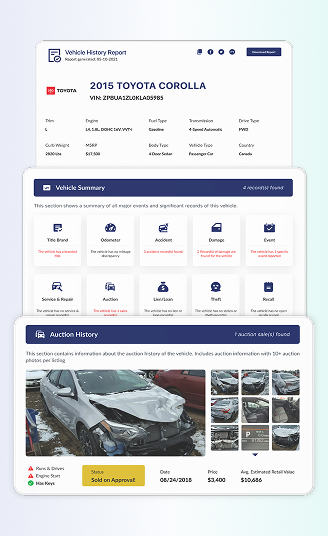
These are different questions. Decoding turns the characters into specifications such as make, model year and engine, and it can combine what the VIN encodes with other available data. Researching records means looking for what other parties have reported against the VIN. The VIN Decoder answers the first question; a Vehicle History Report compiles the available records for the second. If you are unsure which you need, see which tool answers which question. Coverage differs by vehicle, identifier and record type, as described on the coverage page.
Sources and basis
- 49 CFR 565.13, General requirements: 17 characters, who assigns the VIN, how and where it is marked, permitted characters
- 49 CFR 565.14, Vehicles imported into the United States: original manufacturer’s VIN, substitute label for non-compliant VINs
- 49 CFR 565.15, Content requirements: the four sections of the VIN, check digit, model-year position