

Virginia VIN Check: Research a Used Car Before You Buy or Title It
A Virginia VIN check helps you identify a vehicle and review the historical records available for it before you buy, sell, import, or title it. Enter the 5-17-character VIN to see decoded vehicle information and request a Vehicle History Report that may include title-brand history, odometer records, accident and damage records, auction and sales history, theft-related records, liens, recalls, and service information where available.
A VIN check is not a substitute for a Virginia safety inspection, a mechanic’s inspection, a legal title review, or an independent appraisal. It is a practical first step for understanding what documentation exists before money changes hands.
What a Virginia VIN check can tell you
A VIN is the manufacturer-assigned identifier used to distinguish a vehicle, trailer, or manufactured home from others. In Virginia, it appears on the title, registration, and insurance certificate; for vehicles built after 1969, it is also commonly visible through the windshield on the driver’s-side dashboard.
When you run a VIN through PremiumVIN, the free decoder interprets the identifier and available vehicle data to return information such as:
- Make, model, model year, and trim where available
- Engine, transmission, body style, fuel type, and other specification details where available
- Factory configuration details that may support a reconstructed Window Sticker
- Market-value information to help frame a purchase or sale discussion
- A route to a Vehicle History Report for available historical records
Decoded specifications answer “What vehicle is this?” They do not establish whether the vehicle was wrecked, repaired, stolen, well maintained, or currently roadworthy. Those questions require historical records, physical examination, and, where relevant, official verification.
Why Virginia buyers should check the VIN
Virginia has several title and disclosure rules that make VIN-based due diligence especially useful before a private-party purchase.
Virginia law requires an owner or transferor to record the odometer reading on the certificate of title and title application when ownership is transferred. Knowingly recording an incorrect reading is unlawful, and violations of the dealer odometer-disclosure provision can be a Class 1 misdemeanor.
Virginia also restricts purchases from a seller who does not legally possess a certificate of title. Its dealer-licensing guidance states that no person should purchase, trade, exchange, or barter for a vehicle while knowing or having reason to believe that the seller has not secured or does not legally possess a certificate of title.
That does not mean a VIN report replaces checking the physical title. It means the VIN gives you a way to compare the vehicle’s available record trail with what the seller claims before you agree to a transaction.
Records a VIN check may surface
A PremiumVIN Vehicle History Report compiles available records from its data sources. The fields that appear depend on the vehicle, the VIN supplied, and the coverage of the underlying sources; a missing field or record is not proof that an event never occurred.
Depending on availability, a report may include:
- Title brands and title-related history, including salvage, rebuilt, flood, odometer, and other brands where recorded
- Odometer readings and possible mileage discrepancies
- Accident, damage, and insurance-related records where available
- Auction and sales history, including photos in some cases
- Theft-related records
- Lien or loan information where supported
- Recall and service-record information where available
- Vehicle specifications and market-value context
Virginia DMV specifically directs consumers to vehicle history reports when checking for odometer discrepancies and notes that NMVTIS-based reports can provide title information, brand history, odometer data, and in some cases historical theft data.
Virginia salvage and rebuilt-title checks
Virginia’s salvage rules are one of the most important reasons to review a VIN before buying a used vehicle.
If an uninsured or self-insured late-model vehicle sustains damage and the estimated repair cost exceeds 75% of its actual cash value, the owner must apply to Virginia DMV for a salvage certificate.
A rebuilt salvage vehicle must pass a Virginia state safety inspection and then a DMV examination before it can be titled. The examination reviews available pre-repair photos or video, repair parts and labor documentation, and verifies the VIN, confidential number, odometer, and applicable engine, transmission, or electronic modules.
If the examination finds no irregularities, Virginia DMV may issue a title and registration. The title and later titles issued for that vehicle must be permanently branded as a rebuilt vehicle.
What a rebuilt brand does and does not prove
A Virginia rebuilt brand tells you the vehicle went through the state’s salvage-retitling process. It does not, by itself, tell you:
- How well the repairs were performed
- Whether every prior damage event was documented
- Whether the vehicle is worth its asking price
- Whether it is suitable for your intended use
- Whether it needs further mechanical, structural, electrical, or corrosion inspection
Virginia DMV describes the rebuilt-vehicle examination as an antitheft and antifraud measure, not a certification of the vehicle’s safety or roadworthiness.
For that reason, a VIN report is most useful when paired with the seller’s repair documentation, a pre-purchase inspection, and a close review of the physical title.
How to check a VIN before buying in Virginia
Use this sequence before placing a deposit or signing paperwork.
Step 1: Locate the VIN on the vehicle, title, and registration
Compare all three. A mismatch is a reason to stop and investigate.
Step 2: Decode the VIN
Confirm that the year, make, model, body style, and key equipment reasonably match the listing and the physical vehicle.
Step 3: Run a Vehicle History Report
Look for title brands, odometer patterns, damage or auction records, theft-related entries, liens, and service or recall information where available.
Step 4: Inspect the physical title
Confirm the VIN, owner name, lienholder status, odometer disclosure, and any brands printed on the document.
Step 5: Ask for repair records when a brand appears
For a rebuilt vehicle, ask for pre-repair photographs, parts receipts, labor documentation, and the Virginia rebuilt-vehicle examination paperwork.
Step 6: Arrange an independent inspection
A VIN report cannot assess current mechanical condition, hidden rust, structural repairs, flood damage, or whether repairs were performed properly.
Step 7: Verify the seller’s authority to transfer the vehicle
Make sure the person selling the car is the titled owner or has a lawful basis to transfer it.
Virginia DMV also offers a vehicle-history request for titling transactions; it shows previous titling activity but does not include prior owners’ names. The DMV states that a written request must include the make, year, title number, and VIN, with an $8 research fee.
Virginia odometer and title-brand red flags
| What you see | Why it matters | Useful next step |
|---|---|---|
| "Rebuilt" brand | The vehicle previously entered Virginia's salvage/rebuilt process and received a permanently branded title. | Request repair records and get an independent inspection. |
| "Salvage" or salvage certificate reference | The vehicle may have been declared salvage after qualifying damage. | Confirm whether it was rebuilt, examined, and properly retitled. |
| Odometer inconsistency | Virginia requires odometer disclosure at transfer; a discrepancy may indicate reporting or mileage issues. | Compare title, service, inspection, auction, and history-report readings. |
| "Not actual" mileage brand | Virginia DMV says a title with a discrepancy acknowledgment uses the higher reading and is branded "NOT ACTUAL." | Do not rely on the displayed mileage alone; investigate the record trail. |
| Missing title or seller cannot produce it | Virginia guidance warns against buying when the seller does not legally possess a certificate of title. | Pause the deal and verify ownership and lien status. |
| VIN differs across documents | The VIN should match the vehicle, title, and registration. | Stop and resolve the discrepancy before payment. |
VIN check versus Virginia DMV records
A VIN check and an official DMV inquiry serve different purposes.
| What you see | Why it matters | Useful next step |
|---|---|---|
| "Rebuilt" brand | The vehicle previously entered Virginia's salvage/rebuilt process and received a permanently branded title. | Request repair records and get an independent inspection. |
| "Salvage" or salvage certificate reference | The vehicle may have been declared salvage after qualifying damage. | Confirm whether it was rebuilt, examined, and properly retitled. |
| Odometer inconsistency | Virginia requires odometer disclosure at transfer; a discrepancy may indicate reporting or mileage issues. | Compare title, service, inspection, auction, and history-report readings. |
| "Not actual" mileage brand | Virginia DMV says a title with a discrepancy acknowledgment uses the higher reading and is branded "NOT ACTUAL." | Do not rely on the displayed mileage alone; investigate the record trail. |
| Missing title or seller cannot produce it | Virginia guidance warns against buying when the seller does not legally possess a certificate of title. | Pause the deal and verify ownership and lien status. |
| VIN differs across documents | The VIN should match the vehicle, title, and registration. | Stop and resolve the discrepancy before payment. |
PremiumVIN is not the Virginia DMV, NHTSA, NMVTIS, or any government agency. Government-related data sources do not make a commercial VIN report an official government record, and a report cannot guarantee that every Virginia or out-of-state event was recorded.
VIN check for Virginia sellers
If you are selling a vehicle in Virginia, a VIN check can help you prepare a more transparent listing.
- Confirm that the decoded year, make, model, and trim match your title and advertisement.
- Review available history records before a buyer raises questions.
- Use market-value information as context—not as a guaranteed sale price or certified appraisal.
- Keep the physical title, maintenance records, repair receipts, and odometer disclosure available.
- Disclose known brands, damage history, and title issues rather than relying on a buyer to discover them.
Virginia law requires the odometer reading to be recorded at transfer, and dealers must comply with federal odometer-disclosure requirements. A clear, documented sale protects both sides and reduces the chance of a dispute after the transaction.
VIN check for imported or out-of-state vehicles
Virginia buyers often encounter vehicles previously titled in other states, purchased at auction, or imported from Canada or elsewhere. A VIN check can help you look for available auction, damage, title-brand, odometer, and sales-history records before the vehicle reaches Virginia.
However, coverage is not uniform. A vehicle may have records in one jurisdiction but not another; a vehicle exported before an event occurred may have no U.S. record of that event. PremiumVIN can help identify available historical information, but it cannot promise to uncover every pre-export or pre-import event.
For an imported vehicle, also confirm the applicable federal import, customs, safety, and emissions requirements independently. A VIN report does not establish import eligibility or legal compliance.
How PremiumVIN’s Virginia VIN check works
Step 1: Enter the VIN
Enter the vehicle's VIN in the VIN check tool.
Step 2: Review the Preview
Review the free decoded vehicle information and available market-value preview.
Step 3: Access the Report
Access the delivered report online and download it as a PDF where supported.
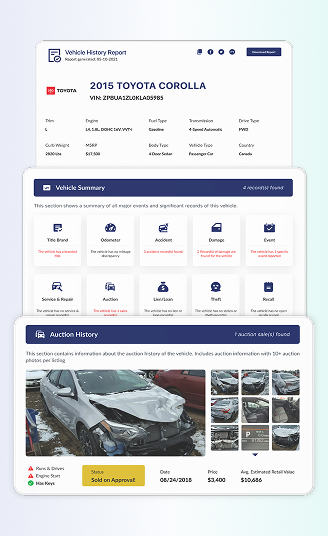
PremiumVIN’s reports draw on available vehicle data from multiple source categories, including manufacturer-sourced information, VIN-derived information, aggregated third-party data, and user-supplied or corrected information where applicable. The report reflects available records; it is not a guarantee of complete vehicle history.
Virginia VIN check FAQs
Is a VIN check required to buy a used car in Virginia?
No. Virginia does not require a private buyer to obtain a commercial VIN report before buying a vehicle. It is a due-diligence step, not a legal prerequisite. However, Virginia’s title and odometer-disclosure rules make it sensible to verify the VIN, title, mileage, and available history before completing a purchase.
Can a VIN check tell me whether a Virginia car has a clean title?
No. A VIN check can reveal title-brand and title-related records that are available in the searched sources. It cannot guarantee that a vehicle has a clean title or that every title event was reported. Verify the physical title and use official sources where appropriate.
Does a rebuilt Virginia title mean the car is unsafe?
Not necessarily. It means the vehicle was previously salvage-related and, to receive a Virginia rebuilt title, passed a state safety inspection and DMV examination. But DMV describes that examination as an antitheft and antifraud measure rather than a certification of safety or roadworthiness, so an independent inspection remains important.
Where do I find the VIN on a Virginia vehicle?
Check the title, registration, and insurance certificate. On many vehicles built after 1969, the VIN is also visible through the windshield on the driver’s side of the dashboard.
Can I find previous owners in Virginia using a VIN?
No. Virginia DMV states that its vehicle-history response shows titling transactions but does not include the names of previous owners. A commercial VIN report is also not a people-search or vehicle-owner identity lookup service.
Does a VIN check show accidents?
It may show available accident, damage, insurance, auction, or related records—but only if those records exist in the available sources. No report can guarantee that every accident or repair was documented.