

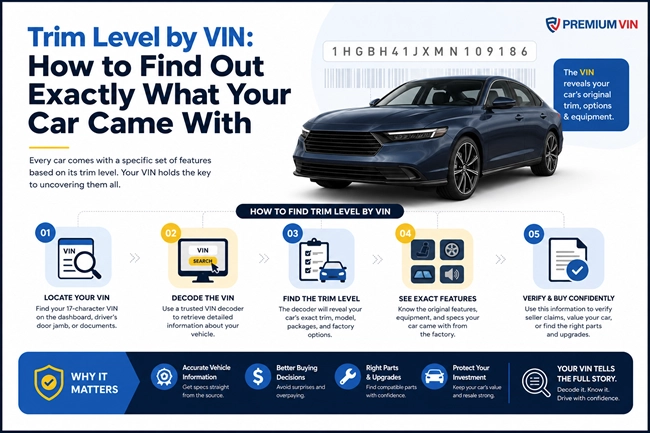
- A trim level determines the factory-installed features, technology, drivetrain options, and equipment included with a vehicle.
- VIN characters 4–8 often contain the information needed to identify a vehicle’s trim designation and configuration.
- Trim codes are manufacturer-specific, so the same VIN character can mean different things across brands.
- A window sticker by VIN can reveal factory equipment, optional packages, engine specifications, drivetrain type, and original color codes.
VIN data reflects the original factory build only and should be combined with a physical inspection to identify aftermarket modifications.
Two used cars can have the same make, model, year, and even the same paint color, yet be worth very different amounts. One might be a basic trim with cloth seats and standard features, while the other comes loaded with leather upholstery, advanced safety technology, and more.
A vehicle’s trim level can impact its value, features, and ownership costs. Unfortunately, not every seller accurately identifies the trim in their listing. You can check the trim level by VIN to see the complete information on the vehicle’s trim before buying.
What is a Trim Level?
A trim level is a specific version of a vehicle model that comes with a defined set of features, equipment, technology, and sometimes performance upgrades. While two vehicles may share the same body style and model name, their trim levels can significantly affect comfort, safety, performance, and market value.
How Manufacturers Use Trim Levels
Manufacturers use trim levels to sell the same vehicle platform at different selling points and to make it more appealing to buyers. Instead of designing the whole vehicle, manufacturers can add or remove features across different trim packages.
Base Trim vs. Mid vs. Top Tier
For example, a 2021 Honda CR-V was offered in LX, EX, EX-L, and Touring trims. Although all versions share the same basic body and platform, the equipment list changes substantially from one trim to the next.
Top-tier trims usually include leather upholstery, premium audio systems, larger touchscreens, adaptive cruise control, blind-spot monitoring, lane-keeping assistance, and, in some cases, a different engine, drivetrain, or suspension setup.
Insurance Companies
Insurance companies often consider trim level when calculating premiums because higher trims may include more expensive replacement parts, advanced sensors, cameras, and technology packages.
A fully loaded model can cost more to repair after an accident than its base-trim counterpart.
Finance
Trim also affects financing. Lenders and valuation services appraise vehicles based on their actual trim level, not simply the model name. If a vehicle is incorrectly identified as a higher or lower trim, it can influence loan-to-value calculations and affect financing decisions.
Resale Value
Resale value is another major factor. Selling a top-trim vehicle as a base model can leave money on the table, while advertising a base trim as a higher-spec version can mislead buyers and potentially constitute fraud.
What is a Trim Level?
Consider a private seller advertising a 2019 Ford F-150 as an XLT, a popular mid-range trim. The listing price reflects XLT market values, but a quick VIN check shows the truck actually left the factory as an XL base model.
The buyer pays for features they expect to receive, only to discover missing equipment when trying to add accessories or verify factory options. What appeared to be a small naming mistake turned into a costly pricing error.
Trim-level confusion is more common than many people realize, especially in the used car market. You can check the trim level by VIN and immediately get the trim information to ensure you purchase the right car.
What Does a VIN Encode About Trim Level?
A VIN has more comprehensive information than what most vehicle owners realize. While many people use it to identify the vehicle’s market, model, and year, it can also help to show the car’s trim when the VIN is properly decoded.
This kind of information becomes valuable when comparing two similar models before buying a used vehicle, such as factory equipment or confirming that a seller’s description matches the vehicle’s original specifications.
How the VIN is Structured
A Vehicle Identification Number (VIN) is classified into three categories: WMI, VDS, and VIS. Each of the fragments has different information that is embedded in the vehicle. Refer to the section below to examine how a VIN is structured.
VIN Example: 1FTFW1EF4FFA12346
World Manufacturer Identifier
The World Manufacturer Identifier is placed in the first to third position, which identifies the manufacturer and the country where the vehicle was built.
Digit 1 to 3: 1FT
- 1 = Country of origin (United States)
- F = Manufacturer (Ford Motor Company)
- T = Vehicle type (Truck)
Vehicle Description Section
This is the most important area when determining a trim level by VIN because it often contains information about body style, engine type, restraint systems, drivetrain configuration, and the vehicle series assigned by the manufacturer.
Digit 4 to 9: FW1EF4
F = F-Series vehicle line
W = 4WD (Four-Wheel Drive) configuration
1 = F-150 series
E = SuperCrew Cab body style
F = 5.0L V8 Flex Fuel (Coyote) engine
4 = Check Digit (used to verify the VIN’s validity)
VIS (Vehicle Identifier Section)
Identifies the model year, while characters 11–17 indicate the manufacturing plant and the vehicle’s unique production sequence number.
Digit 10 to 17: FFA12346
F = Model year (2015)
F = Assembly plant (Dearborn Truck Plant, Michigan, United States)
A12346 = Production sequence number
Why Can’t You Read Trim Information by VIN Manually?
Many vehicle owners assume they can decode the car’s trim level by looking at the VIN number, but the process is not that simple. While trim information is embedded in the VIN, the characters are not designed to be manually decoded with no proper database to cross-check information.
For example, you cannot look at the fifth character of a VIN and immediately know it represents an EX-L, XLT, Touring, Limited, or Sport model. The meaning of each character depends entirely on the manufacturer’s internal coding system and production records.
To accurately identify a vehicle’s trim level, the VIN must be matched to the vehicle’s factory data to get the right information.
What Trim Information Actually Comes From the VIN
A VIN has the complete information of the vehicle right after it has finished being built. Aside from identifying the trim level, it can provide details about equipment, packages, drivetrain configuration, and other factory-installed specifications.
Factory-Installed Equipment
A VIN can access the window sticker or build sheet data for a specific vehicle. This reveals standard trim features, optional packages, engine and transmission specifications, drivetrain type, and factory color codes.
Packages and Options
Trim badges do not always tell the full story. Manufacturers often offer optional packages that add equipment without changing the trim designation.
What the VIN Doesn't Confirm About Trim
The VIN does not include aftermarket modifications, dealer-installed accessories, or equipment added after the vehicle was sold. If a previous owner installed a lift kit, remote starter, upgraded wheels, or a sunroof, those changes will not appear in VIN records. A physical inspection is needed to check whether the past owner installed additional modifications.
How to Find Your Car's Trim Level by VIN?
To find a car trim level by VIN is easy; firstly, you’ll need to get an original window sticker that shows complete information about the car. Follow these instructions to get the document to see complete vehicle information.
Step 1: Find the VIN
Check the windshield, driver’s side doorjamb, and the vehicle’s documentation, such as paperwork, title, and even the bill of sale.
Step 2: Fill in the Form
Once you have the VIN, click the form and write the VIN. Then, click on the button to submit the form.
Step 3: Get the Window Sticker
Examine the preview page, where you can see the specification and market value. Then, proceed to payment to get the full vehicle trim information.
Why Checking Trim Level by VIN Matters
Knowing a vehicle’s trim level is not just useful for buyers. Sellers, owners, lenders, insurers, and repair shops all rely on accurate trim information to determine value, equipment, compatibility, and vehicle history.
Used Car Buyers
A trim level affects much more than features. It influences vehicle value, financing, insurance costs, and whether the car being advertised is actually what the seller claims it is.
Verifying What the Listing Claims
Online vehicle listings frequently display the wrong trim level. In some cases, it’s an honest mistake. In others, a higher trim is advertised to justify a higher asking price.
Buyers should also remember that exterior badges are not proof of trim. Replacement badges are inexpensive and can be installed in minutes. The most reliable way to verify a vehicle’s original trim is to decode the VIN against manufacturer build data.
Pricing a Used Car Accurately
Vehicle values can vary significantly between trims. Pricing tools such as KBB and Edmunds often assign different market values to the same model year based on trim level, sometimes creating a difference of several thousand dollars.
For example, a 2022 Jeep Grand Cherokee Limited listed for $42,000 may seem fairly priced. However, if the VIN shows the vehicle is actually a Laredo, the buyer could be paying thousands more than the vehicle’s true market value.
Sellers
For sellers, trim verification helps maximize vehicle value while ensuring listings accurately reflect the vehicle’s factory configuration and equipment.
Pricing the Car Correctly
Many sellers focus on mileage and condition while overlooking the impact the trim level has on value. As a result, some unknowingly advertise well-equipped vehicles at base-model prices. Knowing the correct trim can lead to more accurate pricing.
Avoiding Misrepresentation Claims
Advertising a vehicle as a higher trim than its VIN indicates can create problems for sellers. Even if the mistake is accidental, buyers may claim the vehicle was misrepresented, and it could lead to a dispute in the future.
Current Owners
Even if a vehicle is not being bought or sold, knowing the original trim level can simplify maintenance, repairs, recalls, and future upgrade decisions.
Ordering the Right Parts
Many components vary between trims, even when two vehicles share the same model name. Brake systems, suspension parts, infotainment units, and electronic modules can differ depending on the original trim package.
Warranty and Recall Verification
Some recalls and warranty programs apply only to specific trims, engines, or equipment packages. Two vehicles from the same model year may be affected by different campaigns depending on how they were configured at the factory.
How to Tell Trim Level by VIN for Popular Models
Many vehicle owners search for model-specific answers because trim decoding can vary significantly between manufacturers. Understanding how different brands encode trim information helps explain why some VINs are easier to decode than others.
Why Model-Specific Trim Decoding Can Be Tricky
There is no universal VIN character that always identifies the trim level. Manufacturers use positions 4–8 differently, meaning the same character can represent completely different information depending on the brand. Toyota, Ford, Honda, Chevrolet, and other automakers each use their own coding systems.
How to Tell Prius Trim Level by VIN?
When you search for how to tell the Prius trim level by VIN, you need to understand that Toyota uses multiple VIN characters to identify vehicle configuration. Prius trims such as L Eco, LE, XLE, Limited, and AWD-e are linked to codes found within the Vehicle Descriptor Section.
For many Prius models, VINs beginning with JTDKARFU indicate specific configurations, while the eighth character often identifies the engine or drivetrain combination. Check the fifth character to distinguish standard Prius models from Prius Prime variants and other sub-models.
Ford, Chevrolet, and Honda
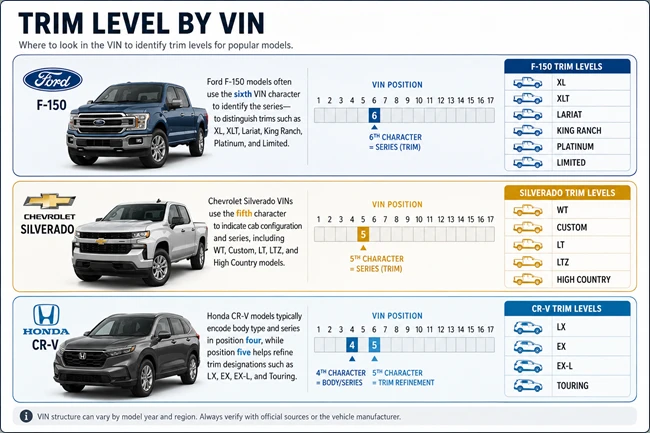
- Ford F-150 models often use the sixth VIN character to identify the series–to distinguish trims such as XL, XLT, Lariat, King Ranch, Platinum, and Limited.
- Chevrolet Silverado VINs use the fifth character to indicate cab configuration and series, including WT, Custom, LT, LTZ, and High Country models.
- Honda CR-V models typically encode body type and series in position four, while position five helps refine trim designations such as LX, EX, EX-L, and Touring.
There is a chance that VIN coding for each different make can change yearly; hence, manual decoding is not always reliable. For most owners, getting a vehicle’s window sticker by VIN is more convenient than decoding the VIN manually.
Is it Important to Know the Vehicle’s Trim Level?
Yes. Knowing the vehicle’s trim information is not just about satisfying curiosity; it also helps the buyer and seller to verify the correct trim level and other vehicle information, such as options, interior and exterior information, MSRP, safety ratings, and more, through the window sticker by VIN.
Before you buy or sell a used vehicle, be sure to always have a copy of the window sticker to ensure you put the right information on the vehicle, including the trim information.
Remember, even though the vehicles have the same year and model, if they have different trims, they must have different values and additional equipment. So, always run a window sticker lookup to check trim information and much more.
FAQs About Trim Level by VIN
Can you tell the trim level by VIN?
Yes, a vehicle’s trim level can often be identified using its 17-character VIN. The VIN contains factory-assigned information about the vehicle, including details such as the engine, transmission, body style, and trim configuration.
How do I check what trim level my car is?
One way to identify a vehicle’s trim level is by checking for trim badges on the trunk, tailgate, or side panels. If no badges are present, use the vehicle’s 17-digit VIN and enter it into a VIN decoder such as PremiumVIN to view the original factory specifications.
Is LS or LT a higher trim?
Yes, LT is generally positioned above LS in the trim hierarchy. While LS typically serves as the entry-level trim, LT models often include additional comfort, technology, and convenience features that are not available on the base version.
How do I know what trim package I have?
The quickest way to identify a vehicle’s trim package is by checking the model badge, reviewing registration documents, or decoding the 17-digit VIN. A VIN lookup can provide detailed factory information, including the original trim level.
Does LT stand for luxury trim?
LT is commonly understood to mean “Luxury Touring” in many Chevrolet and General Motors vehicles. It is typically a mid-level trim that offers additional features and amenities compared to entry-level models, while remaining below premium trims such as LTZ, Premier, or High Country.