
Fuel Economy by VIN - Check MPG & EPA Ratings
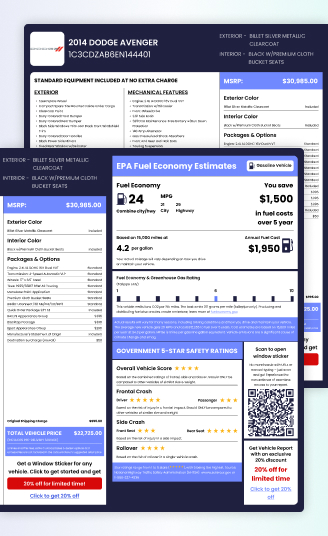
Get a window sticker by VIN now to see complete information about the vehicle’s MPG ratings, fuel economy, and even the NHTSA safety ratings. Click the form below to check the car’s MPG by VIN through a reliable window sticker.
What Our Fuel Economy Report Reveals
A fuel economy by VIN helps you understand how efficient a vehicle really is before you buy or sell it. The report shows official EPA fuel ratings, fuel specifications, and powertrain details to help you estimate running costs and compare vehicles more easily.
Complete EPA Ratings
EPA fuel economy ratings give a better idea of how much fuel a vehicle may use in daily driving conditions. Check the window sticker to see the vehicle’s MPG.
City MPG
See the estimated fuel efficiency during stop-and-go city driving conditions.
Highway MPG
Check the expected fuel economy when driving on highways at steady speeds.
Combined MPG
View the combined fuel economy rating based on both city and highway driving.
Annual Fuel Cost
Estimate the yearly fuel expenses based on average driving distance and fuel prices.
Fuel Type & Specifications
Different vehicles require different fuel grades and tank capacities. Knowing the correct fuel information helps avoid unnecessary costs and performance problems.
Required Fuel
Find out whether the vehicle requires regular, mid-grade, premium gasoline, diesel, or another fuel type.
Fuel Tank Capacity
See how much fuel the tank can hold when filled.
Range Calculation
Estimate how far the vehicle can travel on a full tank based on official fuel economy ratings.
Powertrain Configuration
Fuel economy is strongly affected by the engine, transmission, and drivetrain setup. This section explains the vehicle’s core mechanical configuration.
Engine Size & Type
View the engine displacement and configuration, such as inline-4, V6, turbocharged, or hybrid.
Transmission Type
Identify whether the vehicle uses an automatic, manual, CVT, or dual-clutch transmission.
Drivetrain
Check the drivetrain layout, including front-wheel drive, rear-wheel drive, all-wheel drive, or four-wheel drive.
Why Official Fuel Economy Matters
Official fuel economy information helps drivers understand the real cost of owning and operating a vehicle. It also helps buyers avoid misleading claims and choose a vehicle that fits their driving needs and budget.
For Buyers
Fuel economy affects long-term ownership costs more than many buyers expect. Checking official ratings to compare vehicles is always recommended.
Calculate True Ownership Cost
A fuel-efficient vehicle may save thousands of dollars in fuel costs over time compared to less efficient models.
Compare Accurately
Official EPA ratings make it easier to compare fuel efficiency between vehicles in the same category.
Verify Seller Claims
A VIN-based report helps confirm whether the advertised fuel economy matches the vehicle’s actual factory specifications.
For Current Owners
Understanding the expected vehicle fuel economy can help identify problems and improve ownership planning.
Diagnose Problems
A sudden drop in fuel economy may indicate maintenance issues, engine problems, or tire pressure concerns.
Budget Accurately
Knowing your average fuel costs helps you plan monthly transportation expenses more effectively.
Plan Trips
Estimated fuel range and efficiency help drivers prepare for long-distance travel and fuel stops.
For Sellers
Providing accurate fuel economy information helps buyers better understand the vehicle and builds confidence during the sale process.
Provide Accurate Information
Verified fuel economy data helps create more reliable and transparent vehicle listings.
Justify Value
Efficient vehicles and powertrain combinations increase buyer interest and have stronger resale value.
Real Story: How Fuel Economy Data Revealed a Seller's Exaggeration
A buyer wanted to purchase a used 2006 FORD F-150 from a private seller in Oklahoma. The seller stated that the vehicle’s fuel economy is 20 mpg, which means the buyer will save more on gas. Before he proceeded to purchase the car, he decided to get a window sticker to check fuel efficiency and other information.
What the Report Revealed
The window sticker reveals more information about the vehicle aside from fuel economy. After thoroughly reading the window sticker, here’s what the buyer found.
Fuel Economy
The fuel economy is actually only 16 MPG, which is lower than the claim.
Fuel Economy and Greenhouse Ratings
The vehicle’s rate is 10 in the category. This vehicle emits tons of CO2 per 15k miles. The best emits 0 grams per mile.
Safety Ratings
The vehicle is rated in 5-star categories like Frontal Crash Driver and Passenger, and Rollover. However, the car has not yet been rated on the Side Crash Front seat and rear seat.
MSRP and Total Vehicle
The car’s MSRP is $30,870 and the total price of the car is $33,775.00
The Outcome
The buyer decided not to purchase the car because the claimed fuel economy was wrong and not what he wanted.
EPA vs. Real-World Fuel Economy
EPA fuel economy ratings are created under controlled testing conditions to provide a standard way to compare vehicles. However, real-world fuel economy can vary depending on driving habits, traffic, weather, road conditions, maintenance, cargo weight, and driving style.
While EPA estimates are useful for comparison, actual MPG may be higher or lower during everyday driving.
| Factor | Why Real World Differs |
|---|---|
| Driving Style | Aggressive acceleration lowers MPG |
| Terrain | Hills and mountains reduce efficiency |
| Weather | Cold temperatures and headwinds affect MPG |
| Vehicle Load | Heavy cargo reduces fuel economy |
| Maintenance | Poor maintenance reduces efficiency |
| Tire Pressure | Underinflated tires lower MPG |
How to Check Fuel Economy by VIN
You can check the car’s fuel economy by VIN with our tool and get the complete window sticker. By using the VIN, you can check any vehicle’s complete specifications, fuel economy, and MSRP easily.
Three Simple Steps
Using our tool is easy; you just need to follow these three steps to get the window sticker.

Step 1: Find the VIN
Check the driver’s side doorjamb, engine bay, and paperwork like registration or bill of sale to have the VIN.

Step 2: Fill Out the Form
Click the form and enter the VIN from any make. Then, click on the button to submit the form.

Step 3: Unlock Full Fuel Economy Report
Examine the preview page to see full specs and market value. Then, complete the payment to get the full window sticker and examine its complete fuel economy.
Why Choose PremiumVIN
The PremiumVIN services have helped plenty of buyers and sellers across the globe. Our window stickers are designed to provide accurate specifications, fuel efficiency data, and ownership insights simply.
VIN-Specific
Every report is matched directly to the vehicle’s VIN, helping ensure the fuel economy and powertrain details are accurate for that exact vehicle.
Complete Data
Access detailed information, including EPA fuel ratings, engine specifications, drivetrain details, transmission type, and fuel requirements in one report.
Instant Results
Get your complete fuel economy report within seconds after entering the VIN—no waiting or complicated process required.
Affordable
Access detailed vehicle and fuel economy information at a competitive price without paying expensive dealership or research fees.
Check Accurate Fuel Economy Information
Before you proceed to purchase a used vehicle, ensure you check everything thoroughly to avoid scams or misrepresentation. Get the window sticker now!
Frequently Asked Questions About Fuel Economy by VIN
How do I find my car's official fuel economy?
You can check a vehicle’s official fuel economy through the EPA fuel economy label, manufacturer specifications, or VIN-based fuel economy lookup tools that provide factory MPG ratings and fuel details.
Does fuel type (regular vs. premium) affect cost calculations?
Yes, fuel type can significantly affect overall ownership costs. Vehicles that require premium fuel usually cost more to operate because premium gasoline is typically more expensive than regular fuel.
How accurate are EPA ratings?
EPA fuel economy ratings are useful for comparing vehicles under standardized testing conditions. However, actual fuel economy may vary depending on driving habits, traffic, weather, road conditions, and vehicle maintenance.
Can I get fuel economy for a truck or SUV?
Yes, fuel economy can vary greatly between trucks and SUVs depending on engine size, drivetrain, towing capability, and overall vehicle weight. Smaller or more efficient models generally achieve better MPG ratings than heavy-duty vehicles.
What if my vehicle's fuel economy isn't found?
If fuel economy information is unavailable in official databases, the vehicle may be older, heavily modified, imported from another market, or classified outside standard passenger vehicle categories.
How do I calculate annual fuel cost?
Annual fuel cost is usually estimated by comparing the vehicle’s fuel economy with the average number of miles driven per year and current fuel prices.