
Hyundai Window Sticker Lookup by VIN for Vehicle Details
Check the Hyundai Window Sticker by VIN tool to explore your car’s original specifications; our tool provides an authentic and detailed factory sticker in seconds.
What Does a Hyundai Window Sticker Tell You?
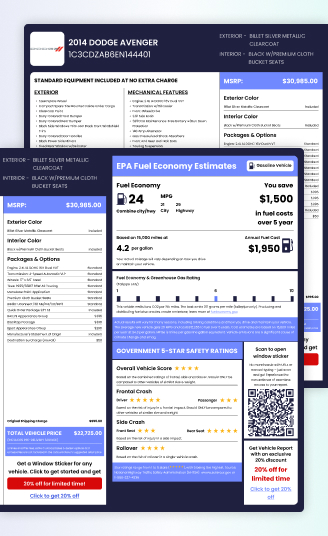
A Hyundai window sticker, also known as a Monroney label, summarizes the equipment and pricing associated with a specific Hyundai when it was offered new. Depending on the vehicle and available information, it includes MSRP, standard features, optional equipment, packages, fuel economy, safety information, and other listed specifications.
Why Check a Hyundai Window Sticker?
A Hyundai can have different equipment, packages, and pricing depending on its model, trim, drivetrain, and model year. Reviewing the window sticker information can help you understand how a particular vehicle was configured rather than relying only on the trim name or online listing.
Used-Car Buyers
A window sticker can give you additional details to consider when comparing Hyundai vehicles, especially when two examples share the same model and year but have different equipment.
Match the Vehicle to Its Listed Configuration
Use the window sticker to identify the Hyundai model and configuration, such as an Elantra, Sonata, Tucson, Santa Fe, Palisade, Kona, IONIQ 5, or another model. Depending on the vehicle, the report may also include drivetrain or powertrain details.
Compare Equipment Between Hyundais
See features and packages such as HTRAC® all-wheel drive, panoramic sunroof, premium audio, advanced driver-assistance features, heated and ventilated seats, N Line equipment, or other listed options.
Put the MSRP in Context
Use the MSRP to see Hyundai with similar vehicles. It gives you pricing context for the vehicle’s configuration when new, alongside its current asking price and condition.
Sellers
A window sticker can add useful configuration details to a Hyundai listing. Sharing equipment and pricing information can help buyers understand what is included in the car.
Show Features Buyers May Miss
Highlight listed equipment, packages, technology, wheels, interior features, and other configuration details that may not be easy to identify from photos.
Add More Detail to Your Listing
Including available sticker information can give shoppers additional context when comparing your Hyundai with other listings of the same model or trim.
Dealers and Retailers
Dealers and independent retailers can reference Hyundai window sticker information when evaluating inventory, preparing online listings, and comparing vehicles with different equipment levels.
Check Vehicle Details
Review the model, trim, drivetrain, packages, and equipment information when preparing a Hyundai for sale or comparing similar vehicles in inventory.
Support Vehicle Descriptions
Listing equipment and pricing together helps create more detailed inventory descriptions and provides useful context when discussing a vehicle with prospective customers.
Information You Can Find on a Hyundai Window Sticker
A window sticker, often called a Monroney label, details every factory aspect of your Hyundai. On the window sticker, you can find important information about the vehicle, such as:
Vehicle Description
See the Hyundai’s factory configuration, including the model year, model, trim, body style, exterior color, interior color, and 17-digit VIN. It can distinguish vehicles such as the Elantra, Sonata, Tucson, Santa Fe, or Palisade.
Standard Equipment
See the equipment Hyundai included with the vehicle’s trim level. It features such as Hyundai SmartSense® technologies, touchscreen infotainment, Apple CarPlay®, heated seats, LED lighting, alloy wheels, and dual-zone climate control.
Warranty Information
Review the Hyundai warranty coverage associated with the vehicle, including applicable new vehicle, powertrain, anti-perforation, and roadside assistance protection. Coverage terms vary by model year and vehicle configuration.
Manufacturer’s Suggested Retail Price
The MSRP shows Hyundai’s base price with its standard equipment, before factory options, packages, destination charges, taxes, or other fees are added. Check MSRP by VIN to verify factory pricing.
Optional Equipment
The destination charge covers the manufacturer’s cost of transporting the Hyundai from its assembly or distribution facility to the dealership. It is listed separately from the vehicle’s base MSRP and factory-installed options.
Destination Charge
The fee charged by the manufacturer to transport the vehicle from the assembly plant to the dealership. It’s a non-negotiable part of the total price.
Total Price
This figure reflects the Hyundai’s sticker price after the base MSRP, factory-installed options and packages, and destination charge are combined. It represents the listed price before taxes, registration, dealer fees, discounts, or incentives.
Fuel Economy / EPA Label
The EPA label reports the Hyundai’s estimated city, highway, and combined fuel economy for its specific powertrain. It also shows annual fuel expenses, five-year fuel-cost comparisons, greenhouse gas emissions, and efficiency information for hybrid or electric models.
Safety Ratings
NHTSA ratings show crash-test information for the Hyundai model and model year, including frontal, side, and rollover performance. Ratings use a five-star scale, while vehicles without NHTSA testing have no rating displayed.
Important Details About a Hyundai Window Sticker
Hyundai window sticker information can differ depending on the vehicle, model year, market, and data available for the VIN. Consider the report a reference for reviewing Hyundai’s listed equipment, configuration, and pricing information.
- Information Source: The available sticker details are compiled from manufacturer-related data and information decoded from the vehicle’s VIN.
- Coverage Can Vary: Data availability is not the same for every Hyundai. Model year, vehicle type, market, and individual VIN can affect how much information is shown, particularly for older or less common configurations.
- What the Report May Show: Depending on the available data, the report may include MSRP, standard equipment, optional features, packages, specifications, and other vehicle details. The report is not a document issued by Hyundai.
- For Official Records: If you need to confirm information for registration, title, safety, or another official purpose, check with a Hyundai dealer or the appropriate DMV or government authority.
How to Get a Hyundai Window Sticker by VIN
Use our VIN lookup tool to check available Hyundai window sticker information by VIN. The process only takes a few steps, starting with the vehicle’s 17-digit VIN.

Step 1: Enter the Hyundai VIN
Locate the Hyundai’s 17-digit VIN and enter it into the lookup form above. Make sure all characters are entered correctly before continuing.

Step 2: Submit the Details
Click the submit button to run the lookup.

Step 3: Review the Hyundai Window Sticker
Check the preview to review MSRP, specifications, and other vehicle details. Then, proceed with payment to access the full Hyundai window sticker.
Where to Find Your Hyundai VIN?
The 17-character VIN is the key to unlocking your Hyundai’s Window Sticker. You can find it in several common locations:
Dashboard (Driver Side): Look through the windshield on the driver’s side where the dashboard meets the glass.
Driver’s Side Door Jamb: Open the driver’s door and look at the sticker or metal plate on the door frame/jamb.
Vehicle Documents: The VIN is usually listed on the title, registration, and insurance paperwork.
Understanding Hyundai Model Families and Configurations
A Hyundai VIN points to a specific vehicle, but the model name alone may not show how that vehicle was equipped. Window sticker information can add context about the model, powertrain, drivetrain, trim-level equipment, packages, and listed pricing.
Hyundai Models and Vehicle Families
Equipment and powertrain choices can differ significantly between Hyundai models and trims and markets. Take a look at the section below to see the differences.
| Model / Family | Typical Characteristics |
|---|---|
| Elantra | Compact sedan available with different engines, trim levels, technology features, and performance-oriented configurations. |
| Sonata | Midsize sedan with varying powertrain, comfort, technology, and safety equipment across different model years and trims. |
| Tucson | Compact SUV offered with gasoline, hybrid, and plug-in hybrid powertrains. |
| Santa Fe | Midsize SUV with multiple seating, powertrain, drivetrain, and equipment configurations that vary by generation. |
| Palisade | Three-row SUV focused on passenger space, with different trim levels and equipment packages that can affect its technology. |
| Kona | Subcompact SUV available with gasoline and electric powertrains with different trim and equipment combinations. |
| Santa Cruz | Compact pickup-style vehicle combining an open cargo bed with SUV-like passenger space. |
| IONIQ Models | Hyundai's dedicated electric vehicle family, including models such as the IONIQ 5 and IONIQ 6, with battery, motor, drivetrain, and technology configurations that vary by model year. |
| N Line and N Models | Performance-oriented Hyundai variants with sportier styling, chassis tuning, powertrain upgrades, and additional equipment depending on the specific model and year. |
| Hybrid and Plug-In Hybrid Models | Electrified Hyundai configurations that combine an internal-combustion engine with electric drive components. |
Hyundai Options and Packages to Verify
A Hyundai’s equipment can vary considerably between trims and model years, particularly for SUVs, hybrids, and higher-level configurations. The Hyundai sticker can help identify packages and equipment that may not be obvious from the vehicle’s trim information.
| Package or Feature | Why It Matters |
|---|---|
| Convenience Package | May add comfort, technology, digital displays, convenience features, and other upgrades depending on model |
| Premium Package | Can bundle higher-end interior, technology, audio, lighting, or comfort equipment |
| HTRAC™ AWD | Helps identify an available all-wheel-drive configuration on applicable Hyundai models |
| Panoramic Sunroof | Indicates upgraded roof equipment that may not be clear from exterior photos |
| Premium Audio | May identify an upgraded sound system included with a trim or package |
| Heated & Ventilated Seats | Useful for confirming upgraded front-seat comfort features |
| Driver Assistance Equipment | May include additional cameras, sensors, adaptive cruise control, parking assistance, and related features |
| Hybrid or Electrified Equipment | For applicable models, can help distinguish hybrid, plug-in hybrid, or EV configurations and related equipment |
Check Hyundai Window Sticker Information by VIN
You can look up the Hyundai window sticker to check the vehicle’s build information through the window sticker by VIN by PremiumVIN.
Convenience Process
Enter the Hyundai’s 17-digit VIN into the lookup form to check for the window sticker and get the result in under a minute.
Review Hyundai’s Listed Equipment
Use the window sticker as a reference to review the car’s equipment and other information such as MSRP, standard equipment, optional features, packages, drivetrain details, and more.
Save the Report for Later
Available Hyundai window sticker information is provided in a digital report for convenient review. Don’t forget to download the window sticker in PDF format.
Need Help With Your Lookup?
Our support team is available 24/7 to help you understand the lookup process and report details.
Window Sticker for All Hyundai Models
Below are some popular Hyundai models. PremiumVIN can provide window stickers for all Hyundai models, years, and variants, including older and classic formats.
Hyundai Window Sticker vs. Hyundai Build Sheet
A Hyundai window sticker and Hyundai build sheet are related, but they are not identical documents.
Hyundai Window Sticker
Purpose
Consumer-facing dealership label originally displayed when the vehicle was sold new.
Information Included
MSRP, standard equipment, optional equipment, fuel economy, and retail vehicle information.
Hyundai Build Sheet
Purpose
Factory production document with internal configuration codes.
Information Included
internal production codes, assembly information, manufacturing specifications, and detailed factory configuration data.
Related Hyundai VIN Tools
PremiumVIN also provides Hyundai VIN decoders, MSRP research, factory options checks, and vehicle history reports. These tools help buyers and owners research both factory configuration and historical vehicle information before purchase.
Decode any Hyundai VIN into our Hyundai VIN decoder to view basic vehicle information at no cost. It can point to the manufacturer, model, body style, and engine size, and it’s meant to stay with that vehicle for life.
Get a comprehensive record of a vehicle’s past, generated using its VIN (Vehicle Identification Number). It compiles data from multiple sources to give you a clear picture of a vehicle’s condition, ownership, and risk factors.
Get the vehicle’s original manufacturer’s suggested retail price (MSRP) using the VIN number. The VIN contains factory information that can be used to identify the vehicle’s original pricing details, trim level, options, and standard equipment.
Retrieves the original options and equipment installed on a vehicle using its 17-digit VIN. Every VIN is linked to factory build data, which includes information about trim level, packages, and optional features assembled during production.
Get Your Hyundai’s Original Window Sticker Today
Verify the original factory configuration of a Hyundai using the VIN number. A PremiumVIN Hyundai window sticker lookup can help you research original MSRP, trim levels, SmartSense safety features, factory-installed packages, hybrid and EV configurations, drivetrain details, fuel economy, and OEM vehicle specifications.
Enter your Hyundai VIN above to get your window sticker now.
FAQs About Hyundai Window Sticker Lookup
Where can I find my Hyundai VIN to get the window sticker?
Your Hyundai VIN is typically located:
- On the driver’s side dashboard, visible through the windshield.
- Inside the driver’s door jamb, on the factory label.
- On your registration, insurance, or title documents.
How can I get my Hyundai window sticker by VIN for free?
Locating a free, original Hyundai window sticker for a used vehicle is challenging. Dealerships may offer limited help, but they typically don’t provide access to the original factory-issued sticker. While some enthusiasts share sample stickers on forums, finding one that matches your exact VIN is extremely rare.
For guaranteed accuracy and full vehicle details, we recommend using a trusted third-party service like ours. For a small fee, you’ll receive an official Hyundai window sticker tailored to your vehicle’s unique specifications and sourced directly from factory records.
What information does a Hyundai window sticker show?
A Hyundai window sticker includes complete vehicle details such as:
- Standard equipment
- Trim level and exterior/interior colors
- Engine and transmission type
- Optional features and packages
- MSRP (Manufacturer’s Suggested Retail Price)
- Fuel economy and EPA ratings
- Safety ratings
- Warranty information
Why is a Hyundai window sticker important when buying a used car?
The Hyundai window sticker helps used car buyers verify that the vehicle’s current condition, trim, and features match the factory configuration. It ensures transparency by revealing original options, pricing, and warranty coverage. This protects buyers from misinformation and helps determine the car’s fair market value.