

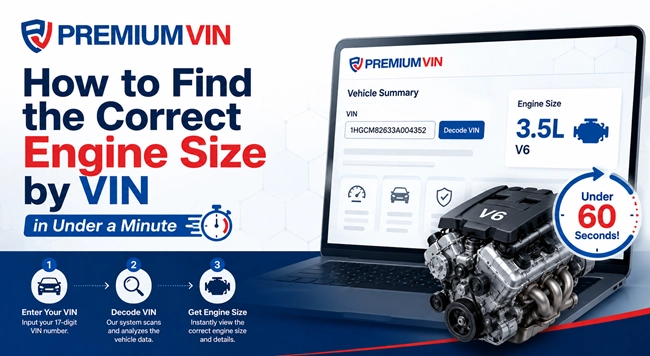
- The VIN encodes factory-installed engine information, making it the most reliable way to verify engine size and specifications.
- In many vehicles, the 8th VIN character serves as the engine identifier, though the exact meaning varies by manufacturer and model year.
- Knowing your engine size helps prevent costly mistakes when ordering parts, scheduling repairs, or performing maintenance.
- A VIN decoder provides more than just engine size, including trim level, transmission, drivetrain, manufacturer details, and other factory specifications.
Ordering the wrong brake pads can be frustrating, and even ordering the wrong engine components can be a lot more frustrating because the mistake can be expensive. Two vehicles parked side by side may share the same model name, body style, and year, yet have completely different engines under the hood.
The most reliable way to check a vehicle’s engine is through a VIN decoder that lets you decode the VIN and get complete vehicle information, such as specifications, engine type and size, MSRP, market value, and more. Read through this article to see why a VIN decoder is important, how to decode the VIN to get the right engine information, and many more.
Why Do You Need to Know Your Engine Size?
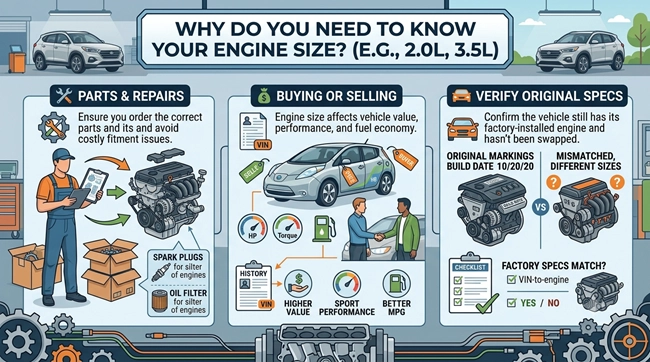
Knowing the engine size is important before you decide to purchase or to run an engine change. The engine affects everything from replacement parts and maintenance requirements to insurance costs and vehicle value. A VIN also shows detailed information about the kind of engine embedded in a vehicle.
Parts Ordering and Fitment
Many replacement parts are designed for a specific engine configuration. Even when two vehicles share the same model name and year, they may use completely different engines that require different components. Verifying engine size by VIN helps prevent costly ordering mistakes.
Engine Size Can Change Anything
Timing chains, belts, gaskets, valve cover seals, spark plugs, and oil filters are often engine-specific rather than model-specific. Ordering parts based solely on the vehicle model can easily lead to compatibility issues.
Emissions and Smog Testing
Engine size and engine codes play an important role in emissions compliance. In some states and jurisdictions, emissions testing programs use engine displacement and factory specifications as part of the certification process.
Insurance Verification
Insurance companies consider engine size when assessing vehicle risk. Larger-displacement engines are often associated with higher performance levels, which can affect the cost calculation.
Buying or Selling a Used Vehicle
Engine size can significantly influence a vehicle’s value, performance, fuel economy, and desirability. Make sure to check the engine size by VIN number to avoid being misinformed and paying a higher fee.
Verifying the Engine Hasn't Been Swapped
A common example involves performance models. A used 2016 Mustang may be advertised as a GT equipped with a 5.0L V8, but a quick VIN decoder can show that it was originally built with a 2.3L EcoBoost four-cylinder, as the badge can be easily swapped.
Confirming What You're Paying For.
Checking engine size by VIN before completing a purchase helps ensure the vehicle matches the seller’s description. A few seconds spent verifying the VIN can prevent a buyer from paying V8 prices for a vehicle that was originally built with a V6 or four-cylinder engine.
Read also: Does the Size Of A Car Engine Matter?
Where to Find the Engine Size Information on a VIN
Every vehicle comes with a VIN attached to it. While the VIN contains information about the manufacturer, model year, assembly plant, and production sequence, it also includes details about the engine originally installed at the factory.
Three Sections of VIN
The VIN is divided into three different parts: WMI, VDS, and VIS. Each of the sections has different information about the vehicle. Here’s a quick explanation of what each section covers.
World Manufacturer Identifier (WMI)
The first three characters identify the vehicle’s manufacturer. This section shows the information on the country of origin, the manufacturer, and the general vehicle type.
Vehicle Descriptor Section (VDS)
The fourth to ninth characters contain information about the vehicle’s configuration. Depending on the manufacturer, these characters may identify the body style, trim level, restraint system, engine type, and other key specifications. The ninth character is reserved as a check digit used to validate the VIN.
Vehicle Identifier Section (VIS)
The final section, from the tenth to the seventeenth, identifies the individual vehicle. It includes information such as the model year, assembly plant, and the vehicle’s unique production sequence number, which distinguishes it from every other vehicle produced.
VIN Breakdown Example
Take a look at the example of how a VIN is broken down into detailed information, where you can see what each VIN code represents.
Sample VIN: 1FMEE5DP7NLB29110
WMI (World Manufacturer Identifier)
Digit 1 to 3: 1FM
- 1 = Country of origin (United States)
- FM = Ford
VDS (Vehicle Descriptor Section)
Digit 4 to 9: EE5DP7
- E = Engine type (2.7L EcoBoost twin-turbo V6)
- 5 = Body style (4-door SUV)
- D = Trim level (mid-range configuration, e.g., Big Bend / Outer Banks)
- P = Series or equipment package within the model range
- 7 = Check Digit
VIS (Vehicle Identifier Section)
Digit 10 to 17: NLB29110
- N = Model year (2022)
- L = Michigan Assembly Plant, Wayne, Michigan, United States
- B29110 = Production sequence number
How to Find the Engine Size by VIN
Finding the engine size by VIN is easy; you can use our tool to decode the VIN and get the complete engine information. Follow these steps to decode the VIN for free and get the engine information in seconds.
Step 1: Find the VIN
Check the driver’s side doorjamb, the windshield, or the vehicle’s paperwork for the VIN.
Step 2: Fill Out the Form
Once you have the VIN, enter the VIN into the form. Then, click on the button to submit the form.
Step 3: Check the Detailed Vehicle Information
Locate the VIN on the vehicle’s body or on the paperwork. Our tool can be used to decode the classic and modern VIN.
REAL Case: Why Checking an Engine Size is Important Before Fixing
Rue wanted to have her father’s 2014 Jeep Grand Cherokee repaired at a body shop in Ohio. Accidentally, the shop ordered the engine based on the year and model, but did not check what engine it came with.
The Downside
Because the shop ordered the wrong part, the repair process is delayed, and they have to reorder the right part for the vehicle.
Why Decoding the VIN is Important
Decoding the VIN to confirm the correct engine size and capacity before placing an order. This step eliminates the chance of ordering the wrong parts and a delayed repair process.
Reference of Popular Model Engine Size by VIN
While the 8th character of the VIN is commonly used as an engine identifier, the exact meaning depends on the manufacturer, model, and year. Check the example below to see how some vehicle manufacturers encode engine information in their VIN sequence.
Ford Engine Code
Ford put their vehicle engine information in the eighth sequence of the VIN. Make sure to check the VIN carefully to find Ford’s factory-installed engine.
F-150 Engine Codes
Some common Ford F-150 engine codes include:
- P = 3.3L Ti-VCT V6 (base engine)
- 6 = 2.7L EcoBoost V6
- F = 3.5L EcoBoost V6
- G = 5.0L Coyote V8
- P (with different model context) = 3.0L Power Stroke diesel
One thing you need to know is that Ford often changes the engine code assignment between model years. Verify the model year before solely checking the 8th character of the VIN.
Mustang Engine Code
The Mustang’s appearance changes a little between different trims, but the factory-installed engine can affect both performance and resale value.
- H: 2.3L EcoBoost I4
- F: 5.0L Coyote V8
- R: 5.2L Voodoo V8 (GT350/GT350R)
GM / Chevrolet Engine Codes
General Motors uses the 8th VIN character to identify the engine installed at the factory. This is useful to check the engine for a truck and a performance car, as multiple engine options might be available for the same model year.
Silverado / Sierra Engine Codes
The Chevrolet Silverado and GMC Sierra share the same platform but can be equipped with several different powertrains. Check this section for more information:
- C: 4.3L EcoTec3 V6
- K: 5.3L EcoTec3 V8
- J: 6.2L EcoTec3 V8
- L: 3.0L Duramax Diesel I6
Corvette Engine Codes
Corvette engine codes are particularly important because performance variants can differ dramatically in power output and market value.
- G: 6.2L LT1 V8 (C7 Stingray)
- R: 6.2L LT2 V8 (C8 Stingray)
- T: 5.5L LT6 Flat-Plane V8 (C8 Z06)
Finding Engine Size by VIN Made Easy
Engine size affects everything from parts compatibility and maintenance costs to vehicle value and insurance rates. While many vehicles look identical on the outside, the VIN reveals the engine that was originally installed at the factory. Whether you’re buying a used vehicle, ordering replacement parts, or verifying specifications, decoding the VIN is the fastest and most accurate way to confirm engine details.
Use the PremiumVIN’s VIN Decoder service to view your vehicle’s engine size, factory specifications, and other essential vehicle information, such as the MSRP and updated market value.
FAQs About Engine Size by VIN
How to find my engine size by VIN number?
To find the engine size by VIN, use a VIN decoder. Although VIN layouts differ between manufacturers, engine-related information is typically found within the Vehicle Descriptor Section (VDS), usually spanning characters 4 through 8.
Can VIN number tell the engine size?
Yes. Your vehicle’s 17-digit VIN includes factory-coded information about the engine. In many modern vehicles, the 8th character serves as the engine identifier, helping distinguish between different engine options available for the same model.
How to tell if the engine is a V6 or V8?
To quickly determine if an engine is a V6 or a V8, check the vehicle’s specifications (VIN, owner’s manual, or registration), look for exterior badges on the car’s fenders or trunk, or pop the hood and count the spark plugs/ignition coils on either side of the V-shaped engine block.
How do I check the engine size?
To find your car’s engine size quickly, check the emissions compliance label under the hood, decode your VIN, or look at your vehicle registration documents. Engine size (displacement) is usually measured in liters (L) (e.g., 2.0L) or cubic centimeters (cc) (e.g., 2000cc).
Which digit in a VIN number is for the engine?
The eighth digit of a 17-character VIN designates the engine type. This letter or number acts as a code.
Manufacturers use this code to identify the specific size, cylinders, and horsepower of the original engine installed in the vehicle.