
How to Research a Vehicle by VIN
Summary: Researching a vehicle by its VIN is not one lookup. It is five different questions. The VIN answers some of them directly, helps with others, and cannot answer the rest. The most common mistake is treating one document as if it answered all five. |
The five questions
| # | Question | What answers it | What the VIN does |
|---|---|---|---|
| 1 | What is this vehicle? | A VIN decode | Answers directly: make, model year, plant, and engine and body where the manufacturer encodes them |
| 2 | How was it built? | A reconstructed Window Sticker or Build Sheet, or the original documents where they exist | Is the starting point. Configuration data is matched to the decoded vehicle. |
| 3 | What has been recorded about it? | A VIN check of available records | Is the key the records are filed under |
| 4 | What does the paperwork say? | The title, registration and any lien information, from the seller and the state agency | Must match. It does not replace the documents. |
| 5 | What condition is it in now? | An inspection and a test drive | Confirms you are looking at the right vehicle, and nothing more |
The order matters because each step narrows what the next needs to confirm.
Step 1: Get the VIN right
Everything downstream depends on the number. Read it from the vehicle, not only from the advertisement. On most cars and light trucks it is visible through the windshield at the driver’s side, and it is also on the door-frame label and on the title. Compare all three. If they disagree, resolve that before spending anything else. Where to find the VIN shows the locations, and what a VIN is explains why the numbers should agree. If the vehicle was built before 1981, the number will not look like a modern VIN. See classic car VINs.
Step 2: Identify the vehicle
A VIN decode turns the characters into specifications. Compare the result with the listing: model year, engine, body style, and where it was built. A mismatch is useful information. A listing that says V8 for a vehicle that decodes as a four-cylinder is a question for the seller, not a rounding error. Decoding identifies the vehicle. It does not show accident, title or ownership history. If you want to see how the characters map to those fields, read VIN format explained.
Step 3: See how it was built
A Window Sticker lists a vehicle’s price, options and ratings, and a Build Sheet covers configuration in more detail. Where the original is not available, a reconstructed Window Sticker or Build Sheet assembles configuration information from available data. Use it to check that the trim, packages and equipment in the listing are plausible for the vehicle. It is not the original and does not prove the vehicle still has its original equipment. Original vs reconstructed explains the difference.
Step 4: Review what has been recorded
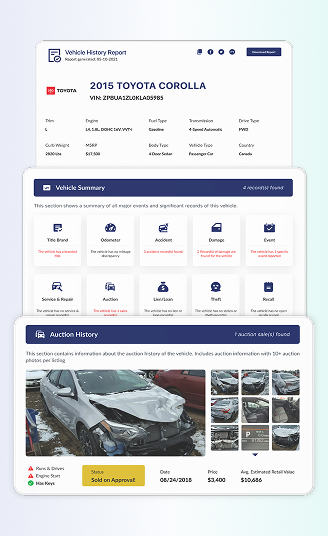
A VIN check looks for records filed under the VIN, such as title events, reported damage, mileage readings and recall notices. It reports what is available and reads as a snapshot. Few entries can mean a quiet history or a thin paper trail, and the two look the same. Open recalls are worth checking separately with the manufacturer or NHTSA, because status can change after any report is generated. See how to check for a recall by VIN.
Step 5: Verify what records cannot show
Records do not tell you the condition of the vehicle or who legally holds title. For that:
- Title and liens. Ask for the title and check its status with the state titling agency. A lienholder can confirm a loan.
- Mileage. Federal law generally requires an odometer disclosure when ownership transfers. Compare the disclosure with the readings in the records and with the wear on the vehicle.
- Dealer paperwork. Dealers selling used vehicles are generally required to post a Buyers Guide that states whether the vehicle is sold as is or with a warranty.
- Inspection. A qualified mechanic, with a body-shop opinion if damage is suspected, is the only step that looks at the vehicle itself.
The limits of a history report are set out in full on their own page.
How far to go
| Your situation | A sensible depth |
|---|---|
| You only want to know what a vehicle is | Step 2 |
| You are checking that a listing's description is plausible | Steps 1 to 3 |
| You are about to buy | All five. The price of a mistake is much larger than the cost of the checks. |
| The vehicle was built before 1981 | Start with classic car VINs. Records are often sparse, so paperwork and inspection carry more weight. |
| The vehicle comes from another country | Identifier formats and available records differ. See coverage. |
Not sure which tool matches a question? See which tool you need.
An illustrative walk-through
This example is invented and does not describe a real vehicle. A listing describes a pickup with a V8 and a premium trim. The decode returns a six-cylinder engine and a lower trim. That does not prove the listing is wrong, because a decode can be limited by how the manufacturer codes its VINs, but it is a question to put to the seller. The seller says the engine was swapped. The VIN check shows no entry about it, which is expected, because most engine swaps are never recorded anywhere. The title and the inspection are now the evidence that matters: does the title match the VIN, and does an inspector find a swap that was done properly?
No single step settled it. Each one changed the question the next had to answer.
When the sources disagree
A decode, a sticker, a report and a seller will sometimes tell different stories. Do not average them or assume the most official-looking one is right. Treat each disagreement as a specific question, and put it to the seller, the titling agency or an inspector.
Sources and basis
- 49 CFR 565.13, VIN requirements: where the VIN is placed on cars and light trucks
- NHTSA recall lookup: nhtsa.gov/recalls
- Federal odometer disclosure and used-car Buyers Guide requirements: general statements to be confirmed against the statute and the FTC rule before publishing