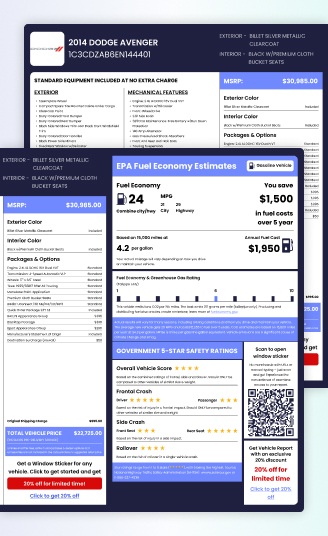

Original vs Reconstructed Window Sticker: What Is the Difference?
When someone asks for a window sticker by VIN, they can mean two different things. One is a label that was fixed to a specific new vehicle before it reached a dealer. The other is a document put together later from the data that exists for that vehicle’s year, make, model and trim. They look alike and cover similar ground, but they are not the same thing, and the gap between them matters if you are going to rely on one. |
The original is a federally required label, issued by the manufacturer for one particular delivery. A reconstructed sticker is a sticker-style document rebuilt from available data. It can show configuration and pricing information that fits the vehicle, but it cannot reproduce details that belonged to the original delivery, and it is not a record issued by the manufacturer.
What the original label is
The original is often called the Monroney label, after the senator who sponsored the Automobile Information Disclosure Act of 1958. The Act is codified at 15 U.S.C. 1231 to 1233. It requires the manufacturer of a new automobile to fix a label to the windshield or a side window before the vehicle is delivered to a dealer. The statute defines an automobile as a passenger car or station wagon, although manufacturers commonly label light trucks and SUVs in the same way.
The entries the statute requires are tied to that one vehicle and that one delivery:
- the make, model and serial or identification number
- the final assembly point
- the dealer the vehicle is delivered to, and where the dealer is located
- the city or town of delivery
- the method of transportation, if the vehicle was driven or towed from the assembly point
- the manufacturer’s suggested retail price
- the suggested delivered price for each accessory or item of optional equipment physically attached when the vehicle reached the dealer, where that item is not already in the base price
- the amount charged the dealer for transportation, and the total of the amounts above
Safety-rating information from the federal New Car Assessment Program is also part of the statute. Other federal rules add fuel-economy information and, under the American Automobile Labeling Act, parts-content details such as the final assembly point and the country of origin of the engine and transmission. That is why the label on a modern vehicle carries more than the 1958 statute alone requires.
Section 1233 makes it an offense to remove or alter the label, or make it illegible, before the vehicle is delivered to the buyer. After the sale it belongs to the owner, who can keep it or throw it away.
What the original label is not
Several other documents get mistaken for it:
| Document | Created by | Applies to | What it shows |
|---|---|---|---|
| Original Monroney label | The vehicle manufacturer | One new vehicle, at delivery to a dealer | Suggested price, factory and delivered options, transportation charge, assembly point, dealer, plus fuel economy, safety ratings and parts content |
| Dealer addendum sticker | The dealer | A vehicle on that dealer's lot | Items and prices the dealer added, such as accessories or protection packages. It is dealer information and is separate from the federal label. |
| Used-car Buyers Guide | The dealer, as required by an FTC rule for used vehicles | A used vehicle offered for sale | Whether the vehicle is sold as is or with a warranty, plus a list of major systems and common problems. It carries no option or price history. |
| Build Sheet | Depends on the source | A vehicle's configuration | A separate document. See How a Build Sheet differs from a Window Sticker. |
| Reconstructed Window Sticker | PremiumVIN, from available data | A vehicle identified by its VIN | A sticker-style document built from available configuration data, described below |
Why the original is often hard to find
The law requires the label to be put on the vehicle. The statute does not describe a public archive of copies. In practice, the original is the paper or film attached to the car, and it goes wherever the car and its owner go. People throw it away, a windshield gets replaced, a vehicle changes hands several times, or the car was never sold new by the current seller. A used vehicle for sale today usually has no label with it. This is the gap a reconstructed document is meant to fill. Some manufacturers or dealers may be able to supply a copy of an original for certain vehicles, and availability varies by manufacturer and model year.
What reconstructed means on PremiumVIN
PremiumVIN generates a reconstructed Window Sticker using available vehicle configuration and sticker-related data. The document may include information such as trim, MSRP, options, packages and colors where available. It is not necessarily the original factory-issued sticker, and the information included depends on the records available for the vehicle.
PremiumVIN is not a manufacturer archive and does not hold a copy of every original label. The product starts from the VIN, uses what can be decoded from it (see what a VIN encodes), and combines that with available data for the year, make, model and trim. Where the data supports it, the document may also show fuel economy, safety ratings and warranty information. It is built to answer one question: what factory configuration and sticker-related information can be reconstructed for this vehicle?
The full method and the kinds of data behind a document are described on the methodology page.
Where a reconstruction can and cannot match the original
Whether a reconstruction can match a given line of the original depends on whether that line is a fact about the vehicle’s configuration or a fact about one delivery.
| Line on the original | Can a reconstruction cover it? | Why |
|---|---|---|
| Model year, make, model, engine and body details | Usually, where the VIN and available data support it | These are specifications that can be decoded or looked up for the vehicle |
| Trim, packages, factory options and colors | Where supported | They come from configuration data for the year and model. Coverage varies by vehicle and may be incomplete. |
| Suggested retail price | Where supported | A price built from configuration data may not equal the original total if any option is missing |
| Fuel economy and safety ratings | Where available | These are published for a model and configuration, not for an individual vehicle |
| Warranty details | Where supported | They follow the manufacturer's terms for that model year, not the history of one vehicle |
| Dealer name and location, delivery city, method of transport, transportation charge | No | These belong to one delivery and cannot be derived from a VIN or from model-level data |
| Accessories attached after the factory but before delivery | Unlikely | The statute prices them on the label as delivered items, and they may not be in configuration data at all |
| Changes made after the sale | No | Nothing on either document tracks them |
The lower rows are the ones that trip people up. A reconstruction can be right about what a vehicle left the factory as, and still be silent about where it was sent, what it cost to ship, or what a dealer bolted on.
What neither document proves
A reconstructed sticker does not prove that a vehicle still has its original equipment. It does not show that the vehicle has not been modified, repainted or repaired, and it does not verify originality or matching numbers. It does not show that every option or package listed is complete, and it should not be read as manufacturer-verified. The original label has limits too: it describes the vehicle on the day it was delivered to the dealer and nothing after that.
For accident, title and other past events, a sticker is the wrong document. Those come from records, not configuration. See what a vehicle history report cannot show for the boundary.
When the difference matters
Checking a listing
A seller advertises a package, a color or an engine. A reconstructed document lets you compare the claim against what the vehicle’s year, trim and VIN support. Treat a mismatch as a question to ask, not as proof of a problem.
Reading an MSRP
The figure is the manufacturer’s suggested price for that configuration. It is not what anyone paid, and it excludes dealer additions that appear on an addendum sticker.
Trying to find the original
If you need the actual label, for example for a collectible vehicle, a reconstruction is a stand-in. Ask the seller whether the original is still with the vehicle, and ask the manufacturer or an authorized dealer whether a copy can be provided.
How to check a reconstructed document yourself

Step 1: Confirm the VIN
Confirm the VIN on the vehicle matches the VIN used. See where to find the VIN.

Step 2: Compare the details
Compare the engine, body style and model year with what the VIN decoder returns.

Step 3: Physical walkaround
Walk around the vehicle and match visible options, wheels and colors with the document.
Step 4: Check the paperwork
Ask for the original label, the window-sticker copy or the sales paperwork if it exists.
Step 5: Investigate discrepancies
If a field is missing or looks wrong, see why vehicle data may be missing or incorrect.
Common questions
Is a reconstructed sticker the label required on new vehicles?
No. The label required by law is the one the manufacturer attaches to a new vehicle. A reconstructed document is an information document and is not a replacement label.
Can I show it to a buyer?
You can share it as a reference, as long as it is described as a reconstructed document and not presented as the original.
Does the original show what the dealer paid?
No. The statute covers the manufacturer’s suggested price, the suggested delivered price of options and the transportation charge to the dealer, not the dealer’s cost.
Why does my reconstructed sticker have fewer options than I expected?
Configuration data is not complete for every vehicle, and items added after the factory may not be recorded. See the Window Sticker page for what a document can include, and missing fields explained.
Sources and basis
- 15 U.S.C. 1231, Definitions: the term automobile
- 15 U.S.C. 1232, Label and entry requirements: when and where the label is affixed, required entries, safety-ratings information
- 15 U.S.C. 1233, Violations and penalties: removal, alteration or illegibility of the label