

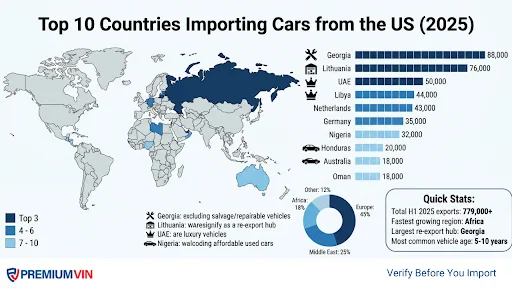
The United States remains one of the world’s largest exporters of vehicles, especially used and salvage cars. In 2025, global demand for affordable transportation, repairable vehicles, and luxury imports continues to drive strong export growth.
According to recent industry data, over 779,000 vehicles were exported from the U.S. in the first half of 2025 alone—representing a significant year-over-year increase and positioning the U.S. as a dominant force in the global used vehicle market.
In this market insight article, we break down:
- Top 10 countries importing cars from the U.S.
- Import volumes and year-over-year trends.
- Popular vehicle types by destination.
- Average vehicle age for each market.
- Regional trends shaping global demand.
We’ll also explain how buyers in each country can verify vehicle history before importing—and why that matters for avoiding costly mistakes.
Why Countries Import Cars from the United States
Global demand for U.S. vehicles isn’t accidental. Several economic and practical factors drive this trend, one of which is the lower price compared to a local vehicle.
Lower Prices Compared to Local Markets
Surprisingly, a used car imported from the U.S. is cheaper than a used car within the country. This is one of the reasons why plenty of used car sellers prefer imported cars from the US due to its cheap price and high demand.
Access to Affordable Used Cars
Vehicles in the U.S. tend to depreciate faster than in many countries. A car that holds significant value in Germany or Japan may be available at a fraction of the cost in the U.S. used market. This depreciation gap creates lucrative opportunities for international buyers.
Availability of Auction Vehicles
Many exported cars come from insurance auctions (Copart, IAAI, Manheim), where they are sold at significantly reduced prices. Salvage and repairable vehicles, in particular, attract buyers who have the skills and resources to restore them for local resale.
Wide Variety of Vehicles
As we all know, the U.S. has plenty of vehicle choices, from a regular car to a big truck. For most people, owning that kind of vehicle is interesting. In addition, a luxury car is sometimes priced lower when it is in the state; hence, people love looking for a used luxury car from the state.
Strong Supply of SUVs and Pickup Trucks
The U.S. market offers an unmatched selection of SUVs and pickup trucks—vehicle categories that are in high demand globally, especially in markets where American trucks are considered premium or aspirational.
Luxury Cars at Competitive Prices
Premium brands like BMW, Mercedes-Benz, Audi, and Lexus are often significantly cheaper in the U.S. used market compared to other regions. Buyers in Europe, the Middle East, and Asia can source luxury vehicles at substantial discounts.
Access to Vehicle History Data
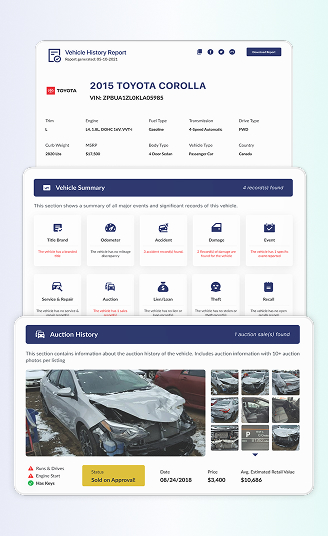
Unlike many other markets, the U.S. has a transparent vehicle history ecosystem. Buyers can verify accident history, title status, and mileage using tools like PremiumVIN before purchasing a vehicle—reducing risk and enabling informed decisions.
VIN Checks Before Importing
You can use our VIN Check tool to help you run a quick background check and secure the vehicle history report to see its actual condition. You can check the accident history, auction records, damage check, and many more.
Top 10 Countries Importing Cars from the US in 2025
Based on recent shipment data, these countries represent the largest destinations for U.S. vehicle exports.
Summary Table: Top 10 Importing Countries
| Rank | Country | Import Volume (2025) | Primary Vehicle Types | Avg. Vehicle Age |
|---|---|---|---|---|
| 1 | Georgia | 88,000+ | Salvage, repairable, auction vehicles | 5-10 years |
| 2 | Lithuania | 76,000+ | Damaged, repairable, European resale | 5-10 years |
| 3 | United Arab Emirates | 50,000+ | Luxury, performance, salvage | 3-8 years |
| 4 | Libya | 44,000+ | Used daily drivers | 8-12 years |
| 5 | Netherlands | 43,000+ | Diverse, European distribution | 5-10 years |
| 6 | Germany | 35,000+ | Specialty, American models | 3-7 years |
| 7 | Nigeria | 32,000+ | Sedans, compact SUVs | 8-15 years |
| 8 | Honduras | 20,000+ | Used sedans, compacts | 8-12 years |
| 9 | Australia | 18,000+ | Muscle cars, LHD conversions | 5-10 years |
| 10 | Oman | 18,000+ | Diverse, Middle East redistribution | 5-10 years |
1. Georgia
Georgia is at the top of the list of the top ten countries imported from the United States. Here are our reasons why:
Import Volume and Market Role
Georgia imported over 88,000 vehicles in 2025, making it the largest importer by volume. This small Caucasus nation has emerged as an unlikely giant in the global vehicle trade.
Why Georgia Imports So Many Cars
Georgia acts as a major re-export hub, distributing vehicles to Eastern Europe (Ukraine, Russia, Belarus) and Central Asia (Kazakhstan, Uzbekistan, Azerbaijan). Its strategic location, combined with favorable customs policies, makes it the gateway for vehicles entering the Eurasian Economic Union.
Typical Vehicle Types
- Salvage vehicles
- Repairable cars
- Auction vehicles (Copart, IAAI)
- Late-model SUVs and sedans
Vehicle History Verification
Given the high volume of salvage vehicles passing through Georgia, buyers should always run a title check and damage history report before purchasing. Many vehicles imported to Georgia are repaired locally before being re-exported.
2. Lithuania
Lithuania is Europe’s main gateway for U.S. vehicle imports, handling large volumes through Klaipėda. Many vehicles are processed, repaired, and redistributed across Europe, making it a key hub for resale and refurbishment.
Import Volume
Lithuania imported more than 76,000 vehicles from the U.S., making it Europe’s largest entry point for American vehicles.
European Re-export Hub
Similar to Georgia, Lithuania serves as a European redistribution center. Vehicles arrive at the port of Klaipėda, are processed and often repaired, and then distributed across Western and Eastern Europe.
Popular Imports
- Damaged and repairable vehicles.
- European-spec vehicles (often re-exported).
- American SUVs and trucks (rare in Europe).
- Auction vehicles requiring bodywork.
Vehicle History Verification
Lithuania is known for its skilled auto body repair industry. Buyers should verify before-damage photos and repair history to ensure vehicles are restored properly.
3. United Arab Emirates
The UAE is a major global hub for importing and redistributing vehicles, especially luxury and salvage units. Its strategic location supports trade across the Middle East, Africa, and Asia, with strong demand for high-end and discounted performance cars.
Import Volume
Over 50,000 vehicles were imported in 2025, cementing the UAE’s position as the Middle East’s premier vehicle trading hub.
Demand for Luxury and Salvage Cars
The UAE market is unique. It imports:
- Luxury vehicles (Rolls-Royce, Bentley, Mercedes-Maybach) for wealthy residents
- High-performance cars (Porsche, Ferrari, Lamborghini) are often available at steep discounts
- Salvage auction vehicles for repair and resale across the region
Regional Redistribution
Dubai and Sharjah serve as key hubs for exporting cars to Africa (Nigeria, Kenya, Ghana) and Asia (Pakistan, Bangladesh, Afghanistan).
Vehicle History Verification
The UAE salvage market is active. Buyers should verify flood damage, frame damage, and title status—flooded American cars sometimes end up in the UAE with undisclosed water damage.
4. Libya
Libya’s used car market is growing rapidly due to replacement demand after years of conflict. Imports focus on affordable, reliable vehicles, with buyers prioritizing practicality over luxury or performance.
Rapid Growth Market
Libya imported more than 44,000 vehicles, showing strong growth despite ongoing political instability. The country’s vehicle fleet was decimated during the years of conflict, creating sustained replacement demand.
Demand for Affordable Transportation
Most imports are used vehicles for daily use, not luxury or salvage. Libyan buyers prioritize affordability and reliability over prestige.
Typical Vehicle Types
- Japanese sedans (Toyota Camry, Honda Accord)
- Korean compacts (Hyundai Elantra, Kia Optima)
- American SUVs (Ford Explorer, Jeep Grand Cherokee)
Vehicle History Verification
With limited local vehicle history infrastructure, Libyan buyers rely heavily on U.S. VIN checks to verify odometer accuracy and title cleanliness.
5. Netherlands
The Netherlands plays a key role in Western Europe’s vehicle import network. With Rotterdam as a major entry point, vehicles are efficiently processed and distributed across nearby countries for resale and logistics operations.
Import Volume
Approximately 43,000 vehicles are imported, making the Netherlands a key entry point for vehicles destined for Western Europe.
European Logistics Hub
The port of Rotterdam (Europe’s largest seaport) handles a massive volume of vehicle imports. From there, vehicles are distributed across the continent.
Typical Vehicle Types
- Diverse mix (sedans, SUVs, trucks, luxury)
- Vehicles destined for European resale
- Occasionally salvage and repairable units
Vehicle History Verification
European buyers often use U.S. VIN checks to confirm that imported vehicles haven’t been flood-damaged or salvage-titled before incurring expensive shipping costs.
6. Germany
Despite its strong domestic auto industry, Germany imports a significant number of U.S. vehicles. These include specialty models, American muscle cars, and re-imported European brands that may offer better pricing due to market differences.
Strong Automotive Market
Germany imported over 35,000 vehicles from the U.S.—an impressive number given Germany’s own robust domestic auto industry.
Types of Vehicles Imported
- Specialty cars not available in the European market
- American models (Ford Mustang, Chevrolet Camaro, Dodge Challenger)
- Classic American cars for enthusiasts
- Military personnel vehicles returning with service members
Unique Market Dynamics
Ironically, some vehicles imported to Germany are European brands (BMW, Mercedes, Porsche) that were originally exported to the U.S. and are now being re-imported. These can be bargains due to currency exchange and depreciation differences.
Vehicle History Verification
German buyers (TÜV inspections are strict) must verify that imported vehicles meet European safety and emissions standards. A VIN check Germany helps confirm original specifications.
7. Nigeria
Nigeria is Africa’s largest importer of used vehicles, with strong demand driven by affordability needs. Most buyers focus on practical, older vehicles suitable for daily use, transport services, and long-term reliability.
Major African Importer
Nigeria imported more than 32,000 vehicles, making it Africa’s largest importer of U.S. used cars.
High Demand for Used Cars
Nigeria’s used car market is massive. Most imports are:
- Sedans (Toyota Camry, Honda Accord, Mercedes C-Class)
- Compact SUVs (Honda CR-V, RAV4)
- Affordable vehicles for personal and taxi use
Typical Vehicle Age
Most imported cars are 8-15 years old, reflecting affordability needs. Newer vehicles are too expensive for the average buyer; older vehicles offer the best value.
Vehicle History Verification
Nigeria has a history of importing flood-damaged and salvaged vehicles. Buyers should always run a flood check and title check before purchasing.
8. Honduras
Honduras is a growing player in Central America’s used car market. It imports affordable vehicles and also serves as a distribution point for neighboring countries, supporting regional demand for reliable transportation.
Growing Central American Market
Over 20,000 vehicles are imported, making Honduras a key player in the Central American used vehicle trade.
Popular Vehicle Types
- Used sedans
- Compact vehicles
- Japanese and American models
Regional Role
Honduras serves as a distribution point for neighboring countries, including El Salvador, Guatemala, and Nicaragua.
9. Australia
Australia imports fewer vehicles but focuses on high-value and specialty models. Demand centers on American muscle cars, trucks, and classics, often requiring modifications to meet local driving and compliance standards.
Import Volume
Around 18,000 vehicles imported modest volume but high-value content.
Demand for Specialty Vehicles
Australia’s unique import market focuses on:
- American muscle cars (Mustang, Camaro, Challenger)
- Left-hand drive conversions (Australia drives on the left)
- Trucks and SUVs not available locally
- Classic American vehicles for collectors
Unique Challenge
Australia has strict import regulations, including left-hand drive conversion requirements for vehicles under 30 years old. Buyers must verify that conversion is possible before purchasing.
10. Oman
Oman is an emerging vehicle import market in the Middle East, benefiting from regional trade networks. It receives a mix of vehicles, often routed through neighboring hubs, supporting both local demand and redistribution.
Emerging Market
Oman imported approximately 18,000 vehicles, establishing itself as an important secondary market in the Middle East.
Regional Trade Role
Oman is connected to broader Middle Eastern vehicle redistribution networks, often receiving vehicles that pass through UAE ports first.
Vehicle Types
- A diverse mix similar to the UAE
- Both luxury and economy vehicles
- Salvage and clean-title units
Global Trends in US Car Exports
Understanding these trends helps explain why certain countries dominate imports—and where future growth will occur.
Europe Leads in Import Volume
Europe dominates U.S. vehicle imports due to its strong logistics network, skilled repair industry, and high demand for American models. Several countries act as entry points, processing and redistributing vehicles across the region efficiently.
Largest Regional Market
Europe, specifically Georgia, Lithuania, the Netherlands, and Germany accounts for the largest share of U.S. car exports. The combination of re-export hubs, skilled repair industries, and strong demand for American vehicles drives this dominance.
Why European Demand Remains Strong
- Favorable import duties in some countries
- Skilled labor force for vehicle repair
- Proximity to multiple consumer markets
- Currency exchange advantages
Africa Shows Fastest Growth
Africa is seeing the fastest growth in U.S. vehicle imports, driven by rising demand for affordable transportation. Expanding infrastructure and a growing middle class continue to fuel imports across several key countries in the region.
Rapid Increase in Demand
Countries such as Nigeria, Ghana, Kenya, and South Africa are experiencing rapid growth in U.S. vehicle imports, reflecting increased demand for used and affordable cars.
Drivers of African Demand
- A growing middle class is seeking personal vehicles
- Limited local auto manufacturing
- Rising importation infrastructure (ports, logistics)
- Price sensitivity favors cheaper U.S. used cars
Middle East as a Trade Hub
The Middle East plays a strategic role in global vehicle trade, acting as a bridge between continents. Countries in this region import, process, and redistribute vehicles to surrounding markets, increasing overall trade efficiency and reach.
Re-export and Redistribution
The United Arab Emirates and Oman function as major redistribution hubs, exporting vehicles to Africa, South Asia, and neighboring Middle Eastern markets after initial import and processing.
The Dubai Effect
Dubai stands out as a global logistics hub. Its advanced infrastructure and business-friendly policies make it a primary gateway for vehicles entering and moving across the Eastern Hemisphere.
Asia and Latin America: The Next Frontiers
Asia and Latin America remain emerging markets for U.S. vehicle imports. While current volumes are lower, improving regulations and logistics are expected to unlock strong growth potential in the coming years.
Untapped Potential
Countries such as Chile, Peru, and the Philippines are expected to see increased import volumes as trade barriers ease and vehicle demand continues to rise.
What Types of Cars Are Exported from the US
The mix of exported vehicles depends on regional demand, pricing, and local regulations. However, several key categories consistently dominate U.S. car exports, ranging from affordable daily drivers to high-end luxury vehicles and repairable units.
Used Vehicles (Clean Title)
Clean-title used vehicles make up the largest share of exports. These cars are typically affordable, reliable, and ready for immediate use, making them highly attractive in markets where cost and practicality are top priorities.
Affordable High-Mileage Cars
The largest category by volume includes used vehicles with clean titles but higher mileage. They offer strong value, dependable performance, and are often preferred for daily transportation in cost-sensitive markets.
Popular Models for Export
These are the popular models of exported cars from the United States to other countries.
- Toyota Camry, Corolla, RAV4
- Honda Accord, Civic, CR-V
- Ford F-150, Explorer
- Jeep Grand Cherokee, Wrangler
- BMW 3 Series, X5
Salvage and Rebuilt Vehicles
Salvage and rebuilt vehicles are widely exported due to their low purchase cost. Many are repaired in destination countries, where labor is cheaper, and then resold for profit in local markets.
Insurance Auction Cars
Salvage vehicles from auctions like Copart and IAAI form a major export segment. These vehicles often require repairs but can be restored and resold competitively.
Why Salvage Vehicles Are Exported
- Purchase price is a fraction of retail
- Repair costs are lower in destination countries
- Skilled labor is available for bodywork and mechanical repairs
- Profit margins can be substantial
Luxury and Performance Cars
Luxury and performance vehicles are popular exports due to favorable pricing in the U.S. market. Buyers abroad can access premium brands at lower costs compared to local markets, especially in the used segment.
Premium Vehicles at Lower Prices
Luxury brands (Mercedes-Benz, BMW, Audi, Lexus, Porsche) are significantly cheaper in the U.S. used market. Export buyers can acquire high-status vehicles at discounts unavailable in their home markets.
Popular Luxury Exports
- Mercedes-Benz S-Class, GLE, G-Wagen
- BMW 7 Series, X7, M models
- Porsche 911, Cayenne, Panamera
- Range Rover, Land Rover
- Lexus LX, LS
Trucks and SUVs
Trucks and large SUVs are a standout export category due to their size, capability, and limited availability in many regions. These vehicles are especially valued for utility, status, and off-road performance.
American Exclusives
Models like Ford F-150, Ram 1500, and Chevrolet Silverado, along with SUVs like Chevrolet Suburban and Ford Expedition, are uniquely American and widely exported.
Where Trucks Are Most Popular
American trucks have their own market, as it is known to be durable in different terrains. For instance, in the middle of the day, people tend to purchase an American truck due to its ability to be driven in a rough, sandy terrain.
- Middle East (UAE, Saudi Arabia, Oman)
- Australia (converted to RHD)
- Europe (as novelty or work vehicles)
- Africa (as rugged transport)
Average Age of Imported Vehicles
The age of exported vehicles varies depending on market demand, affordability, and local regulations. While some regions prefer newer models, many rely on older vehicles due to lower costs and wider availability.
Why Older Cars Are Exported
Older vehicles dominate export markets because they offer strong value at a lower cost. With most depreciation already absorbed, they become accessible options for buyers in regions where affordability is the primary concern.
Depreciation Advantage
Older vehicles have already gone through most of their depreciation, allowing export buyers to purchase them at significantly lower prices—often 80 to 90 percent below their original MSRP.
Lower Acquisition Cost
A 10-year-old vehicle may cost between $5,000 and $10,000 at U.S. auctions, while a 3-year-old model can range from $20,000 to $30,000. For many markets, older vehicles remain the most practical choice.
Age Range by Market
Vehicle age preferences vary by region based on income levels, import policies, and usage needs. Some countries favor newer vehicles, while others rely heavily on older models that balance affordability, durability, and availability.
| Market Segment | Typical Age Range | Rationale |
|---|---|---|
| Wealthy Markets (UAE, Germany, Australia) | 3-8 years | Buyers want newer, lower-mileage vehicles |
| Re-export Hubs (Georgia, Lithuania) | 5-10 years | Balance between price and condition |
| African Markets (Nigeria, Libya) | 8-15 years | Price sensitivity; older vehicles are affordable |
| Salvage Markets | 2-10 years | Insurance auctions include all ages |
How Age Affects Import Decisions
Vehicle age directly influences pricing, condition, duties, and resale potential. Buyers weigh these factors based on budget and market needs, choosing between newer reliability, mid-range value, or older affordability, depending on their priorities.
Newer Vehicles (0-5 years)
- Best value balance.
- Moderate purchase price.
- Reasonable remaining useful life.
- Most common export category.
Older Vehicles (11-15+ years)
- Lowest purchase price.
- May have limited remaining life.
- Parts availability challenges.
- Popular in price-sensitive African markets.
Why You Should Check Vehicle History Before Importing
Importing a vehicle without checking its history exposes buyers to serious financial and legal risks. A simple VIN check can reveal hidden issues that are not visible in photos or listings, helping you avoid costly mistakes.
Common Risks for Import Buyers
Used vehicles can carry hidden problems that are not disclosed by sellers, especially in cross-border transactions. Understanding these risks helps buyers avoid unexpected repairs, legal complications, and long-term losses after the vehicle arrives.
Hidden Accident Damage
A vehicle may have been in a major accident that was repaired poorly or not disclosed. Without a history check, buyers may discover frame damage or structural issues only after the vehicle arrives too late to reverse the transaction.
Odometer Rollback
Mileage fraud is common. A vehicle advertised with 60,000 miles might actually have 160,000. A VIN check reveals recorded mileage from inspections, service records, and title transfers.
Salvage and Rebuilt Title Issues
Some vehicles have salvage or rebuilt titles that were “washed” by moving to a different state. Buyers who unknowingly import a salvage vehicle may face registration problems, insurance denials, and significant value loss.
Flood Damage
Flood-damaged vehicles (especially from hurricanes) are often cleaned up and exported without disclosure. Flooded cars develop electrical problems, mold, and corrosion that appear months later.
Outstanding Liens
If a vehicle has an active loan, the lender has a legal claim. The buyer could lose the vehicle and their money if the lien isn’t satisfied before export.
How to Verify a Vehicle Before Purchase
Verifying a vehicle before import is essential to reduce risk. A reliable VIN check provides access to critical records, allowing buyers to confirm the vehicle’s condition, legal status, and history before committing to a purchase.
Run a Comprehensive VIN Check
Before purchasing any vehicle for export, buyers should use PremiumVIN to check:
- Title status (clean, salvage, rebuilt, flood)
- Accident history (reported collisions and damage)
- Odometer records (mileage over time to detect rollback)
- Ownership history (number of owners, rental/fleet use)
- Lien status (outstanding loans)
- Theft records (stolen vehicle reports)
- Auction photos (condition before repairs)
Review Before-Damage Photos
For salvage vehicles, auction photos (Copart, IAAI) show the vehicle’s condition at the time of total loss. These images are invaluable for assessing repair difficulty and cost.
Verify Title Authenticity
Ensure the title is genuine and not forged. Cross-check the VIN on the title with the VIN on the vehicle.
Work with Reputable Exporters
Established export companies have processes for verifying vehicle history. However, always run your own independent check—don’t rely solely on the exporter’s report.
Market Outlook: US Car Exports in 2025 and Beyond
U.S. car exports are expected to grow steadily, supported by strong global demand and competitive pricing. Expanding logistics networks, wider access to auction platforms, and improved data transparency continue to make cross-border vehicle sourcing more accessible for buyers worldwide.
Continued Growth Expected
Industry analysts project continued growth in U.S. vehicle exports through 2025 and beyond, driven by:
- Persistent price advantages in the U.S. market
- Growing demand in Africa and Southeast Asia
- Expansion of salvage auction platforms internationally
- Increasing transparency through VIN check tools
Emerging Markets to Watch
New regions are opening up to U.S. vehicle imports, creating fresh opportunities for exporters. As regulations ease and infrastructure improves, several markets are expected to see faster growth in both demand and import volume.
Southeast Asia
Countries like the Philippines, Vietnam, and Indonesia are opening their used vehicle import markets. U.S. exports to these nations are expected to grow significantly.
South America
Chile, Peru, and Colombia have established used car import channels. As economic conditions improve, volume is likely to increase.
Eastern Europe
Beyond Georgia and Lithuania, countries like Ukraine, Poland, and Romania are seeing rising imports due to demand for affordable used vehicles.
Challenges Ahead
Despite strong growth, exporters face ongoing challenges that can impact profitability and volume. Regulatory shifts, logistics costs, and currency fluctuations all play a role in shaping the future of U.S. vehicle exports.
Regulatory Changes
Import regulations can change quickly, including stricter limits on vehicle age, emissions standards, and safety requirements. Exporters must stay updated to ensure compliance and avoid delays or rejected shipments.
Shipping Costs
Ocean freight rates can vary significantly depending on global conditions. When shipping costs increase, the overall price advantage of U.S. vehicles may decrease, affecting demand in price-sensitive markets.
Currency Exchange
Exchange rate fluctuations directly affect affordability. A strong U.S. dollar can make exported vehicles more expensive for international buyers, while a weaker dollar can improve competitiveness and drive higher demand.
Conclusion
The global demand for U.S. vehicles continues to grow, driven by affordability, variety, and access to reliable vehicle data.
Countries like Georgia, Lithuania, and the UAE dominate imports due to their roles as distribution hubs, while regions like Africa show rapid growth in demand for used vehicles. Europe remains the largest regional market, and emerging markets in Southeast Asia and South America represent the next frontier.
For international buyers, the key to success is due diligence. Before purchasing any vehicle for export:
- Run a comprehensive VIN check (title, accidents, mileage, liens)
- Review auction photos (for salvage vehicles)
- Verify local import regulations (age limits, duties, conversions)
- Work with reputable exporters
At PremiumVIN, we make vehicle history verification easy for international buyers. With just a VIN, you can access:
- Complete title history
- Accident and damage records
- Odometer verification
- Ownership history
- Lien and theft checks
- Auction photos (where available)
Ready to import a vehicle from the US? Start with a VIN check at PremiumVIN and buy with confidence.
Frequently Asked Questions About Imported Cars from the US
Which country imports the most cars from the US?
Georgia leads in total volume, importing more than 88,000 vehicles in 2025. However, it mainly acts as a re-export hub, distributing vehicles to Eastern Europe and Central Asia rather than keeping them for domestic use.
Why are US cars exported worldwide?
U.S. vehicles are exported globally due to several key advantages:
- Lower prices from rapid depreciation
- Large supply of used vehicles
- Access to detailed history records through VIN checks
- Unique vehicle types like full-size trucks and muscle cars
What types of cars are most exported?
The most exported categories are:
- Used vehicles (clean title, higher mileage)
- Salvage vehicles (insurance auctions)
- Luxury and performance cars (cheaper than in other markets)
- Trucks and SUVs (unique to the American market)
How can I check a vehicle's history before importing?
Use a VIN check service like PremiumVIN to verify:
- Title status (clean, salvage, rebuilt, flood)
- Accident and damage history
- Odometer readings (detect rollback)
- Ownership records
- Lien status
- Theft records
What is the average age of exported US vehicles?
The average age varies by destination:
- Wealthy markets: 3-8 years
- Re-export hubs: 5-10 years
- African markets: 8-15 years
Is it safe to buy a salvage vehicle for export?
It can be, but only with thorough due diligence. Verify:
- Original damage severity (via auction photos)
- Repair costs and feasibility
- Title status (salvage vs. rebuilt)
- Local registration requirements
Which countries have the fastest-growing import markets?
African countries (Nigeria, Ghana, Kenya) show the fastest growth, followed by Southeast Asian nations (Philippines, Vietnam, Thailand) and South American markets (Chile, Peru).
Do I need to pay import duties on US vehicles?
Yes. Every country has its own import duty structure, often based on:
- Vehicle age
- Engine size
- Vehicle value
- Country of origin
Research your destination country’s import regulations before purchasing.
Can I import a vehicle from the US without visiting?
Yes. Many international buyers work with export agents who inspect vehicles, handle paperwork, and arrange shipping. However, always run your own independent VIN check—don’t rely solely on the agent’s report.
How has the US used car export market changed in 2025?
Key changes in 2025 include:
- Higher volumes (779,000+ vehicles in H1 2025)
- More salvage exports as repair capacity expands globally
- Increased transparency through VIN check adoption
- New markets opening in Southeast Asia and South America