


Before buying a used camper, identify the correct vehicle identification number (VIN) and compare it with the number recorded on the title and registration documents. A number copied from the wrong label, a missing digit, or a mismatch between the vehicle and its paperwork can complicate a purchase and make a VIN search unreliable.
The first step is understanding what type of camper you are checking. A motorhome, travel trailer, fifth wheel, and folding camper do not necessarily display their identification numbers in the same place. Motorhomes can also have a chassis VIN and a separate manufacturer-assigned unit serial number.
This guide explains where to look, which identifiers to compare, how to recognize common inconsistencies, and what a VIN lookup can and cannot tell you about a used camper.
Identify the Camper Type Before Looking for Its VIN
The term camper can describe several different vehicle configurations. The identification process depends partly on whether the living space is built onto a powered chassis or is designed to be towed.
| Camper type | Vehicle configuration | Identification point to investigate |
|---|---|---|
| Class A motorhome | Motorized recreational vehicle built on a heavy-duty chassis | Chassis VIN plate or label, plus manufacturer documentation |
| Class B camper van | Converted van or purpose-built motorized vehicle | Base-vehicle VIN and any separate conversion documentation |
| Class C motorhome | Motorhome built using a truck or cutaway chassis | Chassis VIN and RV manufacturer identification label |
| Travel trailer | Towable recreational vehicle | Trailer VIN plate or frame stamping |
| Fifth wheel | Towable RV connected through a fifth-wheel hitch | Trailer VIN plate or frame stamping |
| Folding or pop-up camper | Collapsible towable camper | Manufacturer identification label and frame area |
Do not assume that the brand name printed on the camper body identifies the company that manufactured the chassis. In a motorhome, the chassis supplier and the RV body manufacturer may be different businesses.
That distinction matters when you compare the VIN with manufacturer records or ask for replacement identification documentation.
Where to Find a Camper VIN
There is no single VIN location that applies to every camper. Check the vehicle itself and its original documents rather than relying on one expected position.
Motorhomes and camper vans
Start with these areas:
- Driver-side dashboard: Look through the windshield for a VIN plate visible from outside.
- Driver-side door area: Inspect the door frame or door jamb for a manufacturer label.
- Chassis identification plate: Check the chassis manufacturer’s designated identification location.
- RV certification label: Look for the recreational vehicle manufacturer’s label, which may contain a separate unit or serial number.
The chassis VIN is particularly important when identifying the powered vehicle. A separate RV manufacturer serial number may identify the coach, conversion, or completed recreational vehicle.
Travel trailers and fifth wheels
For a towable camper, inspect:
- The front exterior section, often near the roadside or driver-side area.
- The trailer frame or A-frame near the hitch.
- The manufacturer’s certification or identification label.
- The original documentation supplied with the trailer.
Some VINs are printed on labels, while others may be stamped into a structural part of the frame. The exact placement varies by manufacturer and model.
Folding and pop-up campers
Inspect the front frame, structural rails, and manufacturer identification label. If the number is not visible, consult the owner’s manual or contact the manufacturer with the model and production information.
Practical tip: Photograph the identification label and any frame stamping. Keep the images with the seller’s paperwork so you can compare the characters without repeatedly returning to the vehicle.
Understand the Difference Between a Chassis VIN and a Camper Serial Number
This is one of the most important distinctions when checking a motorhome.
A motorhome may involve two manufacturing stages:
- A chassis manufacturer produces the underlying vehicle platform.
- An RV manufacturer completes the motorhome by adding the living area, body, equipment, and interior systems.
The chassis VIN identifies the underlying motor vehicle. The RV manufacturer may assign another serial number to identify the completed unit or its production configuration.
These numbers do not automatically serve the same purpose.
For example, Grand Design’s Lineage motorhome documentation identifies a 17-character chassis VIN separately from a 14-digit motorhome unit serial number. This is a manufacturer-specific example, not a universal format for all RV brands.
When checking a motorhome:
- Record the chassis VIN separately.
- Record the RV manufacturer’s unit serial number separately.
- Identify which number appears on the title and registration.
- Ask the manufacturer which identifier applies to warranty, parts, service, or coach-specific records.
Do not enter a coach serial number into a VIN lookup simply because it appears on the same certification label. First establish whether it is actually the vehicle’s VIN.
How to Check Whether a Camper VIN Is Formatted Correctly
Many road vehicles manufactured under modern U.S. VIN requirements use a 17-character VIN. However, the 17-character rule should not be applied indiscriminately to every older camper or every manufacturer-assigned serial number.
For a vehicle using the standard U.S. 17-character VIN format, the characters have defined positions.
| VIN position | General purpose |
|---|---|
| 1–3 | World Manufacturer Identifier (WMI) |
| 4–8 | Vehicle attributes specified under the applicable VIN requirements |
| 9 | Check digit |
| 10 | Model-year code |
| 11 | Plant-of-manufacture code |
| 12–17 | Manufacturer-assigned production sequence, subject to applicable rules |
A few checks can help identify an obvious formatting problem:
- Count all 17 characters when the vehicle should have a standard 17-character VIN.
- Check for missing, unreadable, or substituted characters.
- Look for the letters I, O, and Q, which are not used in standard 17-character VINs.
- Confirm that the model-year code is consistent with the vehicle’s stated year.
- Compare the VIN on the vehicle with the VIN printed on its title and registration.
These checks can identify inconsistencies, but they do not authenticate a vehicle or prove that an identification plate has never been altered.
Once you have located the camper’s VIN, enter it into the PremiumVIN VIN Decoder to review available vehicle specifications, including year, make, model, and supported factory-encoded attributes. PremiumVIN supports recreational vehicles and campers, although decoded information can vary by vehicle age, manufacturer, and VIN format.
Compare the VIN With the Camper's Documents
A VIN check should begin with a direct comparison between the vehicle and its paperwork.
Use the following documents where available:
- Certificate of title
- Current registration
- Manufacturer’s certification label
- Purchase agreement or bill of sale
- Insurance documentation
- Original owner’s documentation
Compare the full VIN character by character. Do not rely on a partial match or assume that a one-character difference is merely a typing mistake.
Pay particular attention to:
The title: Confirm that the VIN printed on the title matches the vehicle identifier being used for the transaction.
The registration: Check whether the registration shows the same VIN as the title and vehicle.
The manufacturer’s label: Determine whether the label displays the chassis VIN, a unit serial number, or another manufacturer reference.
The seller’s documents: Make sure the seller is providing documentation for the same camper being inspected.
If a document shows a different number, pause the transaction until the discrepancy has been explained and resolved through the appropriate manufacturer or vehicle-registration authority.
What to Do if the Camper VIN Does Not Match
A mismatch does not automatically establish fraud, but it should not be ignored.
Possible explanations include:
- A transcription error in a document.
- Confusion between a chassis VIN and a coach serial number.
- A replacement label or component that requires supporting documentation.
- An older vehicle with a non-standard identification format.
- A damaged, unreadable, or missing identification plate.
- An unresolved vehicle identity or documentation problem.
The next step depends on where the mismatch occurs.
| Finding | Appropriate next step |
|---|---|
| One document contains a different character | Ask the issuing authority or seller for an explanation and corrected documentation |
| Chassis VIN and coach serial number are being confused | Contact the RV manufacturer to identify each number's purpose |
| VIN label is damaged or unreadable | Contact the manufacturer and the relevant vehicle-registration authority |
| Frame stamping differs from the visible label | Do not assume either number is correct; seek an official inspection or manufacturer guidance |
| VIN on the vehicle differs from the title | Pause the purchase until the discrepancy is resolved |
Never alter, restamp, or replace a VIN yourself. If the identifier appears damaged or suspicious, seek guidance from the appropriate authority rather than attempting to repair it.
What Can a Camper VIN Lookup Tell You?
Once you have identified the correct VIN, a lookup can help connect the camper to available vehicle information.
Depending on the vehicle and the records available, a lookup may help you investigate:
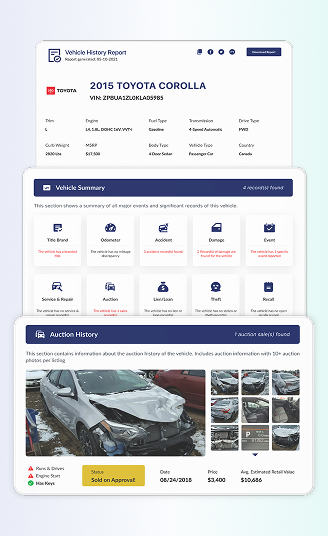
- Vehicle identity: Manufacturer, model year, and other decoded vehicle details supported by the VIN.
- Recorded title information: Available title brands or other reported title events.
- Accident and damage records: Historical records associated with the vehicle, where reported.
- Mileage information: Recorded mileage entries and possible inconsistencies, when available.
- Auction and sales records: Historical listings or transactions present in the available data.
- Other reported events: Additional records supported by the report’s data sources.
A VIN does not contain a complete history of a camper. It is an identifier used to connect a vehicle with records held by manufacturers, government agencies, insurers, auctions, and other data providers.
A lookup result is therefore dependent on the coverage and quality of those records. No result for an event does not prove that the event never happened.
For a camper or motorhome, you can use PremiumVIN’s RV VIN lookup to review available vehicle specifications and historical records associated with a supported VIN.
A VIN Check Does Not Replace a Physical Camper Inspection
A vehicle history search and a physical inspection answer different questions.
A VIN lookup can help investigate recorded events, but it cannot establish the camper’s present mechanical or structural condition.
Before buying, inspect areas that are particularly important to recreational vehicles:
- Roof and seams: Look for signs of water entry, previous sealing work, or visible deterioration.
- Walls and flooring: Check for soft areas, discoloration, swelling, and signs of moisture.
- Windows and storage compartments: Inspect seals and surrounding surfaces for evidence of leaks.
- Frame and underbody: Look for visible damage, corrosion, or signs of structural repair.
- Slide-outs and moving components: Check operation and inspect seals where fitted.
- Electrical and plumbing systems: Test the systems and ask for service documentation.
- Engine, transmission, and running gear: For motorhomes, arrange a mechanical inspection of the powered vehicle and relevant chassis components.
For a towable camper, also inspect the hitch, suspension, tires, brakes, and frame. A clean-looking exterior does not establish that these components are in good condition.
Where the purchase value or condition warrants it, arrange an independent RV inspection before completing the transaction.
Camper VIN Check Before Purchase: A Practical Checklist
Use this sequence when evaluating a used camper:
- Identify whether the camper is motorized or towable.
- Locate the VIN on the vehicle or trailer.
- Record any separate manufacturer-assigned serial number.
- Compare the VIN with the title and registration.
- Check that the identifier’s format is appropriate for the vehicle’s age and type.
- Investigate any mismatch before proceeding.
- Run a VIN lookup to review available specifications and historical records.
- Check for relevant recalls through the appropriate manufacturer or government source.
- Arrange a physical inspection of the camper and its mechanical systems.
- Confirm that the seller can provide the documentation required for the transaction.
This process reduces the risk of relying on the wrong identifier or overlooking a documentation problem.
Check the Camper's VIN Before You Buy
A reliable camper VIN check starts with identifying the correct number. For motorhomes, distinguish the chassis VIN from any separate RV manufacturer serial number. For towable campers, compare the frame or identification label with the title and registration.
Once the identifier is confirmed, use a lookup to investigate the specifications and historical records available for that vehicle. You can start with PremiumVIN’s RV VIN lookup, then combine the results with document checks and an independent physical inspection before making a purchase.
Frequently Asked Questions
Does every camper have a 17-digit VIN?
No. Many modern road vehicles use a 17-character VIN under U.S. requirements, but older vehicles may use different identification formats. A manufacturer-assigned serial number is also not necessarily a VIN. Confirm the correct identifier for the camper’s type and model year.
Where is the VIN on a camper?
The location depends on the vehicle. Motorhomes commonly display the chassis VIN near the driver-side dashboard or door area. Travel trailers and fifth wheels may display the VIN on an exterior label or frame stamping. Check the manufacturer’s documentation for the exact location.
Can a motorhome have two VIN numbers?
A motorhome can have a chassis VIN and a separate RV manufacturer serial number. These identifiers can refer to different parts or stages of the vehicle’s production. Confirm their purposes with the RV manufacturer rather than treating them as interchangeable VINs.
Is a camper serial number the same as its VIN?
Not necessarily. A serial number assigned by the RV manufacturer may identify the completed unit, coach, or production sequence. The chassis VIN identifies the underlying motor vehicle. Check the manufacturer’s documentation to determine which number is required for a particular search or record.
Can I check a camper VIN for accident history?
A VIN lookup may return accident or damage records when those events are present in the available data sources. Not every accident is reported to every database, so a missing record should not be interpreted as proof that the camper has never been damaged.
Can I use a motorhome's chassis VIN to check the RV?
The chassis VIN is the appropriate vehicle identifier for many motorhome-related searches. However, it may not identify every coach-specific component or manufacturer record. Keep the chassis VIN and RV unit serial number separate when contacting the manufacturer or reviewing documentation.
What if the VIN on the camper does not match the title?
Do not proceed as if the difference is harmless. Ask the seller for an explanation and contact the relevant vehicle-registration authority or manufacturer to establish the correct identification. A discrepancy should be resolved before the transaction.
Can a VIN lookup confirm that a camper is in good condition?
No. A VIN lookup can reveal available historical records and vehicle details, but it cannot confirm the camper’s current structural, mechanical, electrical, or plumbing condition. A physical inspection is still necessary.