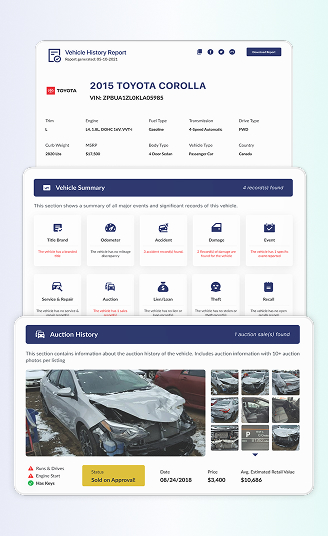

Freightliner Truck VIN Decoder Lookup & History Check
Free Freightliner VIN decoder and lookup tool. Check specs, build data, recalls, and basic history instantly. Need accident, mileage, or title records? Upgrade anytime for a full vehicle history.
What is the Freightliner VIN Decoder?
A Freightliner VIN number is the unique identification code assigned to every Freightliner truck. Most modern vehicles use a 17-character VIN made of letters and numbers, and the code stays with the vehicle throughout its life.
This VIN stores details about the truck’s manufacturer, engine configuration, model year, and assembly plant. It also connects the vehicle to history records like title changes, accidents, auctions, and mileage reports. Older trucks sometimes use shorter VIN formats because the 17-digit VIN standard became widely required after 1981.
Simply enter the number into the form above, and our Freightliner VIN decoder will decode Freightliner VIN data automatically and display the available records.
Key Specifications Revealed by Our Freightliner VIN Decoder
Using our Freightliner VIN number decoder gives you immediate access to the vehicle’s core factory build data. Here is the essential information you can uncover.
Year, Make & Model
Instantly confirm the exact production year, the Freightliner brand, and the specific model (e.g., Cascadia, M2, Columbia). This foundational check helps ensure the truck’s identity matches its paperwork.
Body Type
Understand the fundamental layout, confirming whether it’s a day cab, sleeper cab, or other configuration.
Engine Type & Capacity
The VIN often reveals information about the engine family used in the truck. This may include engine displacement, manufacturer information, and other technical data useful for maintenance planning.
Transmission
Transmission specifications help confirm the truck’s drivetrain setup. Buyers can compare this information with the seller’s description to ensure the configuration matches the factory build.
Trim
Some Freightliner trucks are produced with different trims or configuration packages depending on the fleet order or operational purpose. The report identifies these variations.
Fuel Type
Check the factory-specified fuel type, a fundamental operational detail for these heavy-duty vehicles.
Number of Doors
Confirm the number of doors the truck was built with, which is a key identifier for different cab configurations.
Estimated Market Value
View an estimated market value based on condition (outstanding, clean, average, rough), providing a useful benchmark for pricing and negotiation.
Freightliner VIN Breakdown: What Each VIN Character Means
A Freightliner VIN follows the international 17-character VIN format used by modern vehicles. Each character has a meaning. Together, they reveal where the truck was built, its technical configuration, and its production sequence.
The VIN is divided into three main parts: WMI, VDS, and VIS.
WMI (World Manufacturer Identifier)
The first three characters of the VIN form the WMI section. This code identifies the manufacturer and the region where the vehicle was produced. In the case of Freightliner trucks, the WMI usually indicates the manufacturer within Daimler Truck North America, the company that owns the Freightliner brand today.
WMI Character Meaning (Example Freightliner WMI: 1FU)
- Character 1 (1) – Country of manufacture (United States)
- Character 2 (F) – Manufacturer identifier (Freightliner brand under Daimler Truck North America)
- Character 3 (U) – Vehicle type classification used by the manufacturer
VDS (Vehicle Descriptor Section)
Characters four through nine form the Vehicle Descriptor Section. This part describes the truck’s physical configuration, including engine type, body style, and safety systems. Manufacturers use these characters to describe the vehicle’s technical characteristics.
VDS Character Meaning
- Character 4 – Vehicle model or chassis type
- Character 5 – Engine configuration code
- Character 6 – Body or cab design
- Character 7 – Safety system or restraint type
- Character 8 – Additional configuration code
- Character 9 – Check digit used to verify VIN accuracy
VIS (Vehicle Identifier Section)
The final eight characters form the Vehicle Identifier Section. This section identifies the individual vehicle within the production run. It usually includes the model year, assembly plant, and the truck’s unique serial number.
VIS Character Meaning
- Character 10 – Model year code
- Character 11 – Manufacturing plant code
- Characters 12–17 – Unique production sequence number assigned to that specific truck
Benefits of Using a Freightliner VIN Decoder
A Freightliner VIN decoder is a practical first step for anyone dealing with these heavy-duty trucks. From buyers and fleet managers to sellers and mechanics, accurate factory specifications provide a solid foundation for any transaction or maintenance.
Buying a used Freightliner truck is a big decision. Trucks work hard for many years, and sometimes their history is not obvious from appearance alone. A Freightliner VIN lookup helps buyers understand the truck’s past that can prevent expensive surprises later.
Confirm the Truck's Real Model and Year
Sometimes sellers list incorrect details about the truck model or production year. A Freightliner VIN number decoder verifies the exact year, model, and configuration recorded by the manufacturer.
Verify the Engine and Drivetrain
The VIN reveals the original engine configuration and transmission as built at the factory. This helps you spot mismatches between the seller’s claims and the truck’s true specifications.
Understand the Truck's Original Configuration
Knowing the factory build, including body type and optional equipment helps you assess the truck’s authenticity and compare it accurately to other vehicles.
For sellers and dealerships, transparency builds confidence. A Freightliner VIN lookup helps present clear documentation about the truck’s factory background.
Build Buyer Confidence
Displaying verified factory specifications in your listing shows transparency. This credibility often shortens negotiation time and can lead to a faster sale.
Set an Accurate Asking Price
Knowing the exact engine, transmission, and trim lets you justify your price with data, moving beyond rough market estimates.
Create Detailed, Accurate Listings
Using factory specifications allows you to write precise listings that attract serious buyers and reduce repetitive questions.
Accurate vehicle specifications are essential for insurance companies to price policies accurately and handle claims efficiently for these commercial assets.
Calculate Accurate Premiums
A VIN lookup confirms safety features, engine specs, and trim level—key factors that influence insurance premium calculations.
Reduce Fraud Risk
Verifying VIN details helps insurers catch mismatched or falsified vehicle information before a fraudulent policy is issued.
Streamline Claims Processing
An accurate factory data check reduces manual verification, speeding up new policy issuance and claims processing.
Knowing the exact factory specification is crucial for getting the right parts for a Freightliner. A VIN check removes all the guesswork.
Source the Exact Right Parts
The VIN identifies the specific engine, transmission, and chassis configuration, ensuring parts suppliers provide the correct components.
Eliminate Costly Return Mistakes
Ordering the wrong parts wastes time and money. Checking the VIN before ordering dramatically reduces mismatched components.
Write Faster, More Accurate Estimates
Mechanics can instantly access factory specs to build repair estimates without spending extra time manually researching each Freightliner’s exact configuration.
How to Use Our Freightliner VIN Decoder?
Getting your Freightliner VIN lookup results is a straightforward process, taking only a few seconds. Follow these simple steps.

Step 1: Enter the VIN
Enter the Freightliner's VIN into the form at the top of the page. Our tool supports both modern 17-character VINs and many classic shorter formats. You can also search using your license plate number instead.

Step 2: Decode Freightliner VIN Number
Click submit to instantly view the year, make, model, engine, trim, transmission, and more factory details. This basic VIN check is completely free.

Step 3: Upgrade to VIN Report
Buying a used Freightliner? Upgrade your search to get the full vehicle history report and reveal any hidden issues like accidents, title brands, and ownership records.
Where to Find Freightliner Vehicle Identification Number?
Finding the VIN is usually easy. Freightliner trucks display this number in several locations on the vehicle.
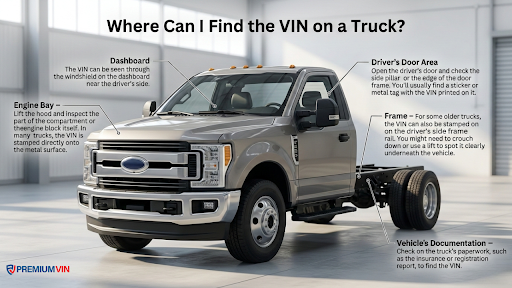
Dashboard
The VIN plate is often visible through the windshield on the driver’s side dashboard.
Driver Door Frame
A label inside the driver door frame usually contains the VIN and manufacturing information.
Engine Compartment
Some Freightliner trucks display VIN plates inside the engine compartment.
Vehicle Documents
Registration papers, insurance cards, and vehicle titles usually contain the VIN number as well.
Easily Decode ALL Freightliner Models
Freightliner offers a range of truck models, and the PremiumVIN Freightliner VIN decoder can decode VINs from all years and variants, including both modern and classic models. Here are some popular models frequently searched by owners.
CASCADIA
CASCADIA 113
CASCADIA 116
CASCADIA 125
CASCADIA 126
CLASSIC 120
COLUMBIA 120
CORONADO 122
CORONADO 132
FL 60
FL 70
FL 80
FLC
FLD 112
FLD 120
FS 65
HC 70
M-LINE
M2
M2 106
M2 112
MT 45
MT 55
S2 106
SPRINTER
ST 120
X-LINE
XC CHASIS
XC-M
XC-P
XC-R
Why Users Trust Our Freightliner VIN Decoder
Checking a VIN is about trust. Buyers want reliable information, and truck owners want accurate data about their vehicles. Our Freightliner VIN decoder focuses on delivering verified vehicle records that help people make better decisions.
Most comprehensive database coverage
Our VIN decoding system connects to multiple vehicle record databases and public records to gather detailed Freightliner history information.
High accuracy, cross-checked results
All VIN decoding results are cross-checked against verified sources to reduce errors and improve reliability.
Unlimited free checks
Users can run basic Freightliner VIN checks without restrictions before deciding whether to purchase a full report.
Daily data updates
Vehicle records are updated regularly, so users receive the most current available information.
Live Chat with VIN Expert
Customers can also speak with a VIN expert through live chat to better understand the report results.
Downloadable PDF
Users can download their Freightliner vehicle history report as a PDF file for future reference.
Free Freightliner VIN Decoder vs Vehicle History Report
Many websites offer a free VIN lookup. But most free tools only provide basic information. If you want deeper historical records, a full report becomes necessary.
| What You Can Check | Free Freightliner VIN Decoder (Quick Check) | Premium Freightliner Vehicle History Report (Full Report) |
|---|---|---|
| Freightliner year, model, and make | ✓ Confirms basic identity | ✓ Fully confirmed with production details |
| Basic Freightliner specs (engine, body, trim) | ✓ General specifications | ✓ Complete factory specifications |
| Title status (e.g., salvage, rebuilt, lemon) | Basic status hint only | ✓ Full title brand history |
| Accident history check | Not available | ✓ Detailed accident records when reported |
| Mileage and odometer records | Not available | ✓ Multiple recorded mileage entries |
| Odometer rollback/mileage inconsistency checks | Not available | ✓ Rollback flags and inconsistency alerts |
| Auction history and photos | Not available | ✓ Auction listings and images when available |
| Online listings and advertised sales | ✓ Current listing snapshot (when available) | ✓ Listings and advertised sales records |
| Timeline of previous listings and sales | Not available | ✓ Timeline of past listings and sale activity |
| Sales listings records & photos | Not available | ✓ Listing records and photos (when available) |
| Freightliner market value estimate | Not available | ✓ Value estimates and pricing ranges |
| Number of previous owners | Not available | ✓ Owner count (when available) |
| Past vehicle use (private, rental, fleet, commercial) | Not available | ✓ Use-type indicators when reported |
| Outstanding loans or lien records | Not available | ✓ Lien/loan flags when reported |
| Stolen vehicle check | Limited check | ✓ Detailed theft records if reported |
| Flood, fire, or hail damage indicators | Not available | ✓ Damage-event indicators when reported |
| Reported service or repair history | Not available | ✓ Service/repair records (when available) |
| Recall and warranty information | Limited overview | ✓ Recall history and basic warranty status |
| Downloadable PDF report | X Not included | ✓ Yes, easy-to-save PDF |
| Best suited for | Quick Freightliner VIN lookup and early screening | Buyers, sellers, collectors, and serious checks |
What You Gain from a Paid Freightliner VIN Report
A Freightliner VIN lookup already gives helpful information about a truck’s identity. But the PremiumVIN vehicle history report goes much deeper than a basic Freightliner VIN number decoder.
Once you run a VIN check, the system gathers data from multiple verified sources to build a complete truck history report. Below are some of the key sections included in the Freightliner VIN check report.
Vehicle Specifications
The vehicle specifications section is usually the first place where the Freightliner VIN decoder reveals meaningful information. By decoding the VIN structure, the report explains the truck’s factory configuration and build information.
Year, Make, Model
This section confirms the official manufacturing year, the Freightliner brand identity, and the exact model name assigned to the truck during production.
Trim
Some Freightliner trucks are produced with different trims or configuration packages depending on the fleet order or operational purpose.
Engine Details
The Freightliner VIN engine code often reveals information about the engine family used in the truck. This may include engine displacement, manufacturer information, and other technical data useful for maintenance planning.
Transmission Information
Transmission specifications help confirm the truck’s drivetrain setup. Buyers can compare this information with the seller’s description to ensure the Freightliner configuration matches the factory build.
Stolen Check
Truck theft is a serious issue in commercial transportation. A Freightliner VIN check helps confirm whether the vehicle appears in theft databases.
Stolen Status Check
The report searches national databases to determine whether the Freightliner VIN was reported stolen.
Recorded Theft Incidents
If theft records exist, the report will include information about the location and date when the Freightliner truck was reported stolen.
Title Brand Check
Title branding is one of the most important parts of a Freightliner VIN check. Title brands reveal whether a truck has experienced serious damage, insurance claims, or legal status changes that could affect its resale value or safety.
Salvage
A salvage title means the Freightliner truck was declared a total loss by an insurance company. This usually happens after major accidents, floods, or severe structural damage that makes repairs financially impractical.
Rebuilt
A rebuilt title indicates the truck was previously declared salvage but later repaired and inspected. After meeting safety requirements, the truck was approved to return to road use under a rebuilt title status.
Lemon
Although uncommon for commercial trucks, a lemon title may appear if the vehicle experienced repeated mechanical problems that could not be fixed under warranty. This designation warns buyers about potential reliability concerns.
Junk Title
A junk title typically means the Freightliner truck is no longer considered safe for road operation. Vehicles with this status are usually restricted to salvage yards, recycling facilities, or parts harvesting.
Ownership Records
Ownership history helps explain how a Freightliner truck has been used throughout its lifetime. A Freightliner VIN lookup collects ownership records, registrations, and transfer events connected to the vehicle identification number.
Owner Count
This section shows how many individuals, companies, or fleet operators have owned the Freightliner truck throughout its lifetime. A high number of owners may sometimes indicate frequent resale or operational changes.
Ownership Timeline
Ownership timeline data tracks when the Freightliner truck changed hands between different owners. This helps buyers understand the length of ownership periods and whether the vehicle changed ownership frequently.
Vehicle Use Type
This part may reveal whether the Freightliner truck was used for commercial freight transport, fleet leasing, government operations, or private ownership. Usage type helps explain how heavily the truck was likely used.
Registration Locations
Registration records show the states or regions where the Freightliner truck was registered over time. These locations sometimes provide clues about operating conditions, climate exposure, and regional usage patterns.
Odometer Records
Mileage history is extremely important for commercial trucks. While high mileage is normal for Freightliner vehicles, unusual mileage patterns can sometimes indicate inaccurate reporting or odometer manipulation.
Mileage History from Multiple Sources
The report collects mileage records from inspection reports, registration documents, maintenance records, and other official databases connected to the Freightliner VIN number.
Rollback Detection and Alerts
If recorded mileage decreases between different reports, the system flags potential odometer rollback events. This warning helps buyers avoid vehicles with questionable mileage history.
Annual Usage Patterns
By analyzing yearly mileage reports, the system estimates how heavily the Freightliner truck was used each year. These records provide a clear timeline of the vehicle’s condition, helping you identify patterns, risks, and maintenance quality over time.
Lien / Loan Records
Commercial trucks are often purchased using financing, which means lenders may place liens on the vehicle title until the loan is fully repaid.
Lien Record Identification
The report checks whether a bank, financial institution, or leasing company currently holds a lien on the Freightliner truck. Buyers should verify lien releases before completing a purchase.
Dates and Locations
Lien records may include filing dates, locations, and official registration details showing when the financing claim was placed on the Freightliner truck.
Verified Sources
Lien information is collected from verified financial records and government vehicle databases connected to registration and financing systems.
Accident History
Truck accidents can affect structural integrity, safety, and resale value. That is why accident history is an important part of a Freightliner VIN lookup.
Number of Accidents Reported
The report lists the total number of accidents recorded for the Freightliner truck. Even minor incidents can provide useful insight into the vehicle’s operational past.
Date of Reported Accidents
Knowing the date of reported accidents helps buyers determine whether the incident happened recently or many years earlier in the truck’s operating life.
Reported Accident Location
Some accident records include location details that show where the incident occurred. This information can provide additional context about the conditions surrounding the accident.
Damage Check
Even when accidents are not recorded, trucks can still experience damage events that appear in inspection reports or auction listings.
Fire Damage
This section checks whether the Freightliner truck experienced fire-related damage events recorded in official records or insurance claims databases.
Flood Damage
Flood damage can cause long-term electrical and mechanical issues. The report checks whether the truck was ever exposed to flood-related incidents.
Dent and Scratch Damage
Minor body damage, such as dents or scratches, sometimes appears in inspection reports, auction listings, or insurance documentation linked to the Freightliner VIN.
Hail Damage
Hail damage records may appear if the truck was exposed to severe weather events. While cosmetic in some cases, hail damage can still affect resale value.
Used Case: Why Jane Checked a Freightliner VIN First
A Freightliner VIN decoder connects the truck to available records, showing how it was built and what has been reported over time. Sometimes the results are reassuring. Other times, they reveal problems that buyers should know. Let’s look at an example below:
Sample Report: 1FUJGEDR6KLKG4836
Initial Impression
Jane found a 2019 Freightliner Cascadia listed online. The seller described it as well-maintained, ready for work, and suitable for long-haul operations. On paper, it seemed like a fair deal for a working truck.
Critical Findings
- The truck had 1 accident record reported in Augusta, GA (2025)
- The title was marked as salvage in Georgia
- Auction records showed front-end damage and insurance involvement
- Mileage reached 667,328 miles, indicating heavy usage
- A lien record was found, which could affect the ownership transfer
Outcome
For Cecilia, the report answered the main buying question: was this older Geo reasonably consistent on paper? The answer was yes. No accident record, no major title brand, stable long-term ownership, and repeated service entries made the car easier to evaluate with confidence.
The risk level was higher than expected, especially with the salvage title and accident history.
Lessons Learned
A truck can look good on the outside, but the VIN reveals facts you cannot see. For Jane, the Freightliner VIN number decoder prevented a costly mistake.
Sometimes, spending a few minutes on a VIN check saves thousands later.
Understanding Freightliner’s Truck Legacy
Freightliner is one of the most recognized truck manufacturers in North America. For decades, its trucks have been used for freight transport, logistics, construction, and heavy-duty work.
The Brief History of Freightliner
Freightliner began in the 1940s as a truck manufacturer focused on lightweight aluminum truck designs. Over time, the brand became one of the most influential companies in the American trucking industry.
- Freightliner is currently part of Daimler Truck North America.
- The company produces heavy-duty and medium-duty commercial trucks.
- Freightliner vehicles are widely used in logistics, freight transport, and commercial fleets.
Explore Other Freightliner VIN Search Tools
You can explore additional Freightliner vehicle research tools below to learn more about your truck.
A Freightliner window sticker shows the truck’s original factory configuration. It may include the engine type, trim, factory options, and manufacturing details.
A Freightliner recall check helps identify safety issues that may affect certain truck models. Manufacturers sometimes issue recalls to correct design problems or safety concerns.
A license plate lookup allows users to search vehicle records using a license plate number instead of a VIN. So, you can get the available history records about a Freightliner truck when the VIN is not immediately available.
A Freightliner title check helps confirm whether the vehicle has a clean title or has been branded as salvage, rebuilt, or junk. This information can significantly affect resale value and insurance eligibility.
Decode Your Freightliner VIN Now
Enter your Freightliner VIN now to instantly verify its specifications, ownership history, and potential risks before making a buying decision.
Frequently Asked Freightliner VIN Questions
How to read a Freightliner VIN number?
A Geo VIN lookup is an online tool that allows you to enter a VIN number into a decoder tool and retrieve information about the vehicle’s specifications and recorded history. Our PremiumVIN Geo VIN decoder processes the VIN automatically and displays the vehicle’s identity details within seconds.
What details can I get from a Geo VIN Lookup?
To read a Freightliner VIN number, you need to divide the VIN into three sections: the WMI (World Manufacturer Identifier), the VDS (Vehicle Descriptor Section), and the VIS (Vehicle Identifier Section).
The easiest way to simplify this process is by using a Freightliner VIN decoder, such as PremiumVIN. Instead of trying to memorize each digit, you can simply enter the VIN and receive clear details about the engine, model, year, and factory build.
Can I look up a VIN online?
Yes. You can use the PremiumVIN Freightliner online VIN lookup tools to decode Freightliner VIN numbers and view available vehicle records instantly.
Where is the VIN on a Freightliner truck?
The VIN is usually found on the dashboard near the windshield, inside the driver-side door frame, or in official documents like registration and insurance papers.
How to check VIN details online?
Simply enter the VIN into a trusted Freightliner VIN number decoder. The system will retrieve specifications, history records, and other important details linked to that vehicle.
How many characters are in a Freightliner VIN?
Most Freightliner trucks use a standard 17-character VIN format. However, older models made before 1981 may have shorter VIN numbers.
Is there a truly free VIN lookup?
Yes, our basic VIN decoding is free. You can confirm vehicle identity and specs, but full history reports with accident, lien, and mileage data usually require a paid check.
What does each digit in a VIN mean?
Each VIN digit represents specific information such as manufacturer, engine type, model year, and production number. A decoder tool explains all these meanings automatically.
How to check semi truck VIN number?
Use a reliable VIN lookup tool like PremiumVIN. Enter the VIN, and the system will return specifications and history records specific to semi trucks like Freightliner.
What does the 8th letter in a VIN number mean?
The 8th character usually represents engine information. In Freightliner trucks, it can help identify engine type or configuration when decoded properly.
Why is my VIN only 13 digits?
Older Freightliner trucks sometimes used shorter VIN formats before the 17-digit standard became required. These are common in classic or pre-1981 vehicles.
What are common VIN lookup mistakes?
Common mistakes include entering the wrong VIN, confusing letters with numbers, or relying only on free tools without checking full history reports.
What does the first 3 digits of a VIN mean?
The first three characters of the VIN are called the WMI. They identify the manufacturer, country of origin, and vehicle type for the Freightliner truck.
What is a Freightliner VIN Lookup?
A Freightliner VIN lookup is a tool that decodes the VIN to show specifications and vehicle history records, helping users understand the truck’s background.
What details can I get from a Freightliner VIN Lookup?
You can get information about engine type, model year, title status, accident records, mileage, ownership history, and sometimes auction or sales data.
Can a Freightliner VIN Lookup identify the engine and trim level?
Yes, a VIN decoder can identify engine type and some configuration details. For full factory specs, a complete VIN report gives more accurate information.
Does a Freightliner VIN Lookup show recall information?
Yes, VIN decoding can reveal recall records issued by manufacturers or safety authorities, helping users check if repairs were completed.
Is a Freightliner VIN Lookup available for older Freightliner models?
Yes, PremiumVIN supports both modern 17-digit VINs and older Freightliner VIN formats, including classic trucks with shorter VIN numbers.
Do I need to register to use a Freightliner VIN Lookup?
No, basic VIN decoding can be done without registration. You can enter the VIN and view available details immediately.