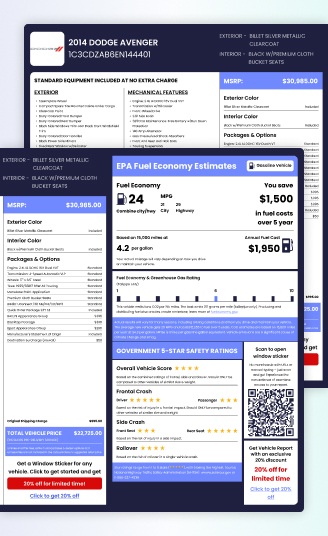

How a Reconstructed Window Sticker Is Created
A window sticker lists a vehicle’s price, options, colors and ratings. None of that is written into the 17 characters of a VIN. This is the central fact behind every reconstruction: the document cannot come from the VIN alone, so the parts it needs have to come from somewhere else. This page explains where each part comes from, which parts are firm, and which are not. |
What the VIN supplies
The structure of a VIN is set by federal rules and covered on the VIN format page. In short, it names the manufacturer, describes the vehicle in a code the manufacturer chooses (positions 4 to 8), carries a check digit, and ends with the model year, the assembly plant and a serial sequence. That is a lot about identity and not much about configuration. The VIN does not carry the price, does not record the paint color, and for most vehicles does not list the options. Even the vehicle attributes in positions 4 to 8 mean something only with that manufacturer’s own code tables.
So decoding a VIN gets you to a precise starting point: this model year, this make and model, this body and engine, built at this plant. It does not get you to this vehicle’s equipment list.
Where the rest comes from
The remaining content comes from available vehicle configuration and sticker-related data keyed to the year, make, model and trim. A reconstruction matches the decoded vehicle to that data and assembles what the data supports: standard equipment for the trim, packages and options that apply, colors, a price for the resulting configuration, and, where available, fuel economy, safety ratings and warranty terms.
The result is a document built from two layers. One layer is what the VIN identifies about this specific vehicle. The other is what is known about vehicles of that year, make, model and trim. The more the two layers pin down, the closer the document comes to what the original showed. Where they leave a gap, the document is only as specific as the data allows.
Four kinds of content in the document
PremiumVIN’s evidence model distinguishes how each piece of information was obtained. For a reconstructed sticker, that looks like this:
| Field | How it is obtained | What to keep in mind |
|---|---|---|
| Model year, make, vehicle type, assembly plant | Decoded from the VIN structure | Firm where the VIN follows the standard format. Older and non-standard formats decode less. |
| Engine, body style | Decoded using the manufacturer's code for positions 4 to 8, where tables exist | Detail varies by manufacturer and era |
| Trim, packages, factory options, colors | Sourced from configuration data for the year, make, model and trim, where available | Can be incomplete. Trim often cannot be settled from the VIN alone. |
| MSRP | Sourced from pricing data for the matched configuration | A total built from partial option data can differ from the original total |
| Fuel economy, safety ratings, warranty | Sourced from model-level data | Published for a model or configuration, not for the individual vehicle |
| A value worked out rather than looked up | Inferred or estimated | Should be identified as such, not presented as fact |
| Dealer, delivery city, transportation charge | Unavailable | These belong to one delivery and are not in the VIN or in model-level data |
The labels matter. A decoded field is a reading of the VIN. A sourced field is attributed to a data source. An inferred field is a judgment. A document that treats all three as one kind of fact would be misleading, and this is why the document should say what is reconstructed, what is sourced, and what is unavailable or uncertain.
A walkthrough with an invented example
The example below is illustrative and does not describe a real vehicle.
Suppose a VIN has the letter M in position 10 and a letter in position 7. On a passenger car or a light truck, an alphabetic seventh character places the vehicle in the 2010 to 2039 cycle, and M in that cycle means the 2021 model year. Position 11 points to an assembly plant, and the manufacturer’s tables turn positions 4 to 8 into an engine and a body style.
With year, make, model, engine and body in hand, the reconstruction looks at the configuration data for that model. Suppose the model came in four trims, and two of them share the same engine and body. The decoded VIN cannot choose between those two. A careful document does not guess. It lists the field as uncertain, or as unavailable, instead of presenting one trim as fact. If the data holds a single match, it can list that trim and its standard equipment, then the packages the data attaches to it.
Each step narrows the options. The document is as precise as the narrowest step allows.
What can go wrong
- The VIN is not standard. A format outside the modern pattern may decode only partly. See what a VIN encodes.
- There is no configuration data for that year or trim. The decoded identity may be fine while the options list is thin or empty.
- The data conflicts. Two sources can disagree about a package or a price. The document should not pick one silently.
- The item was added late. Accessories attached after the factory but before delivery may not appear in configuration data at all.
- A trim was chosen that does not match. If trim cannot be settled from the VIN, a wrong match can bring the wrong equipment with it. Compare the document against the vehicle.
When a field is missing or looks wrong, see why vehicle data may be missing or incorrect and what to do when a window sticker is missing.
Why the result is not an original
An original label was produced by the manufacturer for one vehicle and one delivery. A reconstruction is assembled afterward from data about the vehicle’s year, make, model and trim. It can match many lines and cannot reproduce others. Original vs reconstructed Window Sticker goes through the differences line by line. PremiumVIN does not hold a copy of every original, and a reconstructed document does not prove that a vehicle still has its original equipment.
Checking a reconstruction
Start with the VIN: confirm that the number on the vehicle is the number used. Then compare engine, body style and model year against the VIN decoder result, and match visible options, wheels and colors against the document. If the seller has the original label or sales paperwork, compare against that. The methodology page describes how each kind of information is labeled.
Sources and basis
- 49 CFR 565.15, VIN content requirements: sections of the VIN, model-year position and the position 7 rule