
Pennsylvania VIN Check
Check a vehicle by VIN or license plate to review available history, title, mileage, and other vehicle information. A Pennsylvania VIN check can help you investigate a vehicle before buying, selling, registering, or importing it.
What a Pennsylvania VIN Check Can Help You Investigate
A vehicle’s current title does not necessarily explain every event in its history. A car may have been declared salvage, rebuilt after major damage, affected by flooding, or recovered after theft before it was offered for sale in Pennsylvania.
A vehicle history investigation can help you review available records associated with a vehicle identifier, including:
- Title history: Available title brands and changes in title status, including salvage, reconstructed, and flood-related designations.
- Accident and damage records: Reported collisions, damage events, and available insurance-related information.
- Mileage history: Recorded odometer readings that can be compared to identify possible inconsistencies.
- Theft records: Available theft and recovery information.
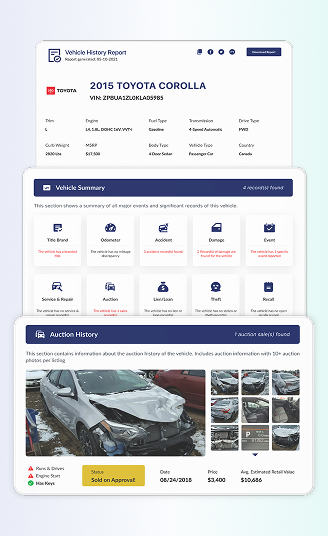
- Auction and sales history: Previous auction or sales records, including photographs when available.
- Lien and loan information: Available records relating to reported liens or loans.
- Recall information: Manufacturer recall information where available.
- Vehicle specifications: Decoded year, make, model, trim, engine, and other supported specifications.
The records returned depend on the vehicle, identifier, and available data. A missing accident, title, mileage, or theft entry does not prove that the event never occurred.
Pennsylvania Title Brands That Used-Car Buyers Should Understand
Pennsylvania has specific title classifications for vehicles that have been salvaged, reconstructed, flooded, recovered after theft, or substantially modified. Understanding these designations is important when evaluating a used vehicle because a title brand can affect its history, inspection requirements, and resale considerations.
Salvage title
A salvage vehicle is generally one that is inoperable or cannot meet applicable vehicle equipment and inspection standards because the cost of repairs would exceed the value of the repaired vehicle, subject to Pennsylvania’s statutory definition.
A salvage certificate is not the same as a regular title that allows ordinary road use. The vehicle may need to be repaired and satisfy Pennsylvania’s requirements before it can receive a reconstructed title.
When considering a vehicle with a salvage history, investigate why it was declared salvage, what components were damaged, which parts were replaced, and whether the supporting repair documentation is available.
Reconstructed title
A reconstructed vehicle is one that previously received a salvage certificate and was subsequently restored to operating condition in accordance with applicable requirements.
Pennsylvania requires reconstructed vehicles to undergo an enhanced vehicle safety inspection. The inspection is performed by an authorized Enhanced Vehicle Safety Inspection Station.
The inspection process includes examining the vehicle’s equipment and supporting documentation. Pennsylvania’s guidance specifically addresses components such as airbags, seat belts and restraint systems, and emissions equipment.
A reconstructed title does not mean that the vehicle has the same history as one that has never been declared salvage. Buyers should still investigate the original damage and the quality of the repairs.
Flood title and reconstructed/flood title
Pennsylvania distinguishes between a flood-branded title and a reconstructed/flood-branded title.
Under PennDOT’s guidance, a flood vehicle is one that has been declared flooded by an insurer. The classification can apply even when the vehicle has no physical damage or when the damage is less than the vehicle’s replacement value.
Where the damage does not exceed replacement value, an acceptable appraisal report from a licensed appraiser may support a flood brand. Where the required appraisal documentation is unavailable, or the damage exceeds replacement value, the vehicle may receive a reconstructed/flood brand under the applicable process.
This distinction matters because a flood designation is not simply a description of visible water damage. The title brand reflects the vehicle’s insurance and title circumstances.
Flood exposure can affect electrical connections, control modules, sensors, wiring, interior materials, and other components. Some problems may not appear during a short test drive. A vehicle with a flood-related title history should receive a careful independent inspection.
Recovered theft title
Pennsylvania has a separate process for vehicles recovered after being reported stolen.
The title treatment depends on factors such as the insurance payment, the vehicle’s damage assessment, and whether a salvage certificate was issued. Depending on those circumstances, the vehicle may receive a recovered-theft designation or a combined reconstructed/recovered-theft brand.
A recovered-theft history does not automatically mean that a vehicle has major collision damage. It does mean buyers should investigate what happened while the vehicle was missing, whether components were removed or damaged, and what repairs were completed.
Modified and specially constructed vehicles
Pennsylvania also has title and inspection procedures for vehicles that have been materially modified or assembled from components.
A modified vehicle may have changes to its body, chassis, or essential parts. A specially constructed vehicle is not originally built under a distinctive make, model, or type by a generally recognized vehicle manufacturer.
These classifications are different from ordinary repairs. If a vehicle has undergone substantial modifications or has been assembled from multiple vehicles, buyers should review the title designation, supporting ownership documents, and applicable inspection records.
For the official classifications and procedures, consult PennDOT’s Enhanced Vehicle Safety Inspection guidance and its PUB 645 Enhanced Vehicle Safety Inspection guide.
Pennsylvania's Enhanced Vehicle Safety Inspection
Pennsylvania uses an enhanced inspection process for certain vehicles that require special title treatment. This is different from an ordinary used-car inspection arranged by a prospective buyer.
The enhanced inspection program applies to categories including:
- Reconstructed vehicles
- Flood vehicles
- Recovered-theft vehicles
- Specially constructed vehicles
- Modified vehicles
- Collectible vehicles
- Street rods
Only inspection stations appointed and contracted by PennDOT as Enhanced Vehicle Safety Inspection Stations may perform these inspections for the purpose of titling the applicable vehicles in Pennsylvania.
The process is intended to establish whether the vehicle meets the relevant equipment and inspection requirements for its title category. It can involve checking structural and operational systems, vehicle identification, repaired or replaced components, and supporting documents.
For a buyer, the important distinction is that an enhanced inspection is part of Pennsylvania’s title process. It is not a guarantee that the vehicle has never been damaged, that every repair is free from defects, or that no future mechanical problems will occur.
If you are considering a reconstructed, flood, or recovered-theft vehicle, ask the seller for the title, repair invoices, parts documentation, inspection paperwork, and any available photographs from before and during the repair process.
You can find the state’s Enhanced Vehicle Safety Inspection program and approved station information through PennDOT.
Why a Vehicle's Previous State Matters in Pennsylvania
A vehicle currently titled in Pennsylvania may have previously been registered or titled in another state. Its earlier title history can therefore be just as important as its current Pennsylvania documentation.
This is particularly relevant for vehicles that were declared salvage, flood-damaged, or reconstructed elsewhere before being transferred into Pennsylvania.
PennDOT’s enhanced inspection guidance includes vehicles coming from another state or jurisdiction among the categories subject to the applicable enhanced inspection process. Its guidance also addresses branded out-of-state titles and salvage certificates.
For buyers, this means that a vehicle’s current Pennsylvania title should not be treated as the only evidence of its history. Review available records for earlier title brands, state transfers, reported damage, and mileage entries.
When the seller provides an out-of-state title, compare the VIN on the title with the identifier on the vehicle. If the title includes a brand or notation, determine what it means in the jurisdiction that issued it and how Pennsylvania treats that designation.
Pennsylvania Vehicle Records and NMVTIS
Pennsylvania participates in the National Motor Vehicle Title Information System (NMVTIS), a system that consolidates vehicle titling information from participating state motor vehicle agencies.
PennDOT explains that NMVTIS can help verify key title information, including the VIN, odometer information, and state title brands such as junk, salvage, and flood.
This is relevant when researching a vehicle with a history that may cross state boundaries. A title brand recorded in one jurisdiction can be important when the vehicle is later transferred or titled elsewhere.
However, NMVTIS is not a complete record of every event in a vehicle’s life. It should be considered one source of vehicle information rather than proof that every accident, repair, ownership event, or mechanical issue has been identified.
You can read PennDOT’s explanation of the National Motor Vehicle Title Information System for more information about its role in vehicle-title verification.
How to Request an Official Pennsylvania Vehicle Record
Pennsylvania provides a separate process for requesting an official record for a vehicle titled in the state.
According to PennDOT’s public-records guidance, a vehicle record can be requested using Form DL-135, Request for Vehicle Information. The record can include information such as the current owner’s name and address, VIN, title, license plate number, make, model, and year. Additional information may be available when specifically requested and permitted.
PennDOT also explains that a license plate number alone is not sufficient to obtain a person’s identity. Requests are subject to the state’s privacy and eligibility requirements.
This official record request is different from a commercial vehicle-history report. A state vehicle record serves a specific government-record purpose, while a commercial report compiles available vehicle information from its data sources.
How to Run a Pennsylvania VIN Check with PremiumVIN
You can use PremiumVIN to investigate a vehicle using its VIN or a supported U.S. license plate.

Step 1: Locate the vehicle identifier
Find the VIN on the vehicle and compare it with the VIN printed on the title and other documents. If you do not have the VIN, you can use the license plate lookup option.

Step 2: Enter the VIN or license plate
Submit the identifier through the PremiumVIN lookup form.

Step 3: Review the available vehicle information
The initial results may include decoded vehicle specifications and a preview of available information.
Step 4: Review the vehicle history report
If you need more detailed historical information, access the available report, which may include title, damage, mileage, theft, auction, and other records.
Step 5: Investigate important findings
Compare report details with the seller's documents, official title information, repair invoices, and an independent vehicle inspection.
PremiumVIN supports VIN Check and license plate lookup across all 50 U.S. states. This confirms identifier lookup support, not guaranteed availability of every state-specific title event or historical record for every vehicle.
For a detailed explanation of the historical information available through the paid product, visit the PremiumVIN Vehicle History Report page.
If you need to identify the vehicle’s factory specifications rather than investigate its history, use the PremiumVIN VIN Decoder. A VIN decoder interprets information encoded in the identifier; it does not replace a vehicle-history investigation.
You can also use the Pennsylvania License Plate Lookup if you have the vehicle’s registration plate rather than its VIN.
What a Pennsylvania VIN Check Cannot Establish
A vehicle-history report is one part of a used-vehicle investigation. It should not be treated as a complete record of everything that has happened to a vehicle.
A report cannot independently guarantee:
- That every accident or damage event has been reported.
- That a vehicle has never had a salvage, flood, or other branded title.
- That the vehicle has no outstanding lien or legal restriction.
- That every odometer reading is accurate.
- That all repairs were completed correctly.
- That the vehicle is currently safe, roadworthy, or mechanically sound.
- That a vehicle has no undisclosed flood, fire, or structural damage.
A report with no recorded damage or title event means that no corresponding record was returned in the available data. It does not prove that the vehicle has never experienced that event.
For a higher-confidence purchase decision, combine the report with an official title review, seller documentation, and an independent inspection by a qualified mechanic.
FAQs About Pennsylvania VIN Checks
How do I check a VIN in Pennsylvania?
Enter the vehicle’s VIN into a VIN lookup service to review available vehicle specifications and historical records. PremiumVIN also supports license plate lookup across all 50 U.S. states. For official Pennsylvania title or vehicle records, consult PennDOT’s vehicle-record request process.
What does a reconstructed title mean in Pennsylvania?
A reconstructed title generally identifies a vehicle that previously received a salvage certificate and was later restored to operating condition under the applicable requirements. Pennsylvania requires reconstructed vehicles to undergo an enhanced vehicle safety inspection before they can receive the relevant title.
What is the difference between a flood title and a reconstructed/flood title in Pennsylvania?
A flood brand identifies a vehicle declared flooded by an insurer under Pennsylvania’s title rules. A reconstructed/flood brand may apply when the vehicle’s damage and supporting appraisal documentation meet the conditions for that classification. The exact treatment depends on the damage assessment and title application circumstances.
Does a reconstructed vehicle need an inspection in Pennsylvania?
Yes. Pennsylvania requires reconstructed vehicles to undergo an enhanced vehicle safety inspection at an authorized inspection station. This process is separate from an ordinary pre-purchase inspection arranged by a buyer.
Can a vehicle from another state have a Pennsylvania title brand?
Yes. Pennsylvania’s title and inspection procedures address vehicles entering the state from another jurisdiction, including vehicles with an existing branded title or salvage certificate. Buyers should investigate the vehicle’s earlier title history rather than relying only on its current registration location.
How can I check whether a Pennsylvania vehicle has a flood history?
Review available title and vehicle-history records for flood-related information. Pennsylvania recognizes flood and reconstructed/flood title brands. You should also arrange an independent inspection for signs of water intrusion, corrosion, electrical problems, and other potential flood-related damage. Not every flood event will necessarily appear in a report.
Can I get an official Pennsylvania vehicle record?
Yes. PennDOT identifies Form DL-135, Request for Vehicle Information, as the form used to request a record for a vehicle titled in Pennsylvania. The information available depends on the request and applicable eligibility requirements.
Can I find a vehicle owner using a Pennsylvania license plate?
A license plate lookup is not a vehicle-owner identity search. PennDOT states that it will not process a request for owner information based solely on a plate number. Official vehicle-record requests are subject to the state’s privacy and eligibility requirements.
Does a clean Pennsylvania vehicle history report mean the car has never been damaged?
No. A clean report means that no relevant damage record was returned in the available data. Some incidents may never be reported or may not be present in the sources searched. Review the vehicle’s physical condition, maintenance records, and repair documents before buying.
Is a Pennsylvania VIN check the same as a PennDOT vehicle record?
No. A PremiumVIN vehicle-history report compiles available vehicle information from its data sources. A PennDOT vehicle record is an official state record requested through the department’s process. They serve different purposes and should not be treated as interchangeable.