
New Jersey VIN Check for Vehicle History Reports
A New Jersey VIN check helps buyers and sellers investigate a vehicle’s available history before completing a transaction. A vehicle’s VIN can connect its identity to available records involving title status, reported accidents, mileage, ownership changes, theft, auction activity, and other historical events.
New Jersey has a specific process for vehicles issued salvage titles. The New Jersey Motor Vehicle Commission (NJMVC) requires qualifying salvage vehicles to undergo a physical identification inspection before a valid negotiable title can be issued after repair. The process includes documentation of replacement components, repair work, and the vehicle’s identification numbers.
These details matter when evaluating a vehicle that has been damaged, repaired, transferred from another state, or previously sold through an insurance or salvage auction.
Use PremiumVIN to search available vehicle history records by VIN. Review the findings alongside the current title, seller documentation, and an independent vehicle inspection.
What a New Jersey VIN Check Can Reveal
A vehicle identification number connects a vehicle to its identifying information and available historical records. A VIN check can help establish whether the vehicle’s reported background is consistent with its title, mileage, and seller-provided information.
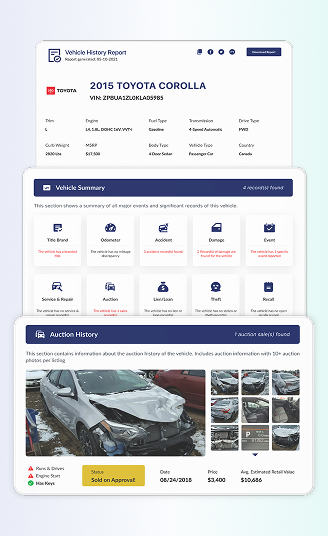
Depending on the vehicle and available source records, a PremiumVIN report may contain the following information.
Title and Salvage History
Title information can help identify reported salvage, rebuilt, or other title-brand events.
New Jersey distinguishes salvage vehicles through its title process. The NJMVC defines a salvage vehicle as one damaged or destroyed to the extent that an insurance company considers it uneconomical to repair.
A reported salvage event deserves further investigation. Check the title itself, the vehicle’s previous registration states, and any available repair or insurance documentation.
Learn more about a salvage title check by VIN and a rebuilt title check.
Accident and Damage History
Available accident and damage records can provide evidence of previously reported collisions, insurance-related losses, or other recorded damage events.
A vehicle may have been repaired before its current sale. Its exterior appearance therefore cannot establish whether it has sustained structural, flood, or other significant damage.
Compare reported incidents with repair invoices, insurance documentation, photographs, and an independent inspection. A missing accident record does not prove that the vehicle has never been damaged.
Odometer and Mileage History
Mileage entries help buyers compare recorded odometer readings from different points in a vehicle’s history.
New Jersey requires an odometer reading to be disclosed when ownership is transferred, subject to the applicable title and disclosure requirements. The state’s odometer disclosure form distinguishes actual mileage, mileage beyond mechanical limits, and mileage that is not actual.
A VIN history search may reveal available mileage records that can be compared with the current odometer and the seller’s disclosure.
Investigate unexplained decreases, inconsistent readings, or an odometer discrepancy designation. A report without a mileage warning does not independently verify the vehicle’s true lifetime mileage.
Ownership and Registration History
Available ownership and registration records can help establish how a vehicle’s recorded history has changed over time.
Depending on source availability, a report may show ownership changes, registration locations, or other recorded transaction information.
A history report does not provide unrestricted access to previous owners’ private identities or residential addresses.
Auction and Sales History
Previous auction or sales records can provide useful context when a vehicle has been sold after damage, insurance loss, or a change in ownership.
Available records may include sale dates, listing descriptions, condition information, or photographs from an earlier listing.
Auction photographs show the vehicle at the time of the recorded listing. They should not be treated as evidence of its current condition or the quality of subsequent repairs.
Theft, Lien, and Other Available Records
A report may also contain available theft-related flags, lien or loan information, recall information, service entries, and other vehicle records.
The presence and detail of these records depend on the vehicle and the contributing data sources. A missing record is not proof that the event never occurred.
New Jersey Salvage Titles and the Restoration Inspection
New Jersey’s salvage-title process is one of the most important state-specific considerations when evaluating a previously damaged vehicle.
The NJMVC requires salvage vehicles to be titled in New Jersey, regardless of whether the owner intends to restore them. A New Jersey salvage title normally displays the word SALVAGE across the title.
A salvage title is not simply a description of past damage. It is part of the state’s vehicle ownership and restoration process.
What Qualifies as a Salvage Vehicle in New Jersey?
The NJMVC defines a salvage vehicle as one that has been wrecked, destroyed, or damaged to the extent that an insurance company considers it uneconomical to repair.
The classification can follow an insurance loss involving collision damage, fire, flood, theft, or another covered event, depending on the circumstances.
A salvage designation does not describe every detail of the damage. Buyers should establish why the vehicle received the designation and what repairs were subsequently performed.
New Jersey Requires Salvage Vehicles to Be Titled
New Jersey requires salvage vehicles to be titled even when the owner plans to restore them.
The NJMVC’s salvage-title procedure requires supporting documents from the insurance company and the assigned title. Its listed documentation includes an insurance listing sheet identifying information such as the vehicle’s actual cash value, type of loss, damage estimate, year, make, and serial number.
The MVC also states that an existing lien shown on the title must be properly satisfied before a salvage title can be issued.
This makes the original title and insurance documentation important evidence when researching a previously damaged vehicle.
Physical Identification Inspection After Repairs
A repaired salvage vehicle must undergo the applicable NJMVC inspection process.
The inspection verifies that the vehicle conforms to the description and identification information on the salvage title. The MVC’s salvage inspection instructions explain that the vehicle must be physically inspected before a valid negotiable title can be issued.
The process is not merely a visual assessment of whether the vehicle looks repaired. It also examines vehicle identification and the identification numbers of major component parts used during reconstruction or repair.
If the inspection is passed and the requirements are satisfied, the vehicle may become eligible for an operable salvage title.
An operable salvage title should not be interpreted as proof that the vehicle has never sustained significant damage or that every repair is mechanically sound.
Major Replacement Parts Must Be Documented
New Jersey requires bills of sale for major component parts used in the reconstruction, rebuilding, or repair of a salvage vehicle.
For new parts, the documentation must include a description and part number.
For used parts, the required information includes:
- Description of the component.
- Date the component was removed, where applicable.
- Name and address of the person or business that removed it.
- Year, make, and model of the donor vehicle.
- Donor vehicle VIN, or a statement explaining why the VIN is unavailable.
The NJMVC identifies major components such as the engine, transmission, frame, roof, doors, hood, fenders, quarter panels, and other structural or body components.
These requirements create a documentary trail for significant replacement parts. When evaluating a repaired salvage vehicle, ask whether the seller can provide the relevant parts receipts, repair orders, and inspection documentation.
Before-and-After Repair Photographs
The NJMVC requires photographs documenting the vehicle before and after repairs.
The inspection instructions specify photographs showing the complete front and left side, as well as the complete rear and right side. If repairs began before the required initial photographs could be taken, an insurance-company damage report may substitute for the before-repair photographs under the stated conditions.
For a flood-damaged salvage vehicle, the MVC inspection guide also requires an insurance-company damage report.
These requirements make repair photographs and supporting documents valuable when evaluating the history of a vehicle that has undergone salvage restoration.
What an Operable Salvage Title Does Not Establish
An operable salvage title reflects the outcome of the applicable state title and inspection process. It does not establish that the vehicle has returned to its original factory condition.
It also does not independently prove:
- That all previous damage has been eliminated.
- That every repair meets manufacturer repair procedures.
- That no structural or electrical issues remain.
- That the vehicle has never been involved in another accident.
- That its current mechanical condition is satisfactory.
Buyers should review the available title history, repair documents, and inspection records and arrange an independent inspection before purchasing a previously salvaged vehicle.
Flood-Damaged Vehicle History in New Jersey
Flood damage can affect a vehicle’s electrical systems, wiring, interior components, corrosion resistance, and long-term reliability.
A vehicle may be cleaned, dried, and cosmetically repaired after water exposure. Its appearance alone may not reveal the extent of previous water intrusion.
New Jersey’s salvage inspection documentation specifically addresses flood vehicles. The NJMVC’s inspection instructions require an insurance-company damage report when the vehicle undergoing salvage inspection is a flood vehicle.
When researching a vehicle with possible flood exposure, examine:
- Available flood or water-damage records.
- Previous insurance-loss information.
- Title history from earlier registration states.
- Auction photographs and condition descriptions, when available.
- Repair invoices and insurance damage reports.
- Signs of corrosion, moisture, or water residue during an independent inspection.
A VIN check may identify available flood-related records, but it cannot detect every vehicle that has been exposed to water.
New Jersey Odometer Disclosure and Mileage Verification
Mileage disclosure is an important part of a New Jersey vehicle ownership transfer.
The state’s odometer disclosure form requires the seller to state the mileage and identify whether the reading reflects actual mileage, exceeds the odometer’s mechanical limits, or is not actual mileage.
These distinctions matter because a displayed odometer reading and a vehicle’s actual accumulated mileage are not always the same.
When checking a New Jersey vehicle, compare:
- The current odometer reading.
- Mileage disclosed on the title or applicable odometer statement.
- Historical mileage entries available in the vehicle-history report.
- Service, maintenance, and repair documents.
- Any mileage discrepancy or mechanical-limit designation.
A lower reading than an earlier record requires investigation. It may reflect an odometer replacement, reporting error, rollover, or possible tampering. The available records alone may not establish which explanation is correct.
Why a Vehicle's Previous State History Matters
A vehicle currently titled or registered in New Jersey may have spent part of its life in another state.
Its earlier history may include a salvage designation, insurance loss, auction sale, flood event, or mileage record created outside New Jersey.
The current title is therefore only one part of the vehicle’s history. Buyers should compare available records across the vehicle’s previous registration states and investigate inconsistencies between earlier and current documentation.
This is particularly important for vehicles that entered New Jersey after an accident, insurance settlement, or salvage sale.
A VIN check can help identify available historical information, but it cannot guarantee that every prior state transaction or title event appears in the report.
How to Run a New Jersey VIN Check
A VIN search begins with the vehicle’s identification number. Check the number carefully before submitting it so the search is associated with the correct vehicle.

Step 1: Locate the VIN
Find the VIN on the vehicle or its ownership documents. Common locations include the driver's-side dashboard near the windshield, the driver's-side door jamb, and the vehicle's title or registration paperwork.
For additional guidance, see where to find a VIN.

Step 2: Enter the VIN
Enter the identification number into the PremiumVIN VIN check form.
Most modern passenger vehicles use a 17-character VIN. Older vehicles and certain specialty vehicle types may use different identification formats.
Review the VIN number format guide if you need help identifying the correct number.

Step 3: Review Available Vehicle Records
Examine the returned vehicle information and available history records. Pay particular attention to title brands, accident and damage events, mileage entries, ownership changes, and auction information.
If the report contains a salvage or other damage-related record, compare it with the seller's title and repair documentation.
Step 4: Investigate Inconsistent Information
Do not dismiss differences between the report, title, odometer, or seller's explanation.
Request supporting documents when necessary. For a previously salvaged vehicle, these may include insurance damage reports, repair orders, replacement-part receipts, inspection documentation, and before-and-after photographs.
What a New Jersey VIN Check Cannot Prove
A vehicle-history report is a research tool. It does not replace the NJMVC’s title records, a physical inspection, or independent verification of ownership and financial interests.
Available records depend on the vehicle, reporting history, contributing sources, and data availability.
A VIN check cannot guarantee that:
- A vehicle has never been involved in an accident.
- A title is free of every previous brand or designation.
- The odometer shows the vehicle’s true lifetime mileage.
- No lien or financial obligation exists.
- A vehicle has never been exposed to floodwater.
- Every previous repair or replacement component has been documented.
- A vehicle is mechanically safe or roadworthy.
- The seller has legal authority to complete the transaction.
For more detail, review the PremiumVIN report methodology, coverage and data availability, and documentation limitations.
Check a New Jersey Vehicle's History Before Buying
A vehicle’s current appearance and title do not necessarily reveal every event in its past. Previous damage, salvage restoration, mileage changes, and out-of-state title history can affect how a vehicle should be evaluated.
A New Jersey VIN check helps you investigate available vehicle records before making a purchase or completing a sale.
Use the PremiumVIN VIN check to search the vehicle’s available history by VIN. Compare the results with its title, mileage disclosure, repair documents, and physical condition before making a decision.
New Jersey VIN Check FAQs
How do I check a VIN number in New Jersey?
Enter the vehicle’s VIN into a VIN-check service such as PremiumVIN to search available vehicle identification and history records. Compare the returned information with the current title and other supporting documents.
What does a salvage title mean in New Jersey?
A salvage title identifies a vehicle that has been classified as salvage under New Jersey’s requirements. The NJMVC defines a salvage vehicle as one damaged to the extent that an insurance company considers it uneconomical to repair.
Can a New Jersey salvage vehicle be repaired and titled again?
Yes. A salvage vehicle can be repaired and may become eligible for an operable salvage title after completing the applicable NJMVC inspection and documentation requirements.
Does New Jersey require an inspection after salvage repairs?
Yes. The NJMVC requires a physical identification inspection for a repaired salvage vehicle before a valid negotiable title can be issued. The process includes verification of the vehicle and identification numbers associated with major replacement components.
What documents are needed for a New Jersey salvage inspection?
The NJMVC’s instructions include the salvage title, inspection application and payment receipt, bills of sale for major replacement parts, before-and-after photographs, repair work orders, and identification numbers for applicable components. Additional documentation may be required for flood or theft-recovery vehicles.
Does an operable salvage title mean a car is as good as a clean-title vehicle?
No. An operable salvage title indicates that the vehicle has met the applicable requirements to become eligible for operation under its title status. It does not erase the previous salvage history or guarantee the quality of repairs or present mechanical condition.
Does a New Jersey VIN check show previous accidents?
A report may include available accident and damage records. However, not every collision or repair is reported to the databases used by vehicle-history providers. A missing accident record does not prove that a vehicle has never been damaged.
Can I check a New Jersey vehicle's mileage by VIN?
A VIN check may reveal available historical odometer readings. Compare them with the current odometer, title disclosure, and service records. A report cannot independently guarantee the vehicle’s true accumulated mileage.