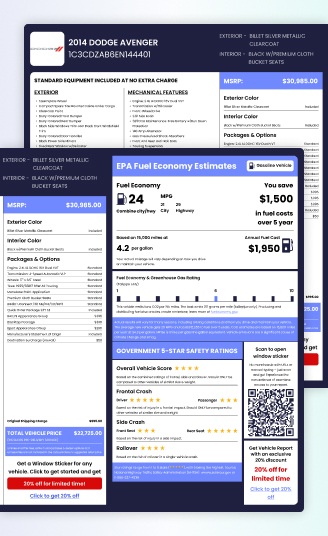

Window Sticker Fields Explained
Summary: A window sticker states a vehicle’s identity, equipment, prices, fuel economy and crash ratings. This page reads a PremiumVIN window sticker block by block, using a sample for a 2006 Ford F-150. For each block it gives the meaning of every field, where the content comes from, and what the block leaves out. |

Layout
| Position | Block | Contents |
|---|---|---|
| Top | Header | Year, make, model, VIN, exterior color, interior color and seat layout |
| Left column | Standard equipment and warranty | Items included at no extra charge, in five categories |
| Middle column | Prices | MSRP, colors, packages and options, shipping charge, total vehicle price |
| Right column, top | EPA fuel economy estimates | Fuel economy, annual fuel cost, five-year fuel cost difference, greenhouse gas rating |
| Right column, middle | Government 5-star safety ratings | Overall, frontal, side and rollover ratings |
| Right column, bottom | QR code and source line | Link to the online document |
Header
Year, make and model
Decoded from the VIN. See what a VIN is.
VIN
The 17-character identifier of the vehicle.
Exterior color
Uses the manufacturer’s color name. The name can include the finish, as in Arizona Beige Clearcoat Metallic.
Interior color
Combines color, material and seat layout. Tan w/Premium Cloth 40/20/40 Front Seat means tan premium cloth on a split front bench seat. The 40/20/40 figures describe the widths of the three sections.
Standard equipment
The heading states that the items are included at no extra charge. They are part of the base price. The sticker groups them into five categories: Exterior, Interior, Mechanical Features, Safety/Security/Options and Warranty. The wording of each item is the manufacturer’s.
Standard equipment can vary by region and sales channel. The sample marks the engine block heater as standard on retail vehicles only in AK, MN, ND, SD, MT, WI and WY, and optional on fleet vehicles. Two vehicles of the same model can carry different standard equipment depending on where and how they were sold.
Warranty. The sample lists four coverages, each with a time limit and a distance limit:
| Coverage | Term in the sample |
|---|---|
| Basic | 36 months or 36,000 miles |
| Corrosion perforation | 60 months, unlimited distance |
| Powertrain | 36 months or 36,000 miles |
| Roadside assistance | 36 months or 36,000 miles |
The terms run from the original sale. The block states the coverage as first offered. It does not show what coverage remains today.
Prices
MSRP. The banner at the top of the middle column states the base price: the manufacturer’s suggested retail price before priced options and shipping. The MSRP page shows how it relates to the total.
Exterior and interior color are repeated here with the status Included.
Packages and Options. Each line carries one of three statuses:
| Status | Meaning | Adds to the total |
|---|---|---|
| Included | The item is in the base price or in a group already paid for | No |
| Standard | The item is standard on the model | No |
| A dollar amount | A priced option | Yes |
The lines state the engine, transmission, wheels, tires, payload package, axle ratio, wheelbase, paint, seats, audio, order code and priced packages. An order code identifies the equipment group a vehicle was ordered with. Its meaning is specific to the manufacturer.
One configuration, not a menu. A vehicle has one seat layout, one audio unit and one paint treatment. If a document lists a standard item and its priced alternative from the same category as both present, it is showing the option menu, not the vehicle. The total then counts an item the vehicle does not have.
Shipping charge and Total Vehicle Price. The shipping charge is the transportation amount. The total vehicle price is the sum of the MSRP, the priced options and the shipping charge. The sample states that license and title fees, state and local taxes, and dealer options and accessories are not included in the manufacturer’s suggested retail price.
EPA fuel economy estimates
The block follows the EPA fuel economy label (40 CFR 600.302-12). Its fields:
| Field | Meaning |
|---|---|
| Fuel economy | Combined city and highway miles per gallon, with separate city and highway figures |
| Fuel use per 100 miles | Gallons the vehicle uses over 100 miles of combined driving |
| Annual fuel cost | Annual miles x gallons per mile x fuel price. The assumptions print at the bottom of the block: 15,000 miles a year and a projected fuel price. |
| Five-year fuel cost difference | The vehicle's five-year fuel cost compared with the average new vehicle. A vehicle that uses more fuel than average shows that it spends more. |
| Fuel economy and greenhouse gas rating | A 1 to 10 scale, with 10 best, based on tailpipe carbon dioxide only. A gasoline vehicle has the same rating for both. |
A worked check of annual fuel cost: at 6.3 gallons per 100 miles, 15,000 miles use 945 gallons, and at $4.30 a gallon that costs $4,063.50.
The EPA redesigned this label for the 2013 model year. A window sticker on a 2006 vehicle originally carried the older format, so a block in the current format on an older vehicle is a reconstruction in a later layout.
Government 5-star safety ratings
The block follows 49 CFR 575.301. Its fields:
- Overall Vehicle Score: a combined result of the frontal crash, side crash and rollover results
- Frontal Crash: separate stars for driver and passenger
- Side Crash: separate stars for front seat and rear seat
- Rollover: stars for resistance to rollover in a single-vehicle crash
- Scale: 1 to 5 stars, with 5 highest
Not Rated appears where NHTSA has not assigned a rating in a category, and To Be Rated where one is pending. The Overall Vehicle Score began with the 2011 model-year ratings, so older vehicles show Not Rated for it. The sample shows 5 stars for driver and passenger frontal crash, Not Rated for side crash and overall score, and 4 stars for rollover. An Overall Vehicle Score is a distinct rating and is not the same as a 5-star frontal or side rating.
QR code
The QR code on the sample opens the online version of the document. It is a PremiumVIN link and not the EPA label’s QR code.
Fields on an original label that this sticker does not show
The original federal label, called the Monroney label after the 1958 Automobile Information Disclosure Act (15 U.S.C. 1231 to 1233), carries entries this sticker omits:
- The dealer, the delivery city and the method of transportation. The statute requires them. They belong to one delivery and are not in the VIN or in model-level data.
- The final assembly point. The statute requires it. The VIN’s plant code, in position 11, can identify the plant where the manufacturer’s plant codes are available. The sample does not print it.
- The parts content block. The American Automobile Labeling Act (49 CFR Part 583) requires the U.S. and Canadian parts content percentage, the two largest sources of foreign parts content, the final assembly point, and the country of origin of the engine and of the transmission. It applies to passenger motor vehicles up to 8,500 lb gross vehicle weight rating. The sample does not print it.
See original vs reconstructed and how a reconstructed window sticker is created.
Sources and basis
- 15 U.S.C. 1231 to 1233: original label entries
- 40 CFR 600.302-12 and fueleconomy.gov label guide: EPA block
- 49 CFR 575.301: safety rating block; Federal Register, July 29, 2011, for the Overall Vehicle Score
- 49 CFR Part 583: parts content label
- 49 CFR 565.15: the plant code in position 11