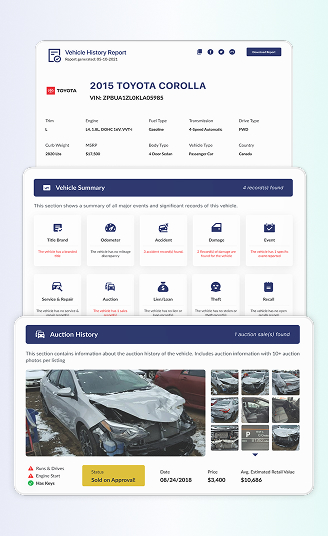


- A VIN is an abbreviation for Vehicle Identification Number, assigned to each vehicle.
- The VIN can be found in different locations on vehicles, such as the doorjamb and documentation
- Decode the VIN to check the complete vehicle specifications and market value by using PremiumVIN’s VIN Decoder tool
Every vehicle on the road has a 17-character code that consists of numbers and letters and contains complete information about the vehicle, including origin, engine type, trim, and the serial number.
Most people only know how to look at it, and sadly, plenty of people do not know how it functions or even how to decipher it one by one because it is hard, and almost all manufacturers use different coding.
A lot of people asked, “How to decode a VIN number?” In this article, we’ll guide you through the easiest way to run a VIN decoder and check the complete vehicle specification, trim information, and engine information without the need to decode them one by one manually.
What is a VIN and Why Does It Exist?
A VIN is an abbreviation for Vehicle Identification Number–often called the vehicle’s fingerprint because it has complete information about the vehicle by the time it was finished being manufactured.
A VIN helps manufacturers, government agencies, insurers, repair shops, and buyers identify a specific vehicle and access important information about its history, specifications, and ownership records.
Why was the VIN Standardized?
The VIN system was created to solve a recurring problem in the automotive industry before 1981: the lack of a consistent way to identify vehicles. As car production expanded globally, a universal identification standard became necessary for tracking vehicles throughout their life.
Before VIN Standardization
Before 1981, manufacturers used their own in-house identification systems. Many VINs came with different variations, lengths (between 5 and 14 digits), and structures–all depending on the manufacturer’s style. Hence, it was very difficult to verify vehicle information across different databases.
The same vehicle model sold in different countries could carry entirely different identification codes. As a result, tracking recalls, insurance claims, registration records, and ownership history often required manual verification and were far less reliable than it is now.
The 1981 Standard — 17 Characters, Globally Recognized
To address these issues, the National Highway Traffic Safety Administration (NHTSA) introduced a standardized 17-character VIN format in 1981. This system became the foundation for vehicle identification in the United States and was later adopted by most major automotive markets worldwide.
The standardized VIN uses a combination of letters and numbers to encode information about the manufacturer, vehicle attributes, and production details. To prevent confusion, the letters I, O, and Q were excluded because they closely resemble the numbers 1 and 0.
Where to Find the VIN on a Vehicle?
A VIN is usually located in a different location on the vehicle or on the vehicle’s documentation. Knowing the VIN location is important whether you need it for running a quick VIN decoder or anything vehicle-related.
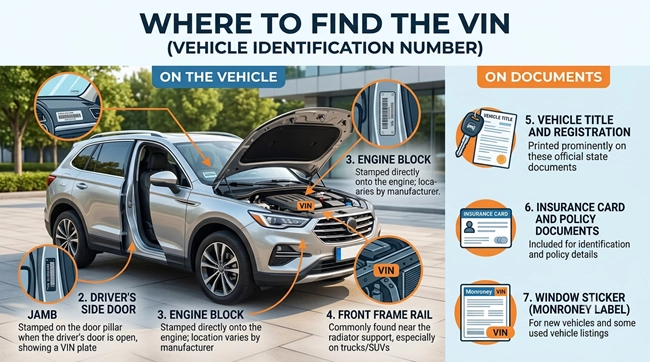
On the Vehicle
The VIN is displayed in several locations on the vehicle. Checking more than one location helps confirm that the vehicle has not been altered or tampered with.
- Dashboard: Visible through the windshield on the driver’s side at the base of the dashboard.
- Driver’s side door jamb: Located on the door pillar when the driver’s door is open.
- Engine block: Stamped directly onto the engine; the exact location varies by manufacturer.
- Front frame rail: Commonly found near the radiator support on many trucks and SUVs.
On Documents
The VIN should also appear on official vehicle paperwork. These records can be used to verify that the VIN on the vehicle matches the VIN on file.
- Vehicle title and registration
- Insurance card and policy documents.
- Window sticker (Monroney label) for new vehicles and some used vehicle listings.
Red Flag: Mismatched VINs
Every VIN location should display the same 17-character code. Even a single character difference is a warning sign that deserves further investigation. The VIN on the dashboard, door jamb, and paperwork should match. A mismatch may indicate vehicle theft, title fraud, or replacement body panels from another vehicle.
How to Decode a VIN Number
A VIN Decoder is the easiest and fastest way to decode any vehicle’s VIN to identify the correct vehicle’s information. While it is possible to manually interpret VIN characters one by one, most vehicle owners use a VIN decoder to quickly access accurate specifications, trim details, engine information, and other factory data.
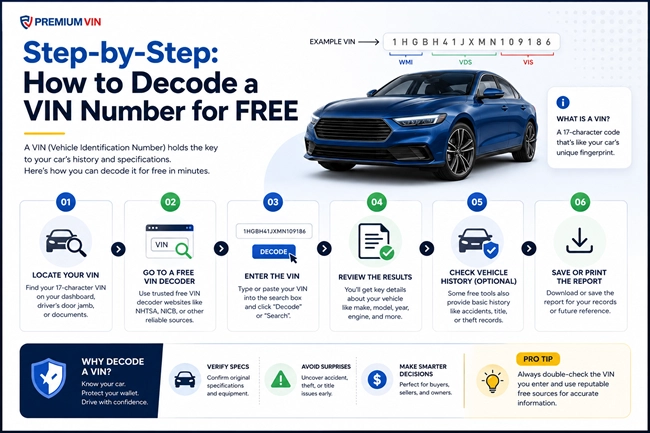
The PremiumVIN’s VIN Decoder provides a free VIN decoding tool to help you identify a vehicle’s correct information, like trim, engine, and model. To get started, follow these simple steps:
Step 1: Find the VIN
Locate the VIN on the vehicle’s body or on the paperwork. Our tool can be used to decode the classic and modern VIN.
Step 2: Submit the Form
Then, click on the button to submit the form on PremiumVIN’s VIN Decoder. Then, wait for a few seconds to get the information.
Step 3: Check Complete Vehicle Information
See the complete information, such as market value, specification, trim, engine, MSRP, and engine information. Need to get more vehicle information? Proceed to payment and download the vehicle history report.
What Information Will You Get from Our VIN Decoder
Once you’ve successfully decoded the vehicle’s VIN with our tool, you’ll get the full information about the vehicle’s specifications, transmission, and even the complete market value that helps you set the price right during negotiations.
Manufacturer and Origin
This component identifies the manufacturer and the country where the vehicle was assembled. Knowing the origin helps buyers understand potential market differences, brand identity, and many other factors.
Model, Trim, and Package Details
Our VIN Decoder shows precise model, trim, and any factory-installed package options. This ensures buyers or sellers can distinguish base, mid-range, and higher trim variants, avoiding mistakes in listings.
Engine Specifications
The engine code within the VIN specifies the type, displacement, and configuration of the engine fitted to the vehicle. This helps mechanics, enthusiasts, and buyers verify that the engine matches the original factory setup, avoiding incorrect replacements or mismatched listings.
Transmission Setup
Check the transmission details, whether automatic, manual, or a specific variant. Knowing the transmission helps assess drivability, performance expectations, and maintenance requirements while confirming the vehicle’s original build.
Body Style
This component identifies the vehicle’s body configuration, such as sedan, coupe, SUV, or pickup. It ensures that listings, insurance records, and buyer expectations align with the actual design and intended functionality of the vehicle.
Model Year
The model year also shown in the VIN is critical for checking the vehicle’s production period. It affects depreciation, insurance rates, recall applicability, and market value, and it helps verify that the VIN is correct in accordance with the design.
Production Plant
The VIN specifies the exact assembly plant where the vehicle was built. This can impact quality control, minor production differences, and occasionally resale value, especially for limited-edition runs or vehicles from highly regarded manufacturing facilities.
Manufacturer Suggested Retail Price (MSRP)
Some VIN decoders provide the original MSRP, showing what the manufacturer intended the vehicle to sell for when new. This gives buyers and sellers a benchmark for evaluating fair pricing, especially when comparing used market values or trade-in offers.
Market Value
The market value information shows the updated vehicle value in different conditions, such as outstanding, clean, average, and rough. The data will be shown from two different markets, such as private and dealership.
The VIN Structure: All 17 Characters Explained
The 17 characters in a VIN are divided into three main groups: the WMI, VDS, and VIS. Each group has different information about the vehicle, like the vehicle’s origin, engine information, and much more.
Characters 1–3: World Manufacturer Identifier (WMI)
These first three characters identify who built the vehicle and where it was manufactured. This section shows the actual country where the vehicle was manufactured, not just the headquarters.
Character 1: Country of Origin
This character shows the country where the vehicle was physically assembled, not necessarily where the brand is based. It helps trace the manufacturing origin of the specific unit.
There are a few examples of a vehicle’s manufacturer code.
- 1 or 4 = United States
- 2 = Canada
- 3 = Mexico
- J = Japan
- K = South Korea
- W = Germany
- S = United Kingdom
For example, a BMW assembled in South Carolina may start with 1 or 4 instead of W, which surprises many buyers who assume all BMWs are built in Germany.
Character 2: Manufacturer
This character narrows down the manufacturer within the country of origin. It helps distinguish between different automakers operating in the same region.
Examples include:
- 1G = General Motors
- USA
- 1F = Ford USA
- 1H = Honda USA
- JT = Toyota Japan
- WB = BMW Germany
Character 3: Vehicle Type or Division
This character identifies the specific division or type of vehicle within a manufacturer. Large automakers use it to separate brands under the same corporate group.
Characters 4–8: Vehicle Descriptor Section (VDS)
This section describes the vehicle’s core specifications, such as body configuration, model series, and engine type.
Characters 4–5: Vehicle Attributes
These characters encode technical details such as body style, restraint system type, and gross vehicle weight rating for trucks. There is no universal decoding system because each manufacturer defines its own structure.
Character 6: Series or Line
This character identifies the model series or trim level within the lineup. It is often where differences like base, mid-range, and higher trim configurations are encoded.
Character 7: Body Style
This character specifies the vehicle’s body configuration, such as sedan, coupe, SUV, wagon, or pickup truck. Combined with earlier characters, it helps narrow down the exact build version.
Character 8: Engine Code
This is one of the most valuable characteristics for identifying mechanical specifications. It reveals the exact engine installed in the vehicle, including configuration and displacement.
For example, on a 2020 Ford F-150, this character can distinguish between the 3.3-liter V6, 2.7-liter EcoBoost, 3.5-liter EcoBoost, 5.0-liter V8, or 3.0-liter diesel engine.
Character 9: The Check Digit
Character 9 is a security feature used to validate the authenticity of the VIN. It is calculated using a mathematical formula based on the other VIN characters. This section aims to validate the VIN.
Characters 10–17: Vehicle Identifier Section (VIS)
This final section identifies the model year, manufacturing plant, and unique production number of the vehicle.
Character 10: Model Year
This character represents the vehicle’s model year using a repeating cycle of letters and numbers.
Codes include:
- A = 1980
- B = 1981
- Y = 2000
- 1 = 2001
- 9 = 2009
- A = 2010
The cycle repeats over time. Most VIN decoders automatically interpret this without manual lookup.
Character 11: Plant of Manufacture
This character identifies the exact factory where the vehicle was assembled. Different plants from the same manufacturer use different codes even if they build identical models. For example, Ford vehicles built in Dearborn will have a different plant code than those built in Kansas City.
Characters 12–17: Production Sequence Number
These final characters represent the vehicle’s unique serial number within the production run at that plant. No two vehicles have the same sequence number.
Brand-Specific VIN Decoder – Ford, Toyota, and More
Even though every manufacturer has its own unique VIN, our VIN Decoder can be used to decode Ford VINs, GMC VINs, Buick VINs, and many more. Pick what makes you want to decode in the section below!
Conclusion on Decoding Any Vehicle’s VIN
A VIN is much more than a string of letters and numbers; it is the vehicle’s fingerprint. By decoding the VIN, you can be informed with plenty of information, such as the manufacturer, model, trim, engine, production plant, and even the model year. For buyers and sellers, this information helps avoid incorrect listings and ensures fair pricing. Use our free VIN decoder tools to decode the VIN in less than a minute.
FAQs About Decoding VIN
How do you decode a VIN number?
You can decode a VIN (Vehicle Identification Number) for free to uncover basic factory specifications and any open safety recalls. For the most reliable, ad-free, and official results, PremiumVIN allows you to decode any VIN quickly and accurately.
Can you decode a VIN for free?
Yes, you can decode a VIN for free and access vehicle information. The PremiumVIN’s VIN decoder tools reveal details such as the make, model, model year, engine type, and production plant.
What does the 8th character of a VIN tell you?
The 8th character of a VIN reveals the engine type. This unique alphanumeric code allows manufacturers to differentiate between the various powertrain options available for a specific vehicle model.
How do I decode a Can-Am VIN number?
To decode a Can-Am VIN, use an online tool such as PremiumVIN’s VIN Decoder to access factory specifications. Alternatively, you can manually read the 17-character code to determine the vehicle’s origin, model family, engine size, and build year.
How to decode a Ford VIN Number?
To decode the Ford VIN, you can use PremiumVIN’s VIN Decoder service and get it done in under a minute. Every modern Ford features a 17-character VIN, typically found on the driver’s side dashboard, the door jamb, or on the vehicle registration.