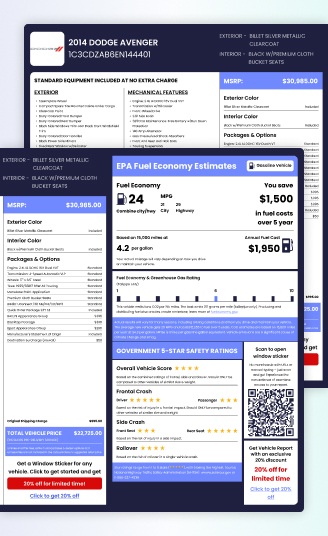

Tesla Window Sticker by VIN: Original Configuration & Pricing
A Tesla window sticker summarizes a vehicle’s configuration and pricing when it was new. Depending on the model year, version and available vehicle data, it may identify the vehicle, show its original MSRP, list selected equipment and options, and provide electric-vehicle efficiency information.
If you are researching a used Tesla, the distinction between an original Monroney label and a reconstructed window sticker matters. An original label is the document issued for the new-vehicle sale. A reconstructed sticker uses available vehicle configuration and sticker-related data to present information in a similar format. It should not be mistaken for an archived document issued by Tesla.
Use PremiumVIN’s Tesla window sticker lookup by VIN to check whether configuration information is available for the vehicle you are researching.
What Is a Tesla Window Sticker?
A Tesla window sticker is the new-vehicle information label associated with the vehicle’s original sale. In the United States, this document is commonly called a Monroney label.
It provides information about the vehicle as offered when new. Depending on the vehicle and its original configuration, the label may identify the model and version, base price, optional equipment, destination charges, and applicable efficiency information.
For a used Tesla, the original sticker can help establish what the vehicle was configured with when it was first sold. It does not establish the vehicle’s present condition or prove that every original component, feature or software capability remains available.
Original Tesla Monroney label vs. reconstructed window sticker
These documents serve related but different purposes:
| Original Tesla Monroney label | PremiumVIN reconstructed Window Sticker |
|---|---|
| Issued for the new-vehicle purchase | Generated using available vehicle configuration and sticker-related data |
| Supplied as part of the new-vehicle delivery documentation | Reconstructed in a window-sticker format |
| Represents the original sale document | May contain fields that depend on available records |
| Obtained through the original purchase documentation | May be available through a VIN lookup, subject to coverage |
| An authentic manufacturer-issued document | Not necessarily an original or archived Tesla document |
PremiumVIN describes its product as a reconstructed document. Its fields may include trim, MSRP, options, packages and colors where available. The exact content depends on the records available for the specific vehicle.
For a more detailed explanation, see how PremiumVIN reconstructs a Window Sticker and the distinction between an original and reconstructed Window Sticker.
How to Look Up a Tesla Window Sticker by VIN
If you do not have the original document, a VIN-based lookup may provide reconstructed vehicle configuration information when the relevant data is available.
To check a Tesla:

Step 1: Locate the VIN
Locate the vehicle's 17-character VIN.

Step 2: Enter the VIN
Enter the VIN into the PremiumVIN Tesla Window Sticker lookup.

Step 3: Submit the lookup
Submit the lookup to check whether a result is available.
Step 4: Review the fields
Review the fields shown in the resulting document.
Step 5: Verify the information
Check the document's information against the vehicle, original purchase paperwork and other available records.
A VIN identifies a vehicle and supports decoding of certain manufacturer-defined attributes. It does not independently encode every factory option, software purchase, color choice or original price. Those details require configuration-related data beyond the VIN structure itself.
If you first need to understand the vehicle identity represented by the VIN, use the PremiumVIN VIN Decoder. Decoded specifications and reconstructed configuration information are different types of data.
What Information May Appear on a Tesla Window Sticker?
The fields available on a Tesla sticker depend on the vehicle’s model year, version and supporting configuration data. The following are relevant categories to examine; they should not be interpreted as a guarantee that every field will appear for every Tesla VIN.
Vehicle identification
The vehicle description may include:
- Model year
- Manufacturer
- Tesla model
- Vehicle Identification Number
- Version or trim designation, where available
Tesla has produced multiple vehicle lines and configurations. Model names alone do not establish the exact equipment or configuration of an individual vehicle.
Original MSRP and pricing information
The manufacturer’s suggested retail price represents the vehicle’s original new-vehicle pricing for the relevant configuration.
Where supporting data is available, a reconstructed sticker may show:
- Base MSRP
- Listed optional equipment prices
- Destination or delivery-related charges
- A calculated original price total
Historical pricing needs to be interpreted in its model-year context. Tesla’s pricing and available configurations have changed over time. A current vehicle price, a later price adjustment or a used-market asking price is not necessarily the vehicle’s original MSRP.
For current resale research, original pricing should also be distinguished from present market value. PremiumVIN provides a separate vehicle market-value lookup, which addresses estimated market-value context rather than original factory pricing.
Exterior and interior configuration
Depending on the available records, configuration information may identify exterior paint and interior choices.
These details can matter when comparing two used Teslas that share the same model and version but were originally ordered with different configurations.
A reconstructed field should not be treated as proof of the vehicle’s present appearance. A vehicle may have been repainted, had interior components replaced or undergone other modifications after delivery.
Factory equipment and options
A configuration document may identify available equipment or options associated with the original vehicle specification.
For a Tesla, the interpretation of software-related features requires particular care. A feature that was available for purchase or activation does not automatically prove that it was included in the vehicle’s original sale configuration. Software availability, later purchases, transfers and current activation status are separate questions.
Likewise, an equipment item shown in a reconstructed document should be checked against the evidence available for that VIN. Do not assume that every feature offered for a particular Tesla model was installed on every vehicle.
See factory options and equipment information for a broader explanation of how configuration details differ from general model specifications.
Electric-vehicle efficiency information
Tesla vehicles use electric propulsion, so their efficiency information is not expressed in the same way as the conventional miles-per-gallon figures used for gasoline vehicles.
Relevant EPA information may include:
- Combined MPGe
- City and highway MPGe
- Energy consumption in kWh per 100 miles
- EPA-rated driving range
- Annual energy-cost estimates, where published
These figures are tied to a particular model year and vehicle configuration. Wheel selection, drivetrain and version can affect the published ratings.
The U.S. Department of Energy and Environmental Protection Agency provide model-specific information through FuelEconomy.gov. For example, the database distinguishes Tesla Model Y configurations by model year and version rather than treating every Model Y as having one efficiency rating.
EPA-rated range is not a measurement of the remaining driving range of a used Tesla. Actual range depends on factors including battery condition, temperature, driving conditions, speed, tires and vehicle use.
Tesla Model Differences Matter When Reviewing a Window Sticker
Tesla model names do not represent one fixed configuration across all production years.
A Model 3, Model S, Model X, Model Y or Cybertruck may have different versions, drivetrains, battery configurations, wheel selections and equipment depending on its production period.
Even vehicles carrying the same model and version name can differ in their original configuration.
When reviewing a Tesla window sticker, compare the following information where available:
- Model year, not just the model name
- Vehicle version or trim
- Rear-wheel drive or all-wheel drive configuration
- Original exterior and interior choices
- Wheel and tire configuration
- Listed options and their original prices
- Applicable EPA efficiency and range figures
This helps prevent a common comparison error: assuming that two vehicles with the same model badge necessarily have the same original equipment or original pricing.
What a Tesla Window Sticker Cannot Confirm
A window sticker is a record of original sale configuration, not a complete inspection or current vehicle-status report.
It does not independently establish:
Current battery health
Original battery configuration and EPA-rated range do not reveal the present state of battery degradation or usable capacity.
Current driving range
Actual range changes with battery condition, temperature, speed, terrain, tires and driving behavior.
Current software entitlement
A historical configuration reference does not necessarily establish whether a software feature is currently active, transferable or available to the present owner.
Accident or repair history
A window sticker is not a vehicle history report and does not establish whether the vehicle has been involved in a collision or repaired.
Present equipment condition
Original equipment information does not prove that components remain installed, functional or unmodified.
For historical records, use a separate Tesla VIN check. For a broader explanation of the difference between configuration and historical records, see the vehicle history report information.
Where to Find the VIN on a Tesla
Tesla provides several VIN locations. The exact locations can vary by vehicle, but common places include:
- Windshield: visible through the lower driver’s-side windshield.
- Door pillar: printed on the vehicle certification label.
- Touchscreen: open Controls, then Software.
- Vehicle documents: check the registration and purchase paperwork.
Tesla’s owner’s manual provides official identification-label guidance. See Tesla – Identification Labels.
Before submitting a VIN, compare it with the vehicle and its documents. A single incorrect character can prevent a lookup from identifying the intended vehicle.
Tesla Supported Models
Here are popular Tesla models you can decode with PremiumVIN. If your Tesla isn’t listed, you can still run a Tesla window sticker lookup. Our Tesla Window Sticker by VIN tool supports Tesla variants and model years.
- Tesla Model S
- Tesla Model 3
- Tesla Model X
- Tesla Model Y
- Tesla Roadster
Review a Tesla's Original Configuration Before Buying or Selling
A Tesla window sticker can help buyers and sellers understand how a vehicle was originally configured and priced. It is particularly useful when comparing vehicles that share a model name but differ in version, equipment or original options.
For the authentic original Monroney label, begin with the purchase documents associated with the original new-vehicle sale. When that document is unavailable, a reconstructed Window Sticker may provide additional configuration information, provided its fields are interpreted according to their available data and limitations.
Check Tesla window sticker availability by VIN to review the configuration information available for the vehicle.
FAQs About Tesla Window Stickers
Can I get a Tesla window sticker by VIN?
A VIN can be used to check whether reconstructed configuration information is available from a lookup service. It does not guarantee that an original Tesla Monroney label can be retrieved. For the authentic original document, check the new-vehicle purchase documentation or ask the original buyer.
Does Tesla provide the original window sticker online?
Tesla states that new-vehicle buyers receive the Monroney label at delivery and that purchase documents are available through the Tesla Account after delivery. The account’s Manage and Documents sections are the official place to check. Tesla also states that Monroney labels are only available for new-vehicle purchases.
Can I get an original Tesla window sticker for a used car?
You may be able to obtain it from the previous owner if they retained the original document or can access it through the account associated with the original purchase. Otherwise, a reconstructed document may provide some configuration information, subject to available data. It should not be represented as the original Tesla-issued label.
Does a Tesla window sticker show the battery capacity?
Battery-related specifications may appear in vehicle configuration or technical information, depending on the document and available data. However, a window sticker should not be treated as a measurement of the battery’s present usable capacity or health.
Does a Tesla window sticker show Full Self-Driving capability?
A reconstructed document may show software-related configuration information where supported by the available records. However, a historical configuration field does not independently prove current activation, ownership, transferability or entitlement. Confirm the current software status through the vehicle and Tesla’s own account or support channels.
Does the Tesla window sticker show MPGe and driving range?
Applicable EPA efficiency and range figures may be associated with the vehicle’s model year and configuration. These are standardized ratings, not a promise of the range a used vehicle will achieve today.
Can I use a Tesla window sticker to verify the vehicle's current condition?
No. A window sticker describes original configuration and pricing information. It does not replace a physical inspection, battery assessment, diagnostic check or vehicle history investigation.
Is a Tesla window sticker the same as a Tesla VIN report?
No. A window sticker focuses on original vehicle configuration and pricing information. A VIN report focuses on vehicle identification or available historical records, depending on the report. They answer different questions and should be used for different research purposes.